
What the Triangle Height Calculator Does
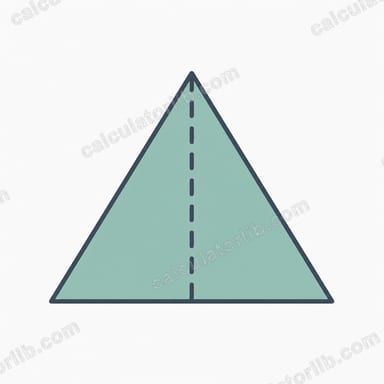
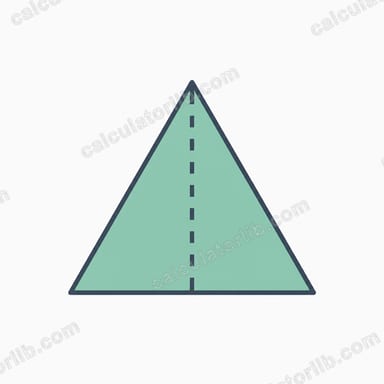
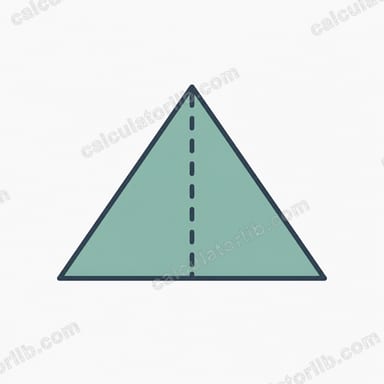
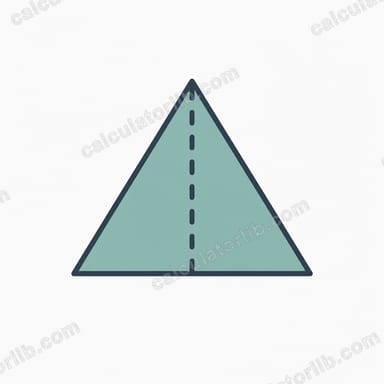
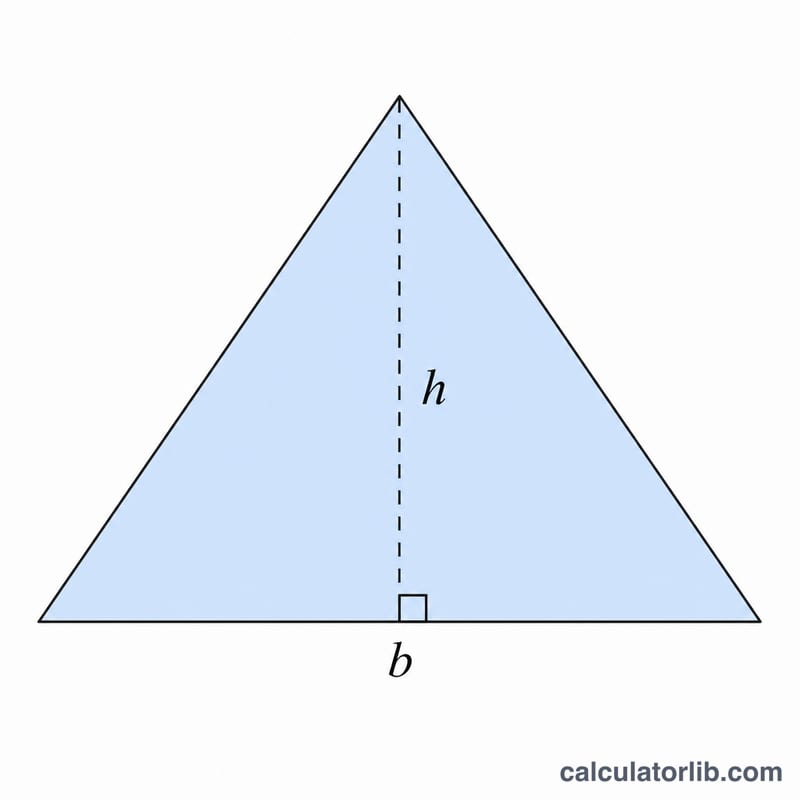
This calculator finds the height (also called the altitude) of a triangle when you already know its area and the length of one side used as the base. The height is the perpendicular distance from that base to the opposite vertex. Instead of rearranging the area formula by hand, you simply enter two values and get the height instantly. It works for any triangle — scalene, isosceles, equilateral or right-angled — as long as the area and base refer to matching units.
The Inputs You Provide
- Base Length: the length of the side you are treating as the base of the triangle (e.g. in cm, m or inches).
- Area: the total area enclosed by the triangle, in squared units that match the base (e.g. cm², m²).
The calculator divides twice the area by the base length to return the corresponding height.
The Formula Explained
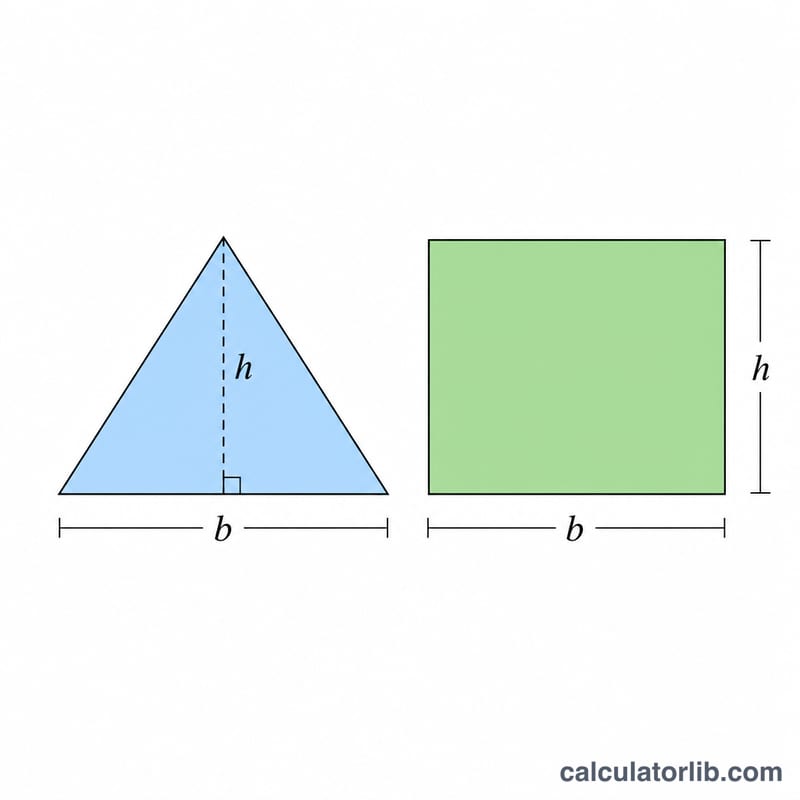
The standard area of a triangle is \(A = \tfrac{1}{2} \times b \times h\). Rearranging that equation to solve for the height gives the formula this tool uses:
$$h = \frac{2A}{b}$$
Here \(h\) is the height, \(A\) is the area and \(b\) is the base length. Because the area already accounts for the ½ factor, we multiply the area by 2 and then divide by the base to isolate the height.
Worked Example
Suppose a triangle has an area of 30 cm² and a base of 12 cm. Plugging the numbers into the formula:
- \(h = (2 \times 30) \div 12\)
- \(h = 60 \div 12\)
- \(h = 5 \text{ cm}\)
So the perpendicular height from the 12 cm base to the opposite vertex is 5 cm.
Frequently Asked Questions
Does the height correspond to a specific base?
Yes. Each side of a triangle has its own associated height. The result you get is the altitude drawn to the exact base length you entered, so always pair the correct base with the area.
What units does the answer use?
The height comes out in the linear unit of your base. If your area is in cm² and base in cm, the height is in cm. Always keep units consistent.
What if I enter zero or leave the base blank?
Dividing by zero is undefined, so the base must be a positive number. Enter a valid non-zero base length to get a meaningful height.