
What is polar form?
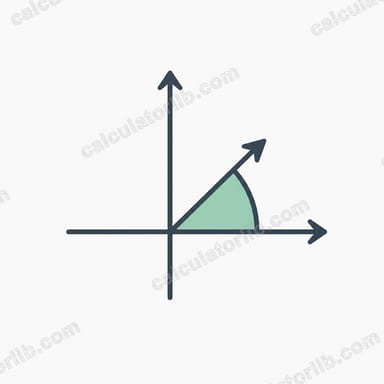
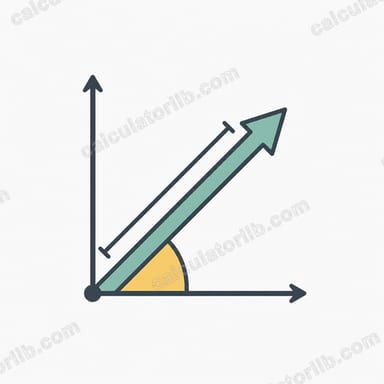
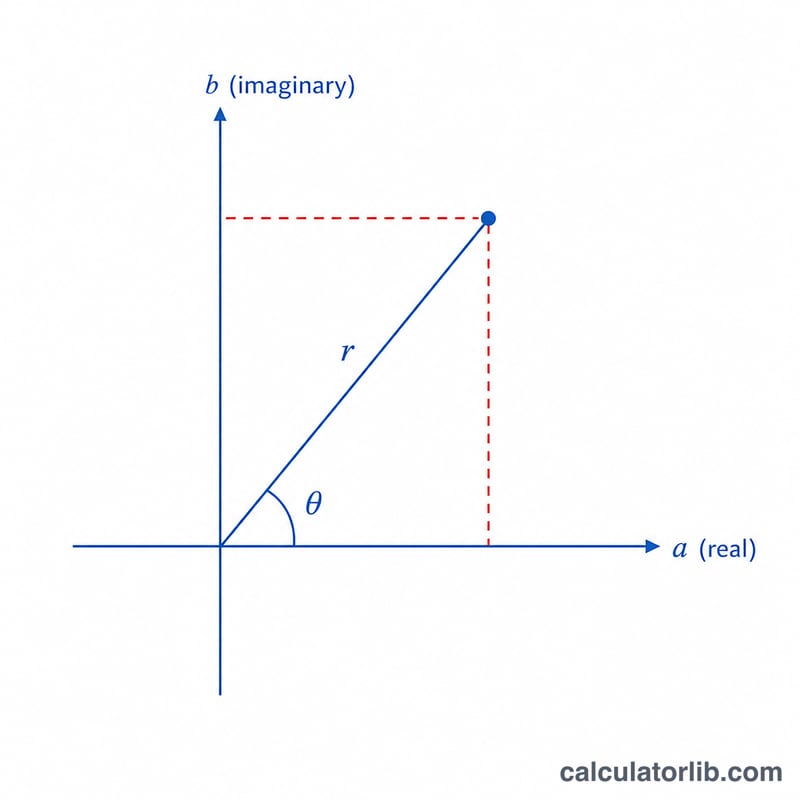
Every complex number can be written two ways. The rectangular (or Cartesian) form is a + bi, where a is the real part and b is the imaginary part. The polar form expresses the same number using its distance from the origin and its direction: \(r(\cos\theta + i\cdot\sin\theta)\), often abbreviated as \(r\angle\theta\) or written as the complex exponential \(r\cdot e^{i\theta}\). This calculator converts any rectangular complex number into polar form, giving you the magnitude r and the angle θ in both degrees and radians.
How to use the calculator
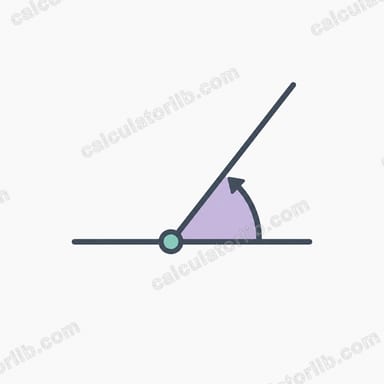
Enter the real part a and the imaginary part b of your complex number, then read off the results. The magnitude tells you how far the point lies from the origin, and the angle tells you its direction relative to the positive real axis. Both forms describe exactly the same point on the complex plane.
The formula explained
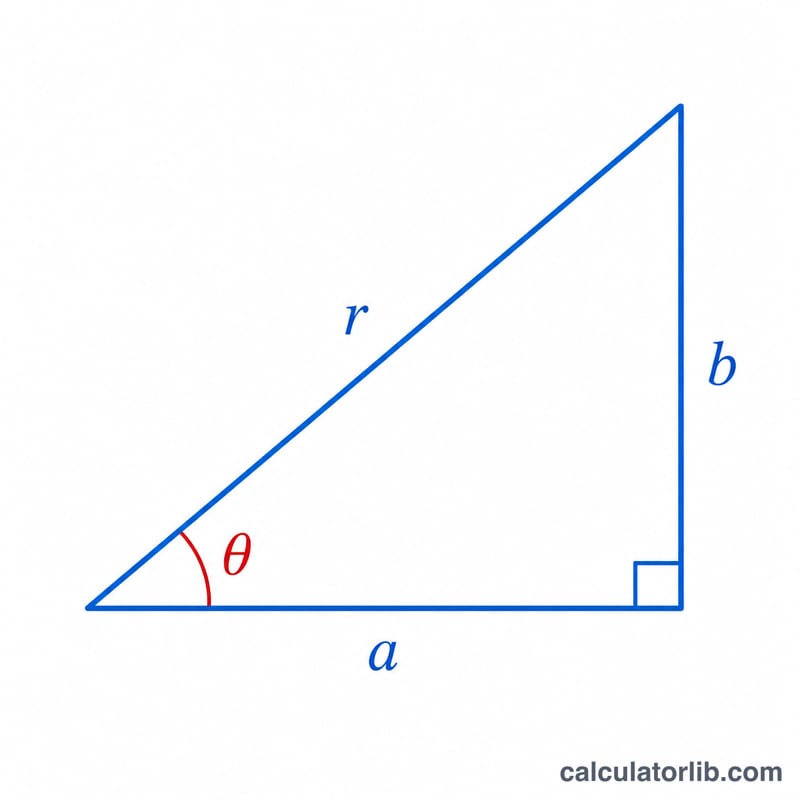
The magnitude is found with the Pythagorean theorem: \(r = \sqrt{a^2 + b^2}\). The angle uses the two-argument arctangent, \(\theta = \operatorname{atan2}(b, a)\), which automatically returns the correct quadrant — something plain \(\arctan(b/a)\) cannot do because it loses sign information. The result is given in the range \((-180°, 180°]\). To convert radians to degrees, multiply by \(180/\pi\).
Worked example
Take the complex number 3 + 4i. The magnitude is $$r = \sqrt{3^2 + 4^2} = \sqrt{9 + 16} = \sqrt{25} = 5.$$ The angle is $$\theta = \operatorname{atan2}(4, 3) \approx 0.9273 \text{ radians} \approx 53.13°.$$ So \(3 + 4i = 5(\cos 53.13° + i\cdot\sin 53.13°)\).
FAQ
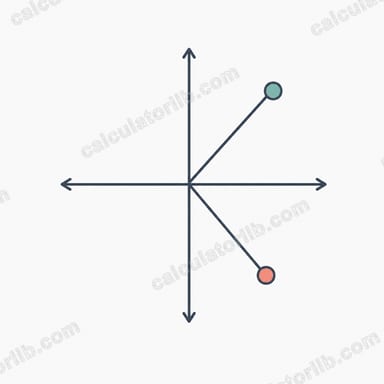
Why use atan2 instead of arctan? Because atan2 considers the signs of both a and b, so it places the angle in the right quadrant. For example, −1 − i would be mislabeled by plain arctan.
What angle range do I get? The angle is returned between −180° and +180° (or \(-\pi\) to \(\pi\) radians). Add 360° if you prefer a 0–360° result.
What if both a and b are zero? Then \(r = 0\) and the angle is undefined (this calculator returns 0).