
What Is the Polar Form Calculator?
This tool converts a complex number written in rectangular (Cartesian) form, a + bi, into polar form. Polar form expresses the same number using its distance from the origin (the magnitude r) and the angle it makes with the positive real axis (the argument θ). It is written as \(r(\cos\theta + i\cdot\sin\theta)\), or compactly as \(r\angle\theta\).
How to Use It
Enter the real part a and the imaginary part b of your complex number, then read off the magnitude and the angle. The angle is reported in both radians and degrees so you can use whichever your problem requires.
The Formula Explained
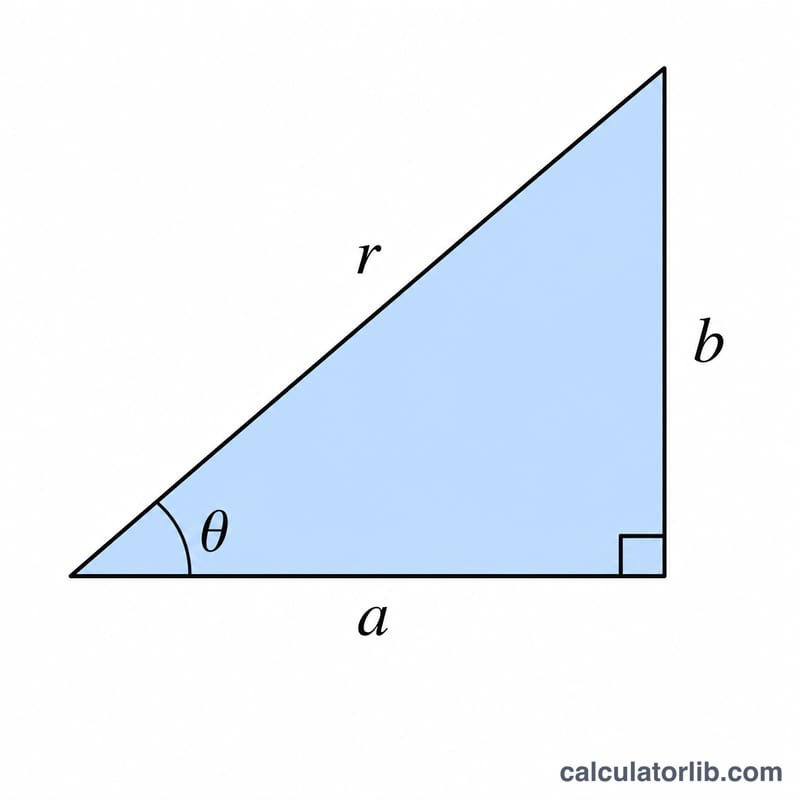
The magnitude comes straight from the Pythagorean theorem: \(r = \sqrt{a^2 + b^2}\), the hypotenuse of the right triangle with legs a and b. The angle uses the two-argument arctangent, \(\theta = \operatorname{atan2}(b, a)\), which returns the correct angle in the full range \((-\pi, \pi]\) by accounting for the signs of both a and b. This avoids the quadrant ambiguity of plain \(\arctan(b/a)\).
$$z = r\,(\cos\theta + i\sin\theta) \qquad \begin{aligned} r &= \sqrt{\text{Re}^{2} + \text{Im}^{2}} \\ \theta &= \operatorname{atan2}\!\left(\text{Im},\, \text{Re}\right) \end{aligned}$$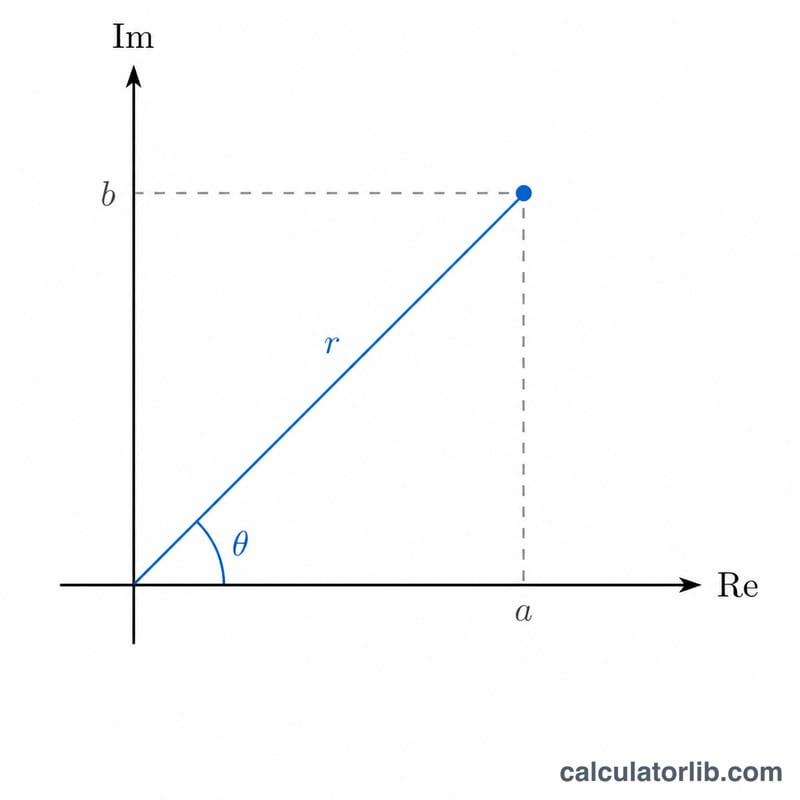
Worked Example
Take the complex number 3 + 4i. The magnitude is $$r = \sqrt{3^2 + 4^2} = \sqrt{25} = 5.$$ The angle is $$\theta = \operatorname{atan2}(4, 3) \approx 0.9273 \text{ radians} \approx 53.13^\circ.$$ So \(3 + 4i = 5(\cos 53.13^\circ + i\cdot\sin 53.13^\circ)\).
FAQ
Why use atan2 instead of arctan? Plain arctan loses sign information and cannot tell which quadrant the point lies in. \(\operatorname{atan2}(b, a)\) uses both inputs and returns the true angle.
What range is the angle in? The radian angle lies in \((-\pi, \pi]\), equivalently \((-180^\circ, 180^\circ]\). Add 360° (or 2π) to express it as a positive angle if you prefer.
What if both a and b are zero? The magnitude is 0 and the angle is undefined (conventionally returned as 0).