
What Is Expanded Form?
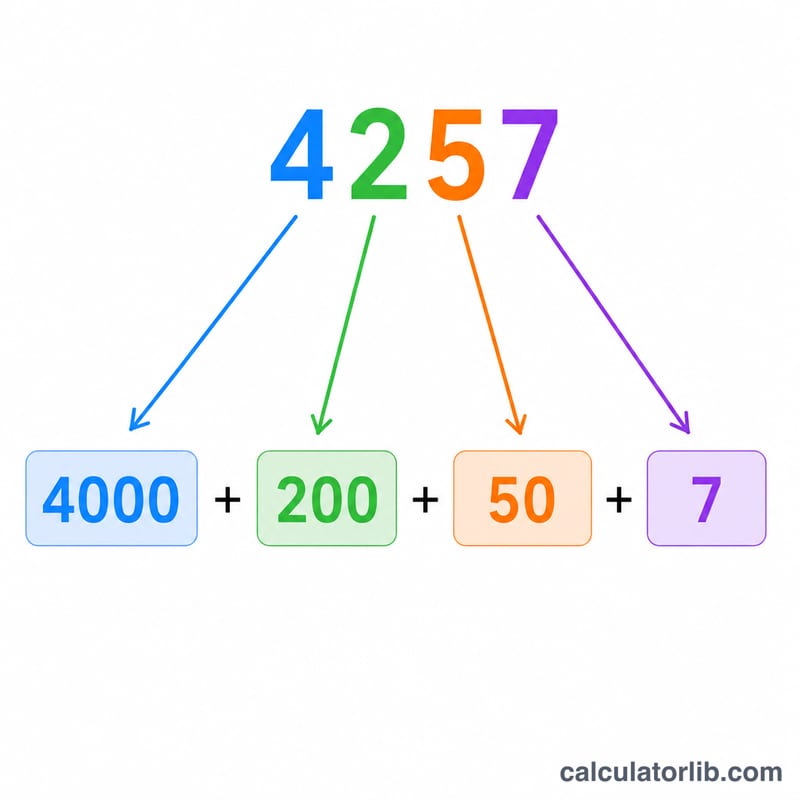
Expanded form is a way of writing a number that shows the value of each digit. Instead of writing 4,567 as a single compact number, expanded form breaks it apart into the sum of each digit multiplied by its place value: \(4000 + 500 + 60 + 7\). This makes place value visible and is a core skill in elementary math.
How to Use This Calculator
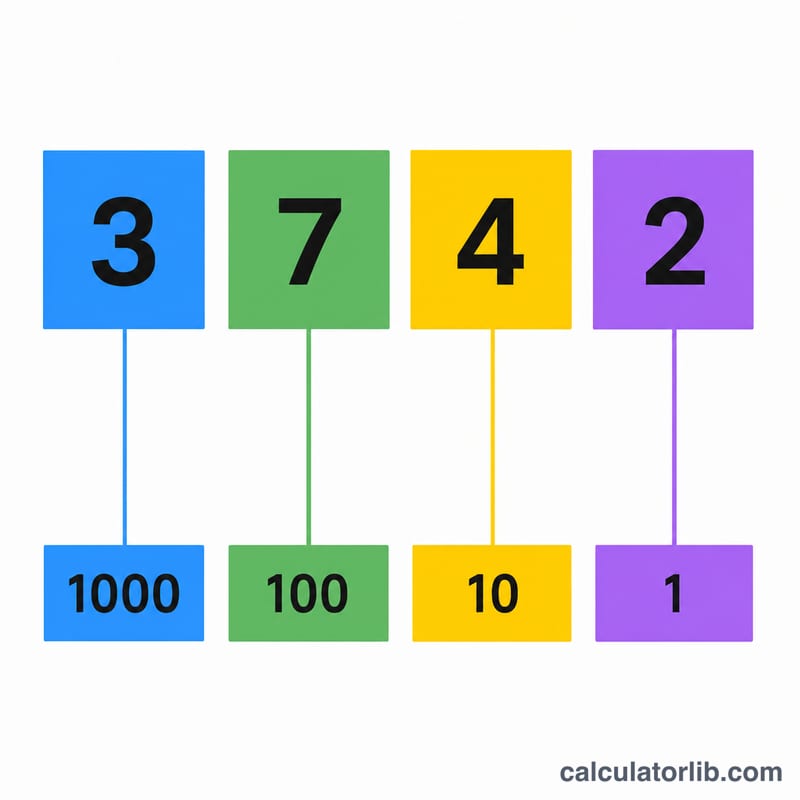
Type any whole number into the input box and the calculator instantly shows two versions of its expanded form: the sum of the place values (e.g. \(4000 + 500 + 60 + 7\)) and the factored version that shows the work (e.g. \(4 \times 1000 + 5 \times 100 + 6 \times 10 + 7 \times 1\)). Zero digits are skipped because they contribute nothing to the total. The result table also reports how many digits and how many non-zero terms the number has.
The Formula Explained
Every whole number can be written as $$N = \sum_{i} d_i \times 10^{\,p_i}$$ where \(d_i\) is a digit and \(p_i\) is its position counted from the right, starting at 0. The rightmost digit has place value \(10^0 = 1\), the next has \(10^1 = 10\), then \(10^2 = 100\), and so on. Multiply each digit by its place value and add the results to recover the original number.
Worked Example
Take the number 3,205. The digits from left to right are 3, 2, 0, 5 in the thousands, hundreds, tens, and ones places. So: $$3 \times 1000 + 2 \times 100 + 0 \times 10 + 5 \times 1 = 3000 + 200 + 0 + 5$$ Dropping the zero term, the expanded form is 3000 + 200 + 5.
FAQ
Why is the zero term left out? A digit of 0 multiplied by any place value equals 0, so it adds nothing and is omitted for clarity.
Does it work with decimals? This calculator focuses on whole numbers; decimal places (tenths, hundredths) are not included.
What about negative numbers? Negative numbers are supported — the expanded form is wrapped in parentheses with a leading minus sign.