
What is exponential to logarithmic form conversion?
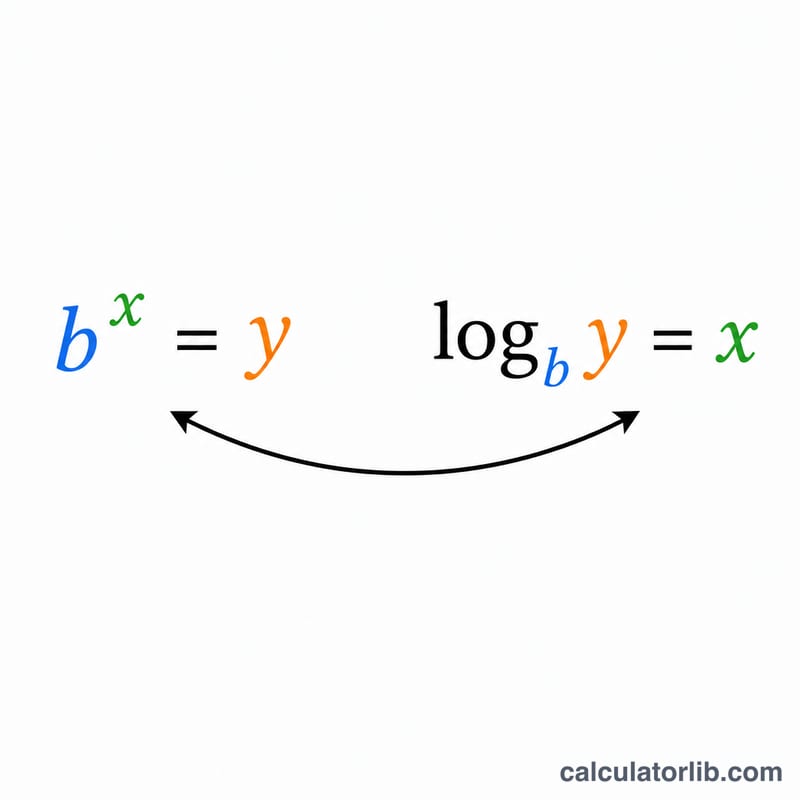
Exponential and logarithmic equations are two ways of expressing the same relationship between three numbers: a base, an exponent, and a value. The exponential form \(b^x = y\) says "base b raised to the power x equals y." The equivalent logarithmic form \(\log_b(y) = x\) says "the power to which b must be raised to get y is x." This converter takes your base and exponent, computes the value y, and shows you both forms side by side.
How to use this converter
Enter the base (\(b\)) and the exponent (\(x\)). The tool computes \(y = b^x\) and rewrites the equation in logarithmic form \(\log_b(y) = x\). For valid logarithms the base should be positive and not equal to 1, and y must be positive — which it always is when \(b > 0\).
The formula explained
The two statements are logically equivalent: $$b^x = y \;\;\Longleftrightarrow\;\; \log_b(y) = x$$ Reading the exponential equation, the base of the power becomes the base of the logarithm, the result y becomes the argument of the log, and the exponent x becomes the value of the log.
Worked example
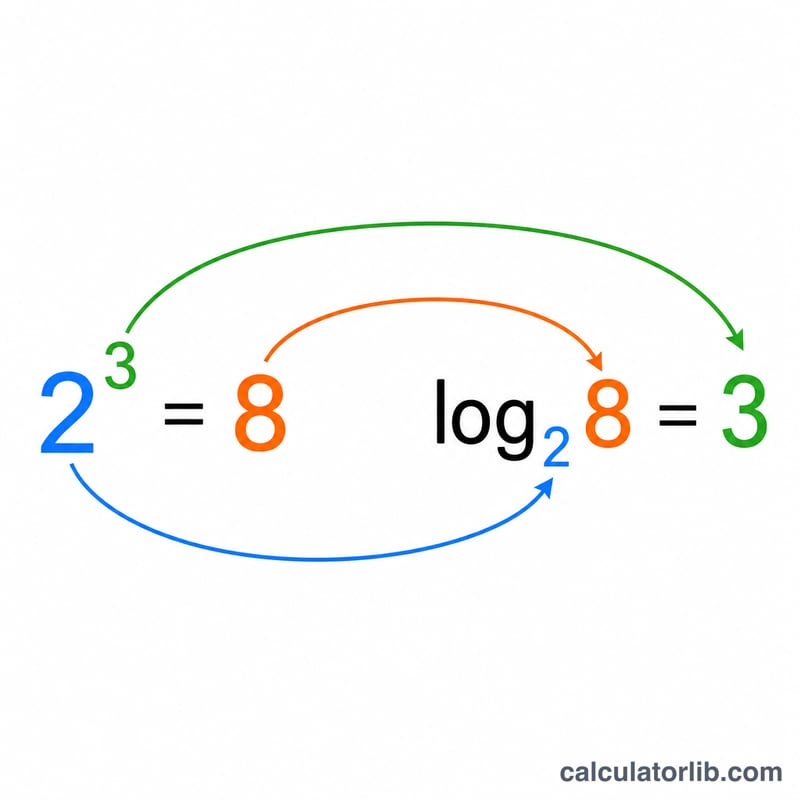
Suppose \(b = 2\) and \(x = 3\). Then \(y = 2^3 = 8\). The exponential form \(2^3 = 8\) converts to the logarithmic form $$\log_2(8) = 3$$ because 2 raised to the power 3 gives 8.
FAQ
Can the base be any number? For a meaningful logarithm the base must be positive and not equal to 1. A base of 10 gives the common log and a base of \(e\) gives the natural log.
What if the exponent is negative or a fraction? That is fine — for example \(2^{-1} = 0.5\) becomes \(\log_2(0.5) = -1\), and \(9^{0.5} = 3\) becomes \(\log_9(3) = 0.5\).
Why is the value y always positive? Any positive base raised to any real power produces a positive result, which is exactly why the argument of a logarithm must be positive.