
What is the Exponential Function Calculator?
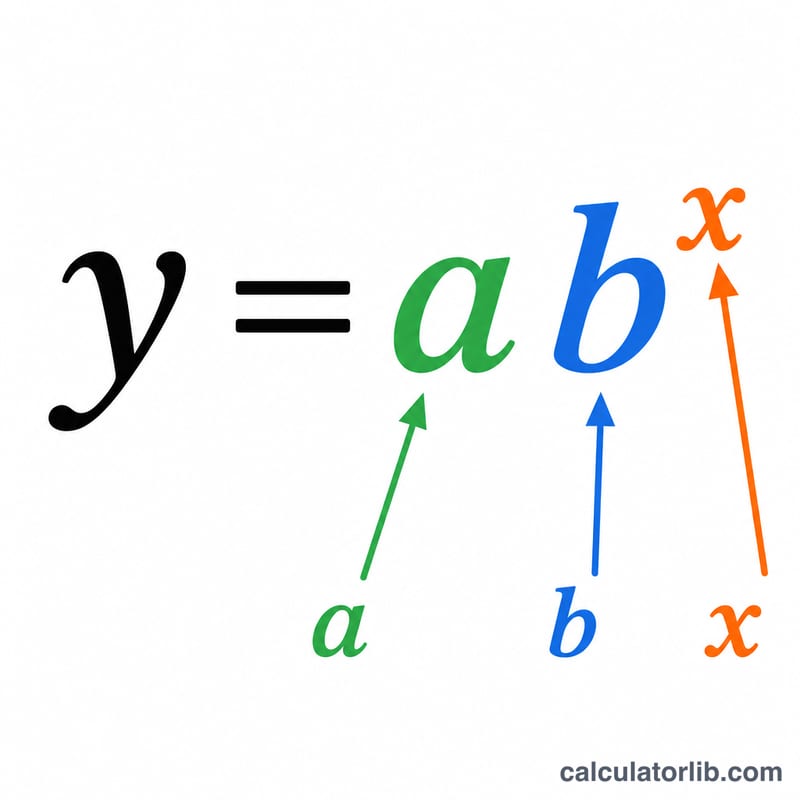
This calculator evaluates exponential functions written in the standard form \(y = a \cdot b^{x}\), where a is the coefficient (the value of y when x = 0), b is the base (the growth or decay factor), and x is the exponent. Exponential functions describe situations where a quantity changes by a constant percentage each step — population growth, compound interest, radioactive decay, and more.
How to use it
Enter three numbers: the coefficient a, the base b, and the exponent x. The calculator raises the base to the power of the exponent and multiplies by the coefficient, returning y instantly along with the intermediate value \(b^{x}\) so you can check each step.
The formula explained
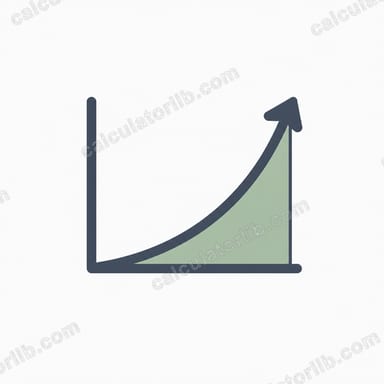
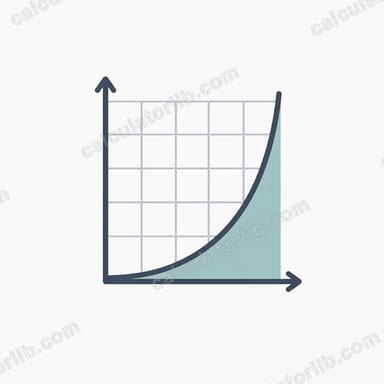
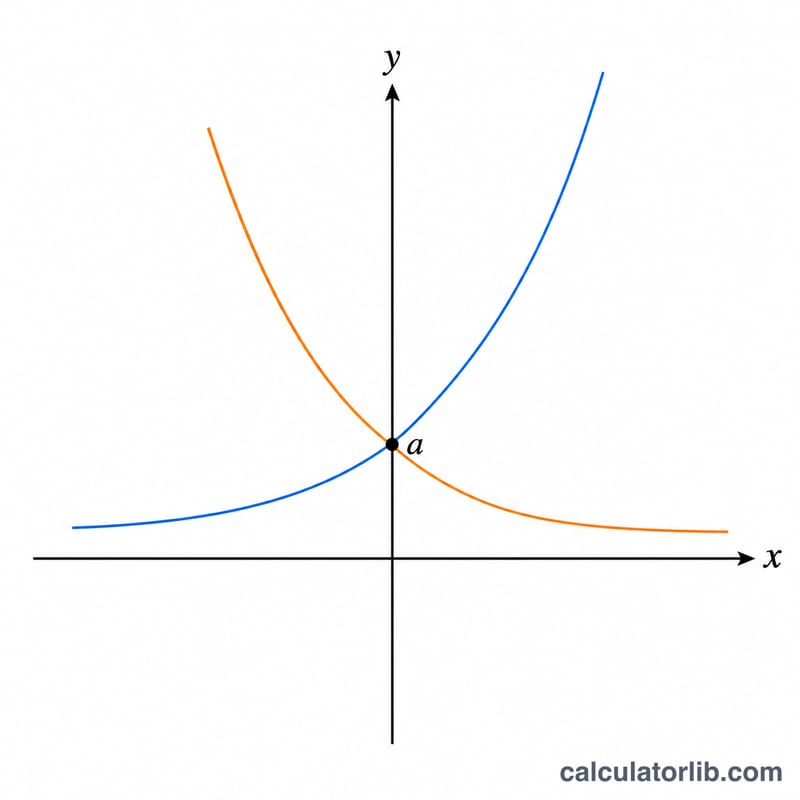
The function $$y = a \cdot b^{x}$$ grows when b > 1 and decays when 0 < b < 1. The coefficient a scales the whole curve vertically. Because every unit increase in x multiplies y by b, exponential change is far faster than linear change for large x.
Worked example
Suppose a = 3, b = 2, and x = 4. First compute \(b^{x} = 2^{4} = 16\). Then $$y = a \cdot 16 = 3 \cdot 16 = 48.$$ If you started with a = 1 and a base of 1.05 (5% growth) over x = 10 periods, \(y = 1.05^{10} \approx 1.6289\).
FAQ
What happens when x = 0? Any nonzero base raised to the power 0 equals 1, so \(y = a\).
Can the base be negative? Negative bases with non-integer exponents are undefined in real numbers, so use positive bases for reliable results.
Does this model growth or decay? Both — a base greater than 1 gives growth, while a base between 0 and 1 gives decay.