What Is the Student Loan Payment Calculator?
This calculator estimates the fixed monthly payment required to fully repay a student loan over a set term. Enter your loan balance, annual interest rate, and repayment length, and it returns your monthly payment along with the total amount paid and total interest over the life of the loan. It uses the standard amortizing loan formula and applies to any fixed-rate installment loan, regardless of country.
How to Use It
Provide three inputs: the loan amount (your current outstanding balance), the annual interest rate as a percentage, and the term in years. The tool converts the annual rate to a monthly rate and the term to a number of months, then computes the level payment that pays off the balance exactly at the end of the term.
The Formula Explained
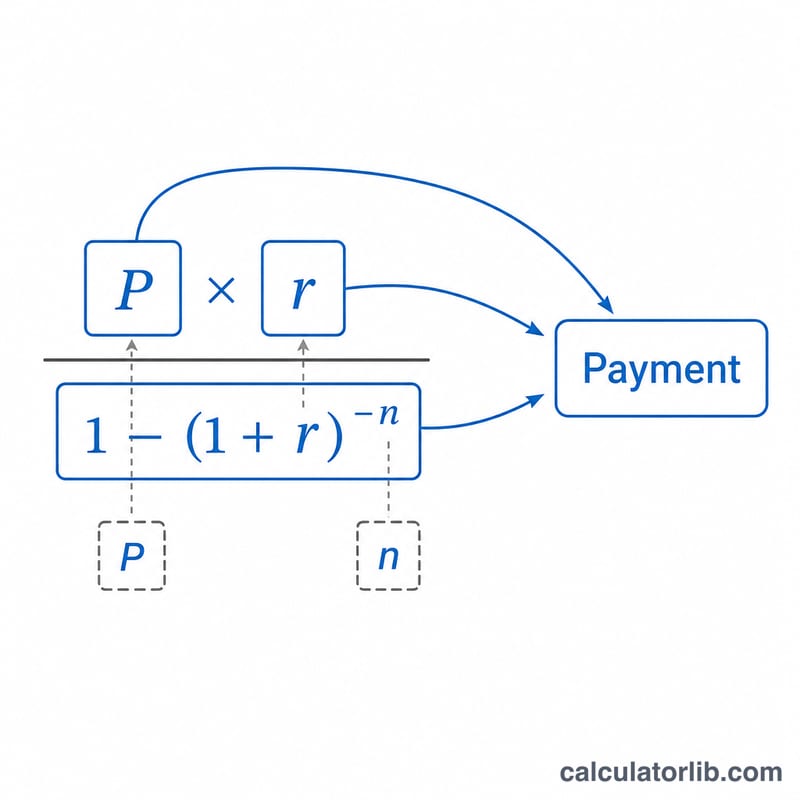
The monthly payment is $$M = \dfrac{P \cdot r}{1 - (1 + r)^{-n}}$$ where P is the principal, r is the monthly interest rate (annual rate divided by 12, expressed as a decimal), and n is the total number of monthly payments (years \(\times\) 12). If the interest rate is zero, the payment is simply the principal divided by the number of months.
Worked Example
Suppose you borrow $30,000 at 5% annual interest over 10 years. The monthly rate is \(0.05 \div 12 \approx 0.0041667\) and \(n = 120\) months. Plugging in: $$M = \frac{30{,}000 \times 0.0041667}{1 - 1.0041667^{-120}} \approx \$318.20$$ per month. Over 120 payments you pay about $38,184 total, of which roughly $8,184 is interest.
Comparing Repayment Terms and Rates
The table below uses a fixed $30,000 balance and the standard amortization formula \(M = P \cdot \frac{r}{1-(1+r)^{-n}}\), where \(r\) is the annual rate divided by 12 and \(n\) is the number of monthly payments. Payments are rounded to the cent, and totals are rounded to the nearest dollar. The figures assume a fixed rate, no fees, and no extra payments.
| Rate | Term | Monthly payment | Total paid | Total interest |
|---|---|---|---|---|
| 5% | 5 years | $566.14 | $33,968 | $3,968 |
| 5% | 10 years | $318.20 | $38,184 | $8,184 |
| 5% | 15 years | $237.24 | $42,703 | $12,703 |
| 5% | 20 years | $197.99 | $47,517 | $17,517 |
| 7% | 5 years | $594.04 | $35,642 | $5,642 |
| 7% | 10 years | $348.33 | $41,799 | $11,799 |
| 7% | 15 years | $269.65 | $48,537 | $18,537 |
| 7% | 20 years | $232.59 | $55,822 | $25,822 |
Example of the substitution for 5% over 10 years: \(r = 5/1200 = 0.0041667\) and \(n = 120\), so \(M = 30000 \cdot \frac{0.0041667}{1-(1.0041667)^{-120}} \approx 318.20\).
Takeaways: a longer term lowers the monthly payment but raises total interest. At 5%, stretching from 10 to 20 years cuts the payment by about $120 a month but adds roughly $9,300 in interest. A 2-point higher rate has a larger effect the longer the loan runs.
Historical U.S. Federal Student Loan Interest Rates
The table shows the fixed interest rates set by the U.S. Department of Education for new Direct Subsidized and Direct Unsubsidized Loans for undergraduate students. Each rate applies to loans first disbursed between July 1 of the start year and June 30 of the following year, and it stays fixed for the life of that loan. Rates for graduate, PLUS and private loans are different. This applies to the United States only; other countries and private lenders use different systems and rates.
| Award year | Undergraduate Direct Loan fixed rate |
|---|---|
| 2019-20 | 4.53% |
| 2020-21 | 2.75% |
| 2021-22 | 3.73% |
| 2022-23 | 4.99% |
| 2023-24 | 5.50% |
| 2024-25 | 6.53% |
These rates exclude loan origination fees, which are charged separately on federal loans. For current rates, check the official U.S. Department of Education Federal Student Aid website.
Key Student Loan Terms
- Principal: the amount borrowed, or the portion of the balance that has not yet been repaid, excluding interest.
- Interest rate (nominal vs. APR): the nominal rate is the stated yearly rate used to calculate interest, here divided by 12 for monthly interest. The APR (annual percentage rate) also includes certain fees, such as origination fees, so it is usually equal to or higher than the nominal rate.
- Term: the length of time over which the loan is scheduled to be repaid, expressed in years or months.
- Amortization: repaying a loan through regular, equal payments, where each payment covers that period's interest first and the remainder reduces principal. Early payments are mostly interest, and later payments are mostly principal.
- Capitalization: adding unpaid accrued interest to the principal balance, after which interest accrues on the larger balance. It can occur, for example, after a deferment or forbearance period, depending on the loan type and rules.
- Grace period: a set time after leaving school or dropping below half-time enrollment during which payments are not yet required. Interest may still accrue, depending on the loan type. Grace periods vary by lender and country.
- Deferment and forbearance: arrangements that temporarily pause or reduce payments. Eligibility and whether interest accrues during the pause depend on the loan type and the program's rules.
- Total cost of the loan: the sum of all payments over the life of the loan, equal to the principal plus total interest (and any fees). This calculator estimates it as the monthly payment multiplied by the number of payments.
Central bank policy rates today
The latest official policy rates of major central banks, updated automatically — the benchmark that bank deposit and loan rates follow.
- Federal Reserve · United States
- 3.75–4.00%
- As of
- 2026-11-13
- Change in 1 year
- 0 pp
Latest change Up +25 bp Federal Reserve changed its rate on 2026-09-17: from 3.50–3.75% to 3.75–4.00%.
| Central bank | Policy rate | As of | Change in 1 year |
|---|---|---|---|
| Banco Central do Brasil (Selic) · Brazil | 13.75% | 2026-11-16 | −1.25 pp |
| Banco de México · Mexico | 6.25% | 2026-11-10 | −1.00 pp |
| Federal Reserve · United States | 3.75–4.00% | 2026-11-13 | 0 pp |
| ECB | 2.50% | 2026-11-16 | +0.50 pp |
| Sveriges Riksbank · Sweden | 2.00% | 2026-11-16 | +0.25 pp |
| Saudi Central Bank (SAMA) · Saudi Arabia | 4.50% | 2026-10-29 | 0 pp |
| Reserve Bank of Australia · Australia | 4.60% | 2026-10-31 | +1.00 pp |
| Central Bank of the Republic of Türkiye · Türkiye | 36.00% | 2026-11-06 | −3.50 pp |
| Bank of Russia · Russia | 14.00% | 2026-11-10 | −2.50 pp |
| People’s Bank of China · China | 3.00% | 2026-11-10 | 0 pp |
| Bank of Canada · Canada | 2.50% | 2026-11-13 | +0.25 pp |
| Reserve Bank of India · India | 5.50% | 2026-10-19 | 0 pp |
| Bank of England · United Kingdom | 4.00% | 2026-11-16 | 0 pp |
| Bank of Japan · Japan | 1.25% | 2026-11-10 | +0.75 pp |
| Bank of Korea · South Korea | 3.00% | 2026-11-02 | +0.50 pp |
Federal Reserve: key rates and overnight market rates
The rates that frame monetary policy and the overnight market rate they steer, each with the date of its latest published value.
| Rate | Level | As of | Change in 1 year |
|---|---|---|---|
| Federal funds target range | 3.75–4.00% | 2026-11-13 | 0 pp |
| Effective federal funds rate (EFFR) | 3.88% | 2026-11-13 | 0 pp |
| Secured Overnight Financing Rate (SOFR) | 3.90% | 2026-11-13 | −0.10 pp |
Each rate keeps the date of its own latest published value; overnight market rates are published on the next business day.
Latest figure: 2026-11-13 Data last updated 2026-11-16 · current
Source: Banco Central do Brasil ODbL; Bank for International Settlements (BIS) Terms of permitted use of BIS statistics; Federal Reserve Bank of New York New York Fed Terms of Use; Board of Governors of the Federal Reserve System Public domain (U.S. government work); European Central Bank ECB reuse policy; Sveriges Riksbank Riksbank open data terms; The World Bank Group CC BY 4.0; Reserve Bank of Australia 2026 RBA copyright terms (Cash Rate); Bank of Canada Bank of Canada terms of use; Bank of England Open Government Licence v3.0
The one-year change is computed by CalculatorLib from these data. The EFFR and SOFR are subject to the Terms of Use posted at newyorkfed.org. The New York Fed is not responsible for publication of the EFFR and SOFR by CalculatorLib, does not sanction or endorse any particular republication, and has no liability for your use.
Source details and methodology
- Banco Central do Brasil
- Bank for International Settlements (BIS) — Central bank policy rates
- Federal Reserve Bank of New York — Reference rates (EFFR, SOFR)
- Board of Governors of the Federal Reserve System
- European Central Bank
- Sveriges Riksbank
- The World Bank Group — World Development Indicators (FR.INR.LEND, FR.INR.RINR)
- Reserve Bank of Australia 2026
- Bank of Canada
- Bank of England
FAQ
Does this include income-driven repayment plans? No. This tool models a standard fixed-amortization plan. Income-driven plans cap payments based on earnings and follow different rules.
Can I use it for any currency? Yes — the math is currency-agnostic. Enter amounts in whatever currency your loan is denominated in.
Why does total interest seem high? Longer terms and higher rates dramatically increase total interest. Try a shorter term to see how much you can save.