

What Is the Marginal Propensity to Consume?
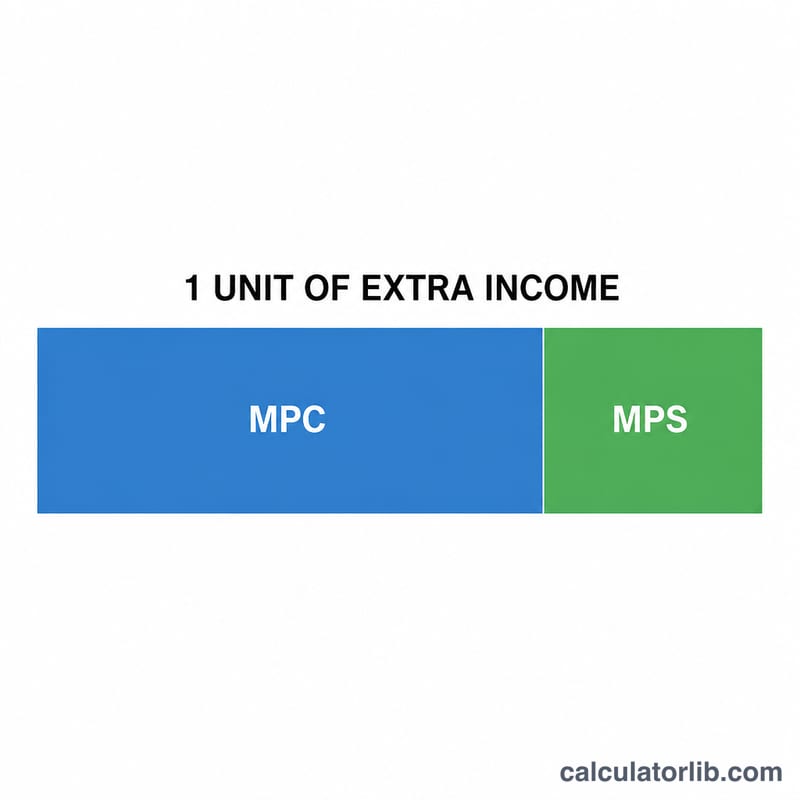
The Marginal Propensity to Consume (MPC) measures how much of each additional unit of income a household or economy spends rather than saves. It is one of the cornerstone concepts in Keynesian macroeconomics and a key driver of the fiscal multiplier. An MPC of 0.8 means that for every extra $1 earned, $0.80 is spent and $0.20 is saved.
How to Use This Calculator
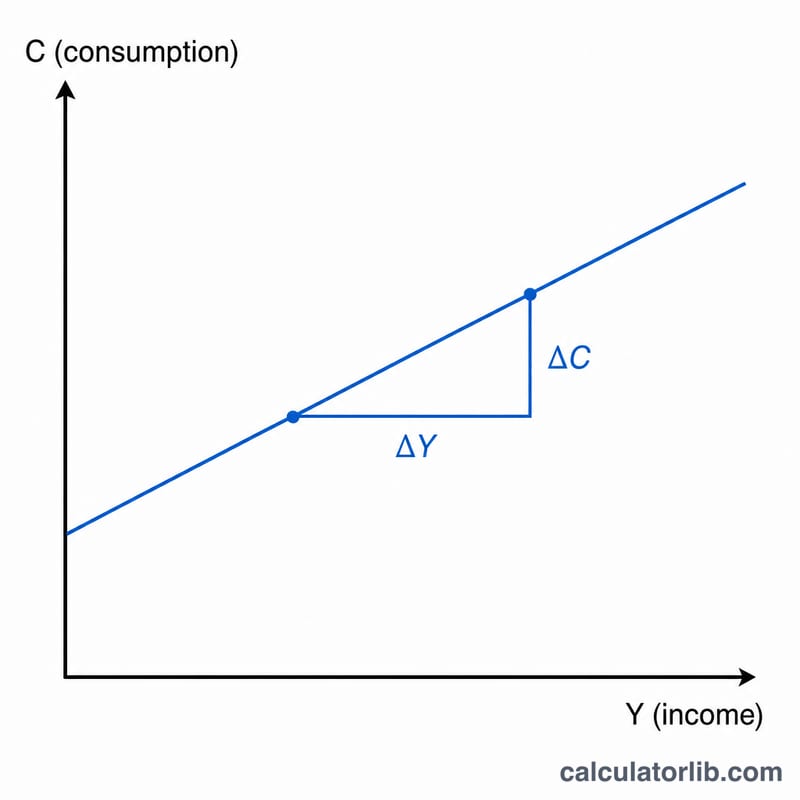
Enter the change in consumption (\(\Delta C\)) — how much spending increased — and the change in income (\(\Delta Y\)) — how much income increased. The calculator divides the two to give the MPC. It also reports the Marginal Propensity to Save (\(\text{MPS} = 1 - \text{MPC}\)) and the spending multiplier (\(1 \div \text{MPS}\)), which estimates how an initial injection of spending ripples through the economy.
The Formula Explained
$$\text{MPC} = \dfrac{\Delta C}{\Delta Y}$$ Because every extra dollar is either spent or saved, \(\text{MPC} + \text{MPS} = 1\), so \(\text{MPS} = 1 - \text{MPC}\). The multiplier follows from the geometric series of repeated spending rounds: $$k = \dfrac{1}{1 - \text{MPC}} = \dfrac{1}{\text{MPS}}$$ A higher MPC produces a larger multiplier.
Worked Example
Suppose income rises by $1,000 and consumption rises by $800. Then $$\text{MPC} = \frac{800}{1000} = 0.8$$ $$\text{MPS} = 1 - 0.8 = 0.2$$ and the multiplier $$= \frac{1}{0.2} = 5$$ A $100 boost in autonomous spending would therefore raise total output by about $500.
FAQ
Can MPC be greater than 1? In theory MPC lies between 0 and 1, but short-term measurements can occasionally exceed 1 if households borrow to spend more than the income increase.
What is the difference between MPC and APC? MPC is the change in consumption per change in income (marginal), while the average propensity to consume (APC) is total consumption divided by total income.
Why does the multiplier matter? A larger MPC means money recirculates more, amplifying the effect of fiscal stimulus or any spending change on overall economic output.