
What this calculator does
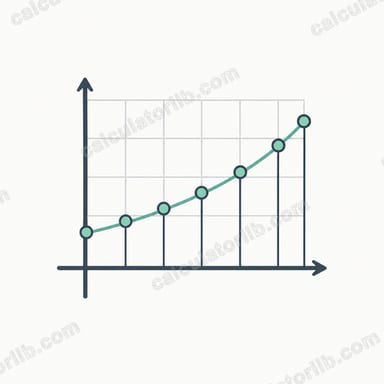
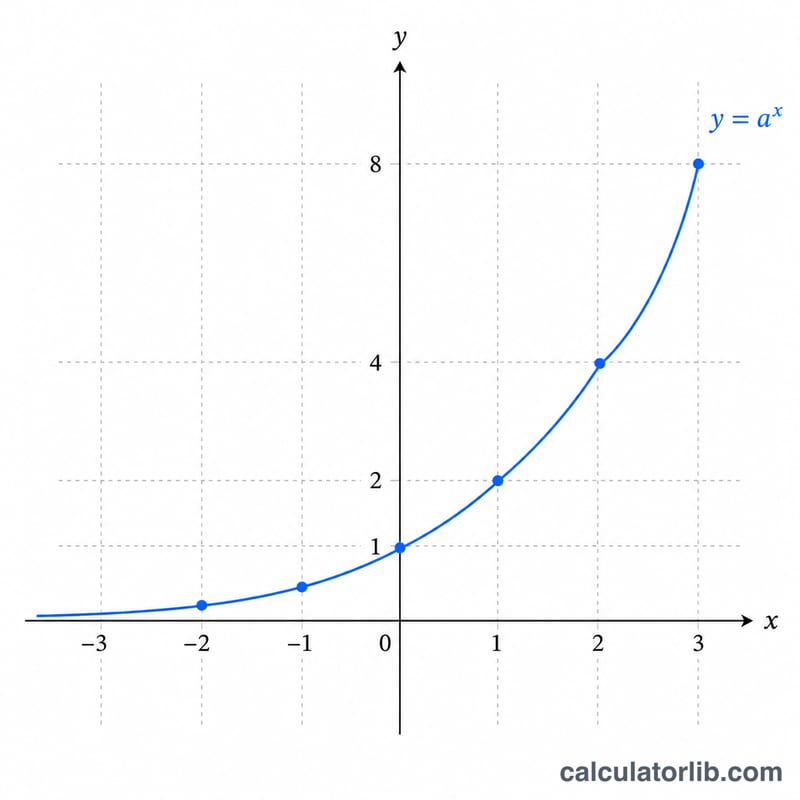
This tool builds a table of values for an exponential function \(y = f(x)\) across a range of \(x\) that you choose. Pick one of three function types: the natural exponential \(e^x\) (base Euler's number \(e\), about \(2.7182818\)), the power of ten \(10^x\), or a custom base \(a^x\) where you supply your own positive base \(a\). The result is a clean two-column \((x, y)\) table you can scan, copy, or plot.
How to use it
Select the function from the dropdown. If you choose \(a^x\), enter the base \(a\) (it must be greater than 0 so the result stays a real number for fractional \(x\)). Then set the \(x\) range with "Range x (from)" and "Range x (to)", choose an Increment (step), and pick how many significant digits to display. Press calculate to get the table.
The formula explained
For \(e^x\) the value is computed as $$y = \exp(x).$$ For \(10^x\) it is $$y = \operatorname{pow}(10, x).$$ For a general base \(a^x\) the value is $$y = \operatorname{pow}(a, x),$$ which is mathematically equal to \(\exp(x \cdot \ln a)\). Each table row uses \(x_i = x_{\min} + i \cdot \text{step}\), computed from the index \(i\) rather than by repeated addition, which avoids floating-point drift so the last row lands cleanly on (or near) \(x_{\max}\). The number of rows is \(\min(301, \lfloor (x_{\max} - x_{\min}) / \text{step} \rfloor + 1)\); the cap of 301 keeps very fine steps from producing an unusably long table.
Worked example
Choose \(e^x\) with \(x\) from \(-2\) to \(3\) and step 1. The rows are: \(x = -2\), \(y = 0.135335\); \(x = -1\), \(y = 0.367879\); \(x = 0\), \(y = 1\); \(x = 1\), \(y = 2.718282\); \(x = 2\), \(y = 7.389056\); \(x = 3\), \(y = 20.085537\) (shown to 6 significant digits). With \(a^x\) and base 2, \(x = 10\) gives $$2^{10} = 1024.$$
FAQ
Why must the base \(a\) be positive? For non-integer exponents, raising a negative base to a power gives complex (non-real) results, so the calculator requires \(a > 0\).
Why does a large \(x\) show Infinity? Double-precision arithmetic overflows; \(e^x\) exceeds the representable range around \(x > 709\), so the value is reported as Infinity.
Does the significant-digits setting change the math? No. It only affects how the displayed \(y\) values are rounded; the underlying computation always uses full double precision.