What Is the Tariff Cost Calculator?
A tariff (also called an import duty) is a tax charged on goods brought into a country. This calculator estimates how much duty you owe and the total cost of your imported goods once the tariff is added. It is useful for importers, e-commerce sellers, and shoppers buying from abroad who want to understand the true cost of a purchase before it arrives.
How to Use It
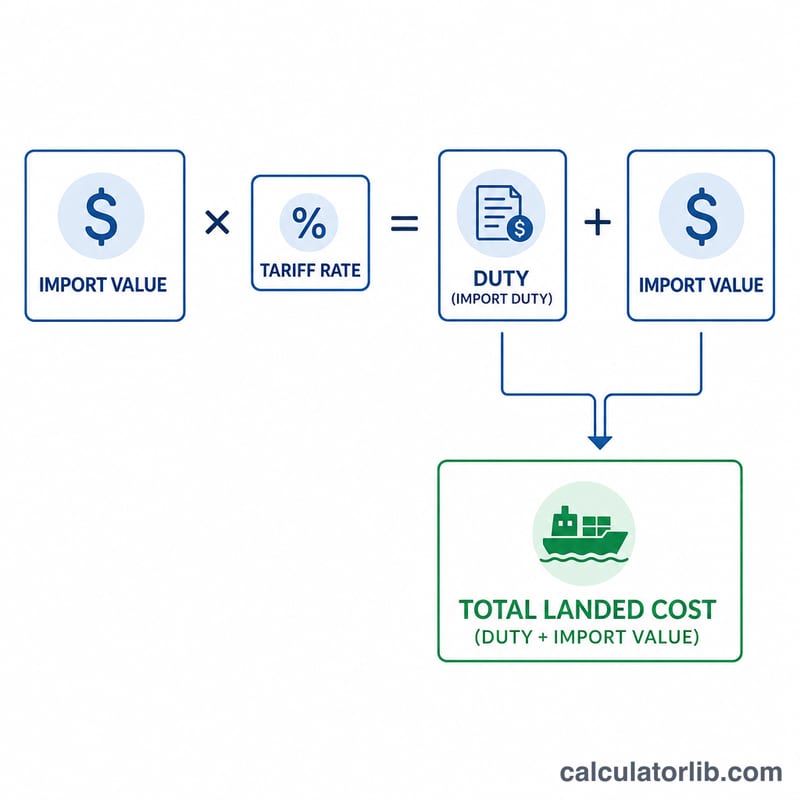
Enter the import value of your goods (the customs value, usually the price paid) and the tariff rate as a percentage. The calculator multiplies the two to find the tariff owed, then adds it to the import value to give your total landed cost. Note that this is a simplified estimate — it does not include sales tax/VAT, brokerage, or shipping fees, which vary by country.
The Formula Explained
The math is straightforward: $$\text{Tariff} = \text{Import Value} \times \left(\text{Tariff Rate} \div 100\right)$$ The rate is divided by 100 to convert a percentage into a decimal. The total cost is simply $$\text{Total} = \text{Import Value} + \text{Tariff}$$
Worked Example
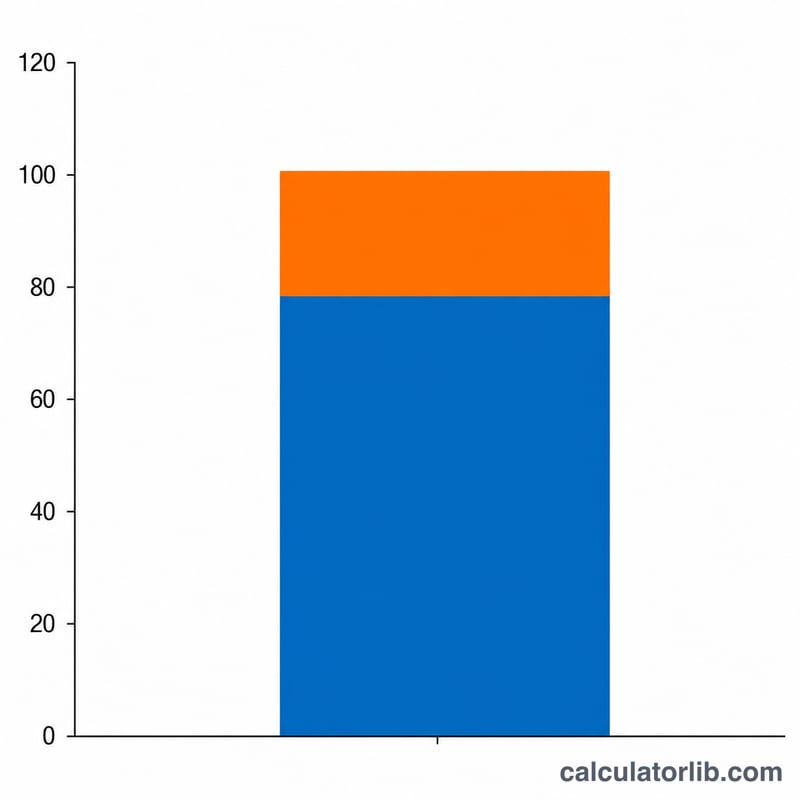
Suppose you import goods worth $10,000 with a tariff rate of 25%. The tariff is $$10{,}000 \times 0.25 = \$2{,}500$$ Your total landed cost (before other fees) is $$10{,}000 + 2{,}500 = \$12{,}500$$
Key Tariff and Customs Terms
This calculator models a simple percentage-based (ad valorem) tariff: the duty is the import value multiplied by the tariff rate, and the total cost is the import value plus that duty. The terms below explain the vocabulary you will meet when working out real import costs. Customs rules vary by country, so always check the rules of the importing country.
- Tariff / import duty
- A tax a government charges on goods brought across its border. The words "tariff" and "duty" are often used interchangeably. Duties are normally paid by the importer of record to the customs authority, and they raise the cost of the goods in the importing country.
- Ad valorem duty
- A duty expressed as a percentage of the goods' value (Latin for "according to value"). This is the type the calculator uses: \(\text{Tariff} = \text{Import Value} \times \frac{\text{Rate}}{100}\). For example, a 10% rate on a value of 1,000 gives a duty of 100.
- Specific (per-unit) duty
- A fixed amount charged per unit, such as per kilogram, litre or item, regardless of price. Some goods have specific duties, and others have compound or mixed duties that combine a percentage and a per-unit amount. This calculator does not model specific or compound duties, so for those goods the result will not be accurate.
- Customs value
- The value on which duty is calculated. Under the WTO Customs Valuation Agreement, it is generally based on the transaction value, meaning the price actually paid or payable, with certain adjustments. Which costs are added, such as freight and insurance, depends on the importing country's rules. Enter the customs value as the import value if you want an accurate duty figure.
- HS code
- The Harmonized System code, an internationally standardized product classification maintained by the World Customs Organization. The first 6 digits are common across member countries, and countries add further digits for their own national tariff lines. The HS code determines which duty rate applies to a product.
- FOB vs CIF
- Incoterms-style pricing terms. FOB (Free On Board) means the price covers the goods up to being loaded on the ship at the port of origin, with international freight and insurance not included. CIF (Cost, Insurance and Freight) means the price includes the goods plus insurance and freight to the destination port. Some countries assess duty on the CIF value and others on the FOB value, so the customs value you enter depends on the importing country.
- Landed cost
- The total cost of getting goods to your door. It includes the product price, freight, insurance, duties, taxes, brokerage and handling fees, and other charges. This calculator's total covers only the import value plus the tariff, so add the other costs separately for a full landed cost.
- VAT / sales tax vs duty
- Duty is a border charge on imported goods, set by product and often by country of origin. VAT or GST is a consumption tax applied to goods and services domestically, and on imports it is usually collected at the border. In many countries, VAT on imports is calculated on the customs value plus the duty, so it is applied on top of the tariff. This calculator does not include VAT or sales tax.
FAQ
Does this include VAT or sales tax? No. Many countries also charge VAT or sales tax on top of the duty; add those separately for a full total.
What value should I use? Use the customs (declared) value of the goods. Some countries include freight and insurance (CIF) in the dutiable value.
Where do I find the tariff rate? Tariff rates depend on the product's HS code and the country of import; check your national customs tariff schedule.