

What Is Opportunity Cost?
Opportunity cost is the value of the next-best alternative you give up when you make a choice. Every decision that uses limited resources—money, time, or effort—means forgoing something else. This calculator quantifies that trade-off by comparing the return you earned from your chosen option against the return you could have earned from the best alternative you passed up.

How to Use This Calculator
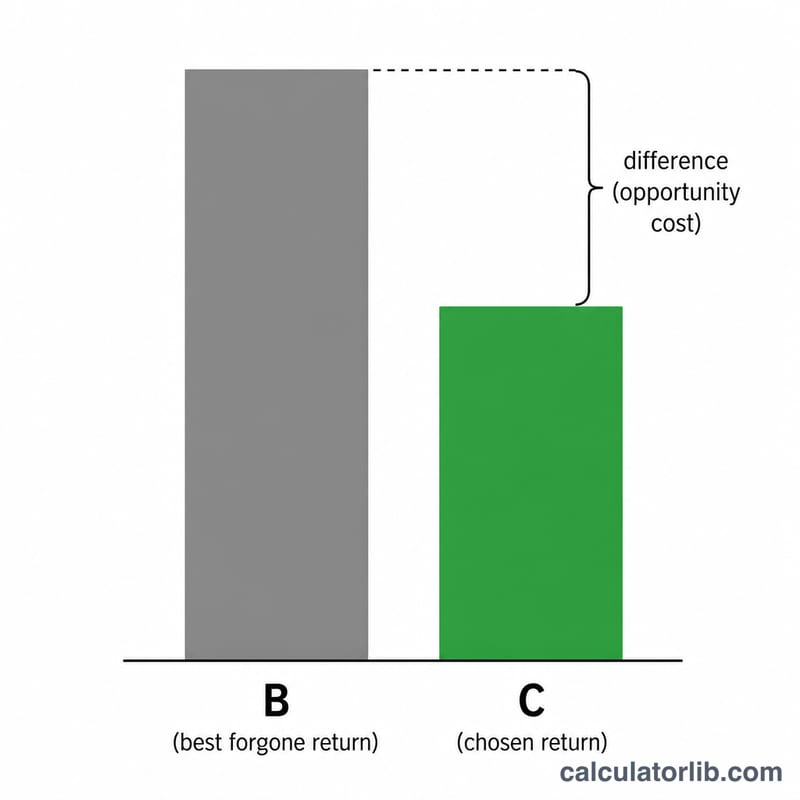
Enter the return (in dollars) of the option you actually chose, then enter the return of the best alternative you turned down. The calculator subtracts your chosen return from the forgone return. A positive result means the alternative would have done better—you "paid" an opportunity cost. A negative result means your chosen option actually beat the alternative.
The Formula Explained
The formula is simply:
$$\text{Opportunity Cost} = \text{Return of best forgone option} - \text{Return of chosen option}$$
Because opportunity cost focuses only on the single best alternative (not every possible option), you compare against one benchmark. Returns can be measured as profit, interest, or any consistent monetary outcome over the same time period.
Worked Example
Suppose you invest $10,000 in a project that earns $5,000. The best alternative—a stock fund—would have earned $7,000. Your opportunity cost is $$\$7{,}000 - \$5{,}000 = \$2{,}000$$ By choosing the project, you gave up $2,000 of potential gain compared with the next-best option.
FAQ
Can opportunity cost be negative? Yes. If your chosen option returns more than the alternative, the result is negative, meaning you made the better choice.
Should I use percentages or dollars? Use whichever is consistent for both options. Dollar returns give a direct monetary trade-off; percentage returns compare efficiency.
Does opportunity cost include the money I spent? No—this tool compares returns only. The initial outlay is assumed equal across both options for a fair comparison.