
What Is the Real Rate of Return?
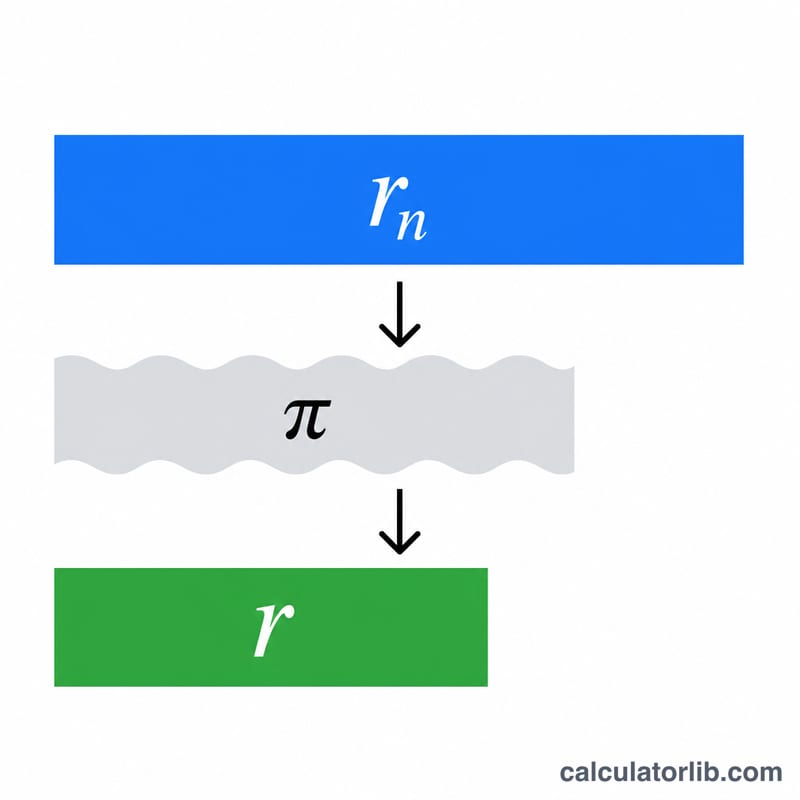
The real rate of return is the profit on an investment after stripping out the eroding effect of inflation. While a nominal return tells you how many more dollars you have, the real return tells you how much more you can actually buy. A 7% return sounds great, but if prices rose 3% over the same period, your true gain in purchasing power was closer to 3.88%.
How to Use This Calculator
Enter your nominal (stated) return as a percentage and the inflation rate over the same period as a percentage. The calculator returns the exact real rate of return using the Fisher equation, plus the common quick approximation (nominal minus inflation) for comparison.
The Formula Explained
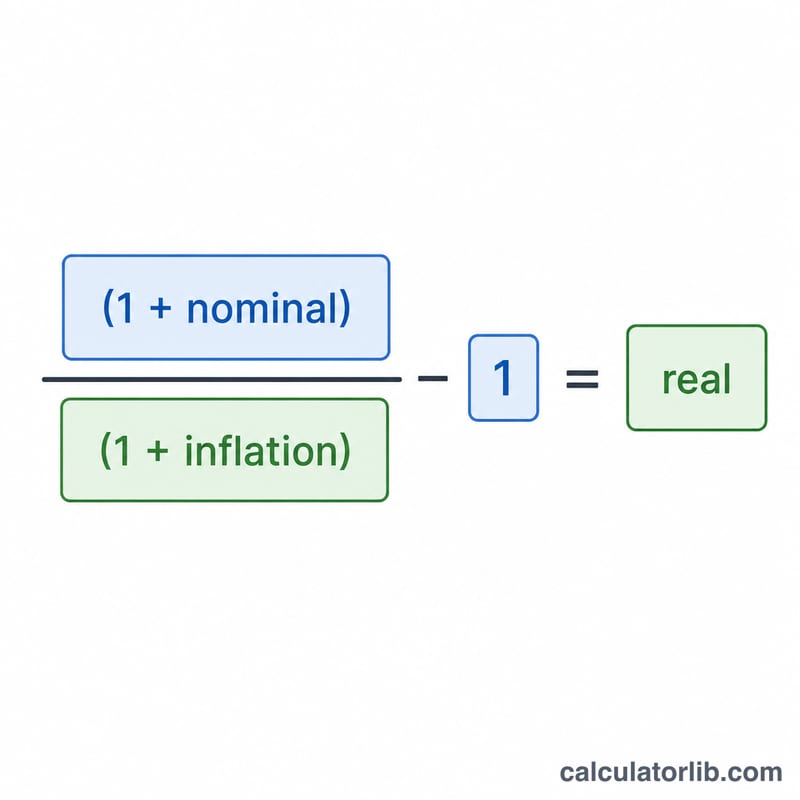
The exact relationship is:
$$\text{Real Return} = \left( \frac{1 + \dfrac{\text{Nominal (\%)}}{100}}{1 + \dfrac{\text{Inflation (\%)}}{100}} - 1 \right) \times 100$$All rates are converted to decimals before the math. Many people simply subtract inflation from the nominal return, but that approximation overstates the real return slightly because it ignores the compounding interaction between growth and inflation.
Worked Example
Suppose an investment earned a 7% nominal return in a year when inflation was 3%. The exact real return is $$(1 + 0.07) \div (1 + 0.03) - 1 = 1.07 \div 1.03 - 1 = 0.038835,$$ or about 3.88%. The quick approximation gives \(7\% - 3\% = 4\%\), which is close but a touch optimistic.
FAQ
Why is the real return lower than nominal minus inflation? Because the exact formula divides rather than subtracts, accounting for the fact that inflation also erodes the gains, not just the principal.
Can the real return be negative? Yes. If inflation exceeds your nominal return, your purchasing power shrinks and the real rate of return is negative.
Which rate should I use for inflation? Use an inflation measure that matches your time horizon — typically the annual CPI change for a one-year return.