
What Is the Rate of Return?
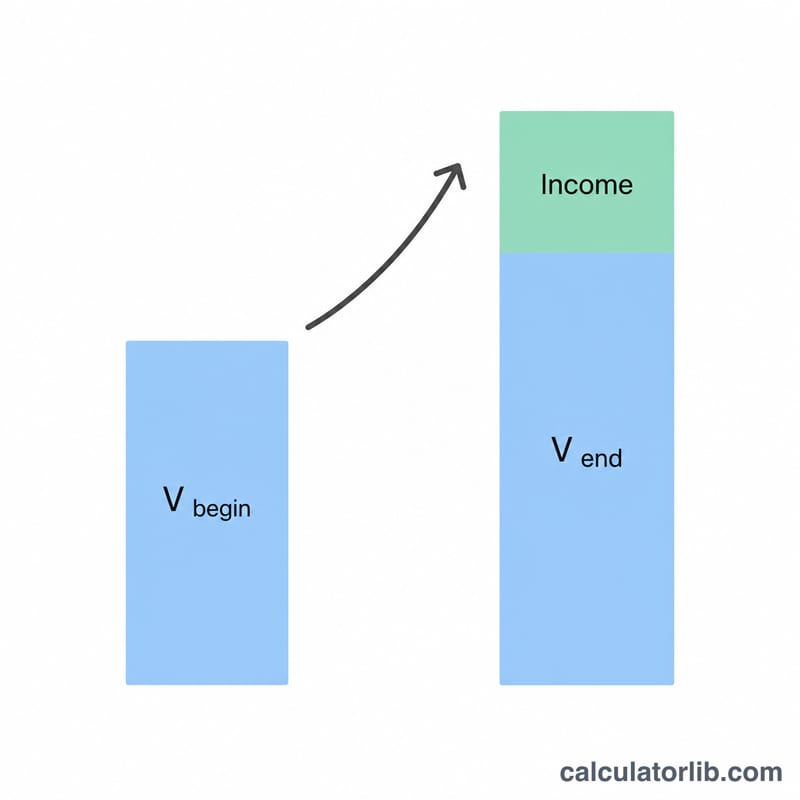
The rate of return (ROR) measures how much an investment has grown or shrunk over a period, expressed as a percentage of the original amount invested. It combines two sources of return: capital appreciation (the change in market value) and any income such as dividends, interest, or rent that you received while holding the investment.
How to Use This Calculator
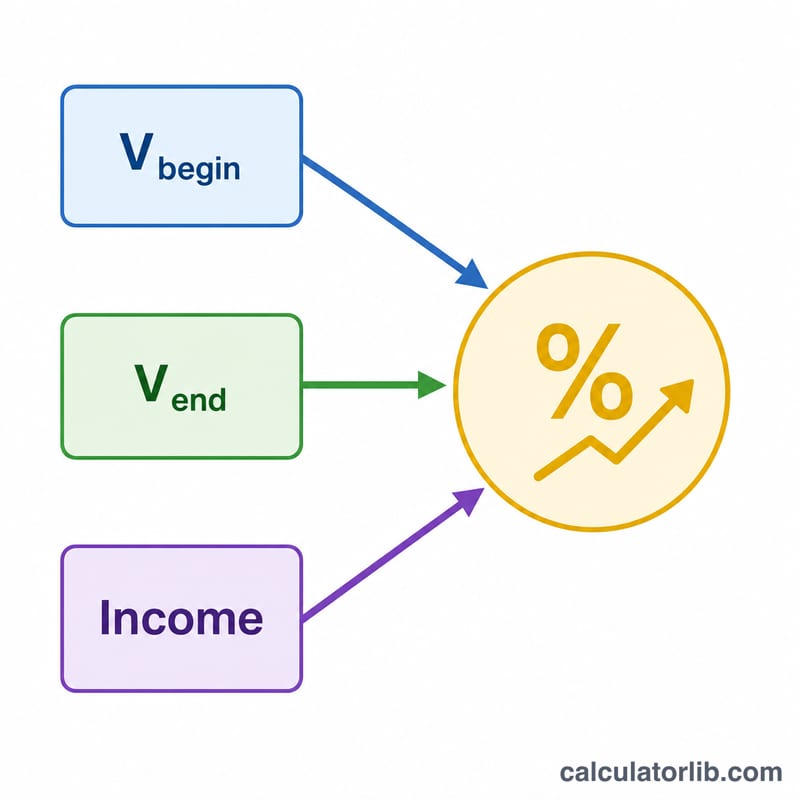
Enter the beginning value (what the investment was worth at the start), the ending value (what it is worth now or when you sold), and any income received during the holding period. The calculator returns the total rate of return as a percentage and the dollar gain.
The Formula Explained
The calculation is:
$$\text{ROR} = \frac{\left(\text{Ending Value} - \text{Beginning Value} + \text{Income}\right)}{\text{Beginning Value}} \times 100\%$$
The numerator is your total profit: the price change plus the income collected. Dividing by the beginning value normalizes that profit against what you originally put in, and multiplying by 100 converts the ratio to a percentage.
Worked Example
Suppose you bought shares for $1,000. A year later they are worth $1,200 and you collected $50 in dividends. Your total gain is \(\$1{,}200 - \$1{,}000 + \$50 = \$250\). The rate of return is $$\$250 \div \$1{,}000 \times 100 = \textbf{25\%}.$$
FAQ
Is this an annualized return? No — this is the total return over whatever period you held the investment. To annualize, you would need to factor in the number of years held.
What if I had a loss? If the ending value plus income is less than the beginning value, the rate of return will be negative, showing the percentage you lost.
Should I include fees? For a more accurate figure, subtract any transaction fees or taxes from your income or ending value before entering them.