
What this converter does
This tool converts an angle written in decimal degrees (for example 30.52°) into the traditional degrees-minutes-seconds (DMS) or sexagesimal form, written as \(D^{\circ}\,M^{\prime}\,S^{\prime\prime}\). DMS notation is the standard way to express angles in land surveying, machining and numerical-control (NC) work, mechanical-drawing inspection, astronomy and the latitude/longitude of map coordinates. The math is universal — it works the same in every country.
How to use it
Type the angle in decimal degrees into the single input box. Negative values and fractional values are both accepted. Press calculate and you will get the combined DMS string plus the three separate components (degrees, minutes, seconds) so you can copy whichever you need.
The formula explained
One degree equals 60 minutes, and one minute equals 60 seconds (so one degree is 3600 seconds). To split a decimal angle, take the magnitude \(a\) = |angle|. The whole part is the degrees: \(D = \lfloor a \rfloor\). Multiply the leftover fraction by 60 to get total minutes; its whole part is \(M\). Multiply that minutes-remainder by 60 to get the seconds \(S\). The sign of a negative angle is written on the degrees term, never as negative minutes or seconds.
$$\begin{gathered} D^{\circ}\,M^{\prime}\,S^{\prime\prime} \\[1.5em] \text{where}\quad \left\{ \begin{aligned} D &= \left\lfloor \left| \text{Decimal Degrees} \right| \right\rfloor \\ M &= \left\lfloor \left( \left| \text{Decimal Degrees} \right| - D \right) \times 60 \right\rfloor \\ S &= \left( \left( \left| \text{Decimal Degrees} \right| - D \right) \times 60 - M \right) \times 60 \end{aligned} \right. \end{gathered}$$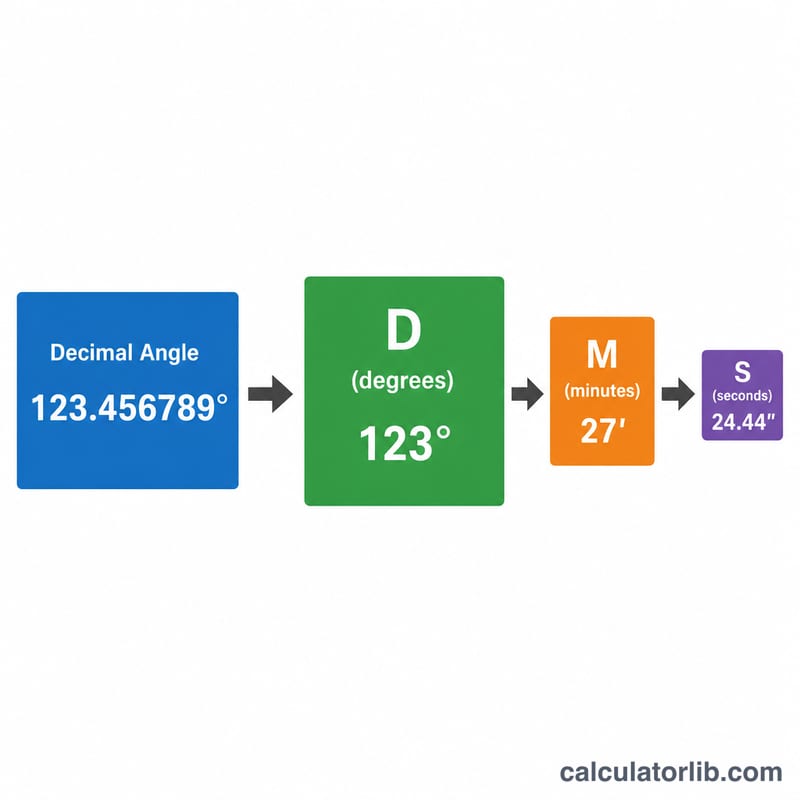
Worked example
Convert 30.52°. Here \(a = 30.52\), so \(D = \lfloor 30.52 \rfloor = 30\). The remainder \(0.52 \times 60 = 31.2\) minutes, so \(M = 31\). The leftover \(0.2 \times 60 = 12\) seconds. Result: \(30^{\circ}\,31^{\prime}\,12^{\prime\prime}\). Check:
$$30 + \frac{31}{60} + \frac{12}{3600} = 30.52$$Correct.
FAQ
How are negative angles handled? The minus sign is applied to the whole angle and shown on the degrees component, e.g. -12.34567° becomes \(-12^{\circ}\,20^{\prime}\,44.412^{\prime\prime}\).
Why do my seconds sometimes show many decimals? Seconds are a real number and can carry long decimal tails from floating-point arithmetic; the converter reports full precision so you can round to your own needs.
What about rounding to exactly 60? If rounding pushes seconds to 60 or minutes to 60, the value is carried up (60 seconds = 1 minute, 60 minutes = 1 degree) so you never see an out-of-range component.