
What Is a Decimal to Binary Converter?
A decimal to binary converter translates a number written in the everyday base-10 system (using digits 0–9) into the base-2 system (using only 0 and 1) that computers use internally. Binary is the native language of digital electronics: every value stored in memory, every pixel, and every instruction is ultimately a sequence of bits. This tool performs the conversion for any non-negative whole number and shows you both the resulting binary string and how many bits it occupies.
How to Use It
Enter a non-negative integer in the Decimal Number field and submit. The calculator returns the binary equivalent, the original decimal value, and the bit length. Negative numbers and decimal fractions are not supported; only whole numbers of zero or greater are converted.
The Formula Explained
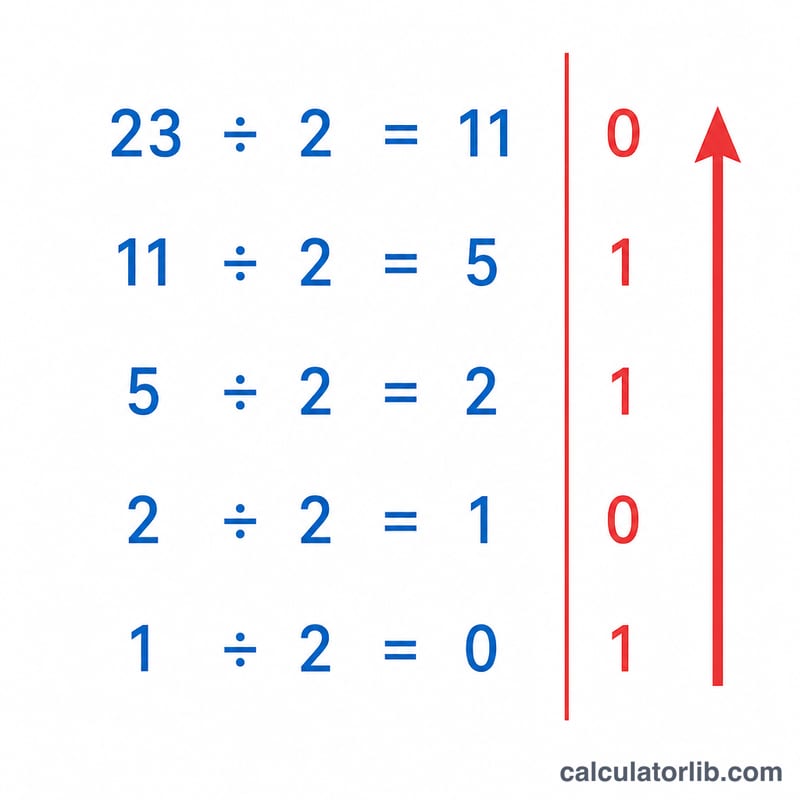
The standard method is repeated division by 2. Divide the number by 2 and write down the remainder (0 or 1). Replace the number with the integer quotient and repeat until the quotient reaches 0. The binary result is all the remainders read in reverse order — from the last division to the first.
$$\text{Binary} = \left(\text{Decimal}\right)_{10} \longrightarrow \sum_{i=0}^{k} b_i \cdot 2^{i}\ \text{where}\ b_i = \left\lfloor \frac{\text{Decimal}}{2^{i}} \right\rfloor \bmod 2$$
For example, the most significant bit comes from the final division, and the least significant bit from the first division. Reading top-to-bottom gives the wrong order, so always read the remainders bottom-to-top.
Worked Example
Convert 156 to binary:
\(156 \div 2 = 78\ \text{r}\ \mathbf{0}\)
\(78 \div 2 = 39\ \text{r}\ \mathbf{0}\)
\(39 \div 2 = 19\ \text{r}\ \mathbf{1}\)
\(19 \div 2 = 9\ \text{r}\ \mathbf{1}\)
\(9 \div 2 = 4\ \text{r}\ \mathbf{1}\)
\(4 \div 2 = 2\ \text{r}\ \mathbf{0}\)
\(2 \div 2 = 1\ \text{r}\ \mathbf{0}\)
\(1 \div 2 = 0\ \text{r}\ \mathbf{1}\)
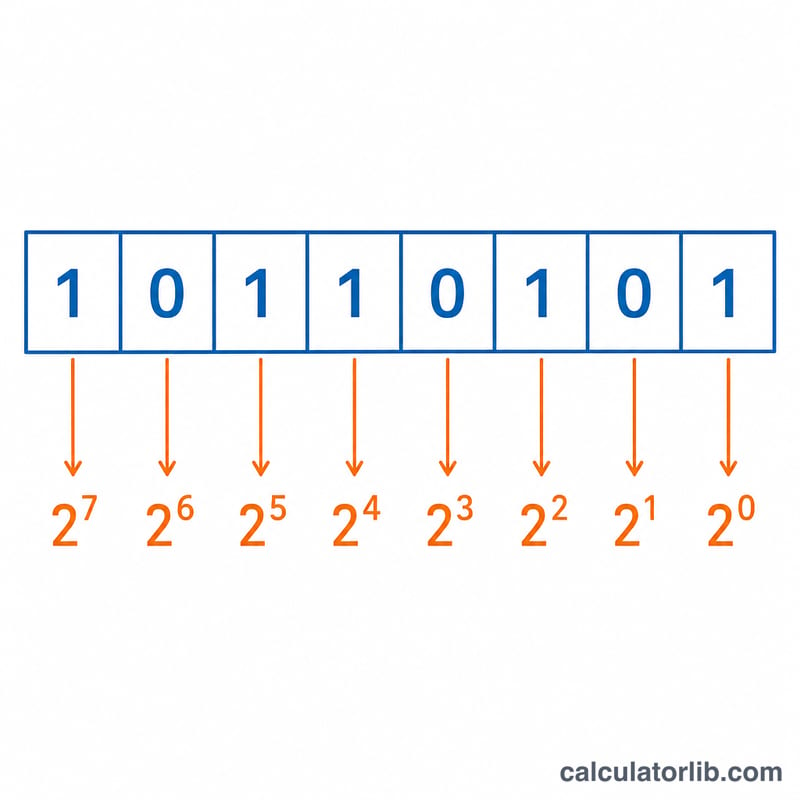
Reading the remainders from bottom to top gives 10011100, an 8-bit number. Verify: \(128 + 16 + 8 + 4 = 156\). ✔
FAQ
Why does binary only use 0 and 1? Because base 2 has exactly two symbols, mirroring the two stable states (off/on, low/high voltage) of digital circuits.
What does the bit count mean? It is the number of binary digits needed to represent the value — useful for understanding storage size and data types.
Can it convert 0? Yes. Zero in binary is simply 0, represented with a single bit.