
What Is a Binary to Decimal Converter?
Binary is the base-2 number system used by all digital computers, written using only the digits 0 and 1. Decimal is the familiar base-10 system humans use every day. This converter takes any binary number and translates it into its equivalent decimal value, making it easy to read and verify machine-level data, IP address octets, color codes, or computer-science homework.
How to Use It
Type a binary number — a string of 0s and 1s — into the input box and submit. Any characters that are not 0 or 1 are automatically ignored. The calculator returns the decimal (base-10) equivalent along with the number of bits in your input.
The Formula Explained
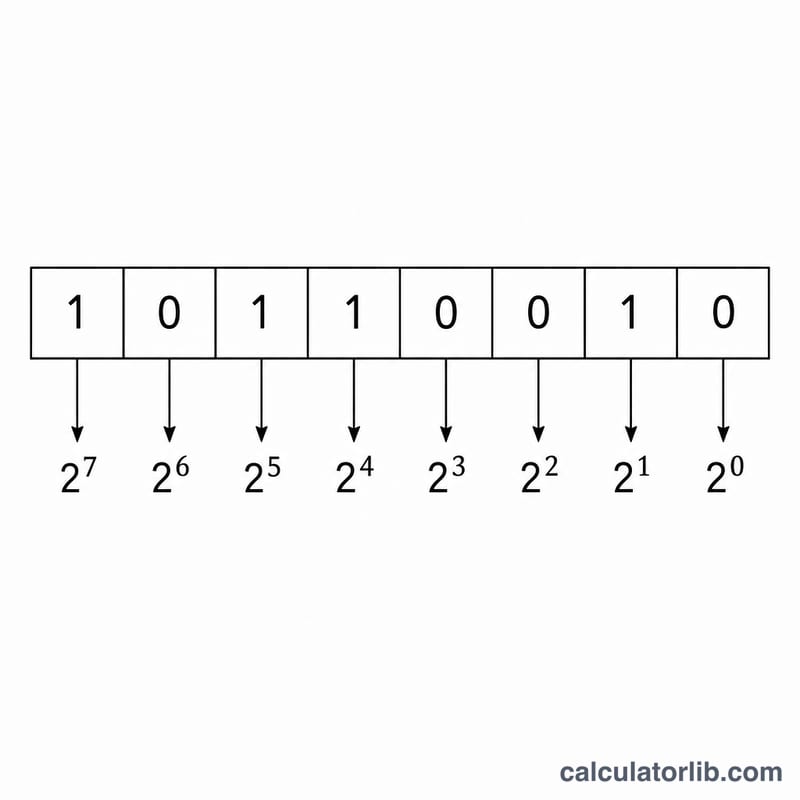
Every position in a binary number carries a weight that is a power of two. Reading from right to left, the rightmost digit has weight \(2^0 = 1\), the next \(2^1 = 2\), then \(2^2 = 4\), and so on. The decimal value is the sum of each bit multiplied by its positional weight:
$$\text{Decimal} = \sum_{i=0}^{n-1} b_i \times 2^{\,i}, \quad b_i \in \text{Binary Number}$$
for \(i = 0\) to \(n-1\), where \(i\) is the position counted from the right.
Worked Example
Convert 101101 to decimal. Reading right to left: $$1\times2^0 + 0\times2^1 + 1\times2^2 + 1\times2^3 + 0\times2^4 + 1\times2^5 = 1 + 0 + 4 + 8 + 0 + 32 = 45$$ So binary 101101 equals decimal 45.
Definitions & Glossary
Understanding binary-to-decimal conversion is easier once the core vocabulary is clear. The terms below describe the building blocks of binary numbers and the positional system that gives each digit its value.
- Bit — short for binary digit, the smallest unit of digital information. A bit holds exactly one of two values: 0 or 1.
- Byte — a group of 8 bits. One byte can represent \(2^{8} = 256\) distinct values, from 0 to 255 in decimal.
- Nibble — a group of 4 bits (half a byte). A nibble can represent \(2^{4} = 16\) values (0–15) and maps neatly to a single hexadecimal digit.
- Base / Radix — the number of unique digits a numeral system uses, including zero. The base also serves as the multiplier between adjacent digit positions. Binary has a base (radix) of 2; decimal has a base of 10.
- Base-2 (Binary) — a numeral system using only the digits 0 and 1, where each position is a power of 2. It is the native language of digital electronics and computers.
- Base-10 (Decimal) — the everyday numeral system using ten digits (0–9), where each position is a power of 10. This is the target format produced by a binary-to-decimal conversion.
- Positional notation — a system in which the value of a digit depends on both the digit itself and its position. Each position carries a weight equal to the base raised to the power of the position index. For binary, the weights are \(2^{0}, 2^{1}, 2^{2}, \dots\) reading from right to left.
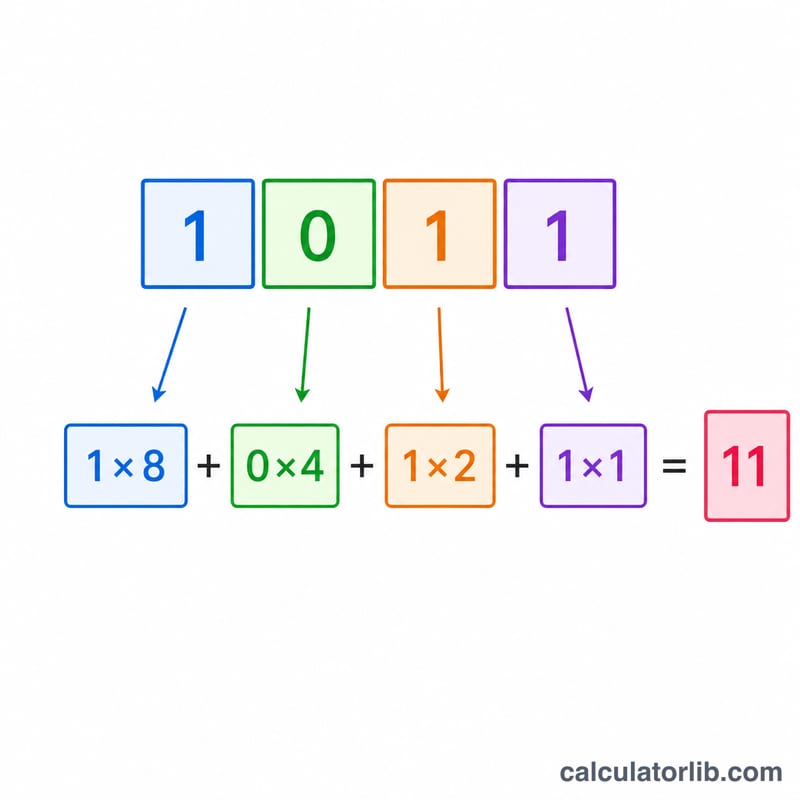
- Most Significant Bit (MSB) — the leftmost bit of a binary number, carrying the largest positional weight. Changing the MSB has the greatest effect on the number's value. For example, in \(1011_2\) the leading 1 is the MSB with weight \(2^{3} = 8\).
- Least Significant Bit (LSB) — the rightmost bit, carrying the smallest weight, \(2^{0} = 1\). It determines whether the number is even (LSB 0) or odd (LSB 1).
FAQ
What is the largest binary number this handles? It accurately converts numbers well beyond 53 bits for typical use; extremely long inputs may lose precision due to floating-point limits.
Does the order of digits matter? Yes — binary is positional. The leftmost digit is the most significant (highest power of two).
What if I enter spaces or other characters? Non-binary characters are stripped out automatically, so "1011 0101" is read as "10110101".