
What is MLVSS?
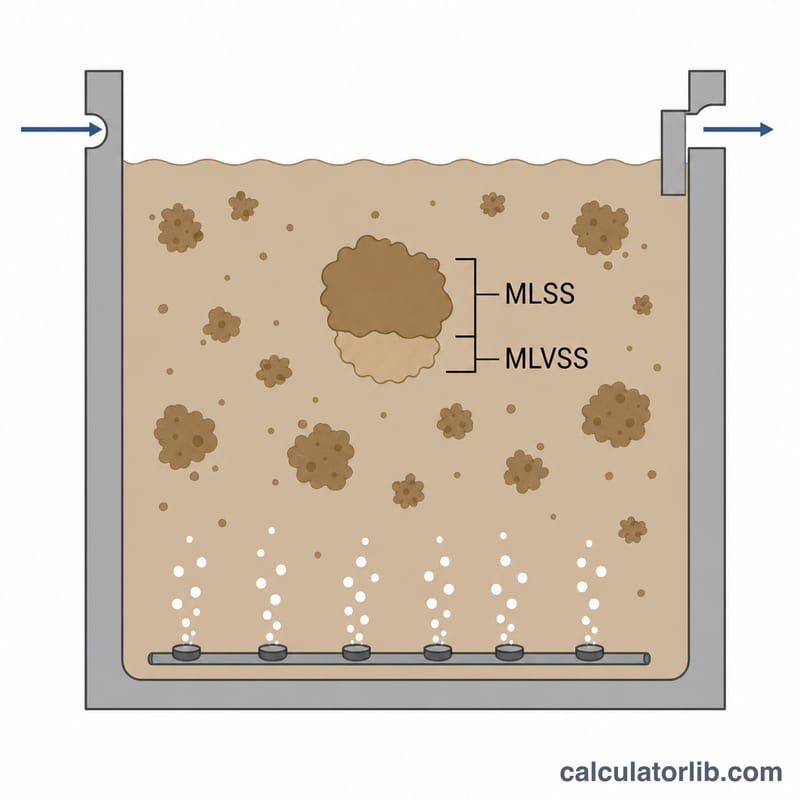
MLVSS (Mixed Liquor Volatile Suspended Solids) is the organic, biologically active portion of the suspended solids in the aeration basin of an activated-sludge wastewater treatment plant. While MLSS (Mixed Liquor Suspended Solids) measures all suspended solids, MLVSS isolates the fraction that burns off at 550 °C — a practical proxy for living and dead microbial biomass. Operators use MLVSS to estimate the food-to-microorganism (F/M) ratio, sludge age, and overall process health.
How to use this calculator
Enter your measured MLSS in mg/L and the volatile fraction (the decimal ratio of volatile to total solids, typically 0.65–0.85 for domestic wastewater). The calculator multiplies the two to return MLVSS in mg/L, and also reports the fixed (inorganic, non-volatile) solids as MLSS − MLVSS.
The formula explained
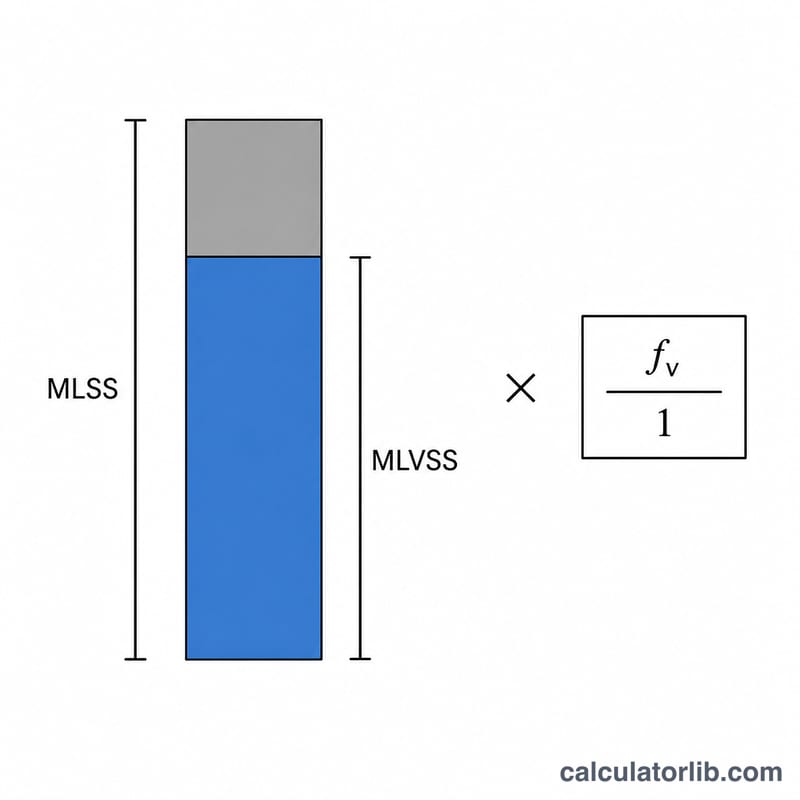
The relationship is simply $$\text{MLVSS} = \text{MLSS} \times f_v$$ where \(f_v\) is the volatile fraction. Rearranged, the volatile fraction itself is \(f_v = \text{MLVSS} / \text{MLSS}\). The fixed solids are whatever remains: \(\text{Fixed} = \text{MLSS} - \text{MLVSS}\). Because the volatile fraction is a ratio between 0 and 1, MLVSS is always less than or equal to MLSS.
Worked example
Suppose a plant measures MLSS = 3,000 mg/L and a laboratory volatile fraction of 0.75. Then $$\text{MLVSS} = 3{,}000 \times 0.75 = 2{,}250 \text{ mg/L}$$ the volatile fraction is 75%, and the fixed solids equal \(3{,}000 - 2{,}250 = 750\) mg/L.
FAQ
What is a typical volatile fraction? For municipal activated sludge it usually runs 0.70–0.85; higher values indicate more biomass relative to inert grit and minerals.
Why use MLVSS instead of MLSS? MLVSS better represents active biomass, giving a more accurate F/M ratio and biokinetic calculations than total MLSS.
Can the volatile fraction exceed 1? No — MLVSS is a subset of MLSS, so the fraction must be between 0 and 1.