
What Is the Ramp Calculator?
This calculator works out the key geometry of a ramp from just two measurements: the rise (the vertical height you need to climb) and the run (the horizontal distance the ramp covers). From these it returns the sloped ramp length, the slope as a percentage grade, the incline angle in degrees, and the slope ratio. It is useful for wheelchair and accessibility ramps, loading ramps, skate ramps, driveways, and any sloped surface.
How to Use It
Enter the rise and run in the same unit (inches, feet, cm, or metres — the result comes back in that same unit). Press calculate. The hero box shows the actual ramp length you would need to build, and the table gives the grade, angle, and ratio so you can check it against your local building code.
The Formula Explained
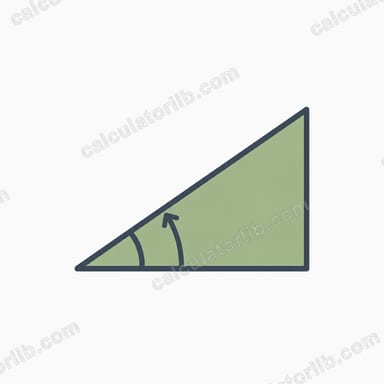
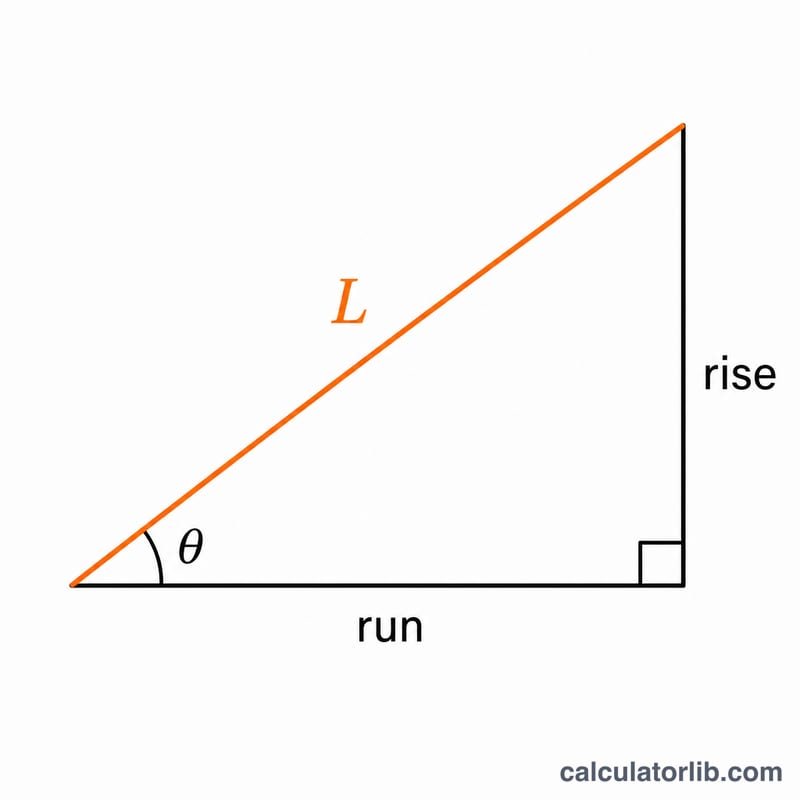
A ramp forms a right triangle where the rise and run are the two legs. The ramp length is the hypotenuse: $$L = \sqrt{\text{Rise}^{2} + \text{Run}^{2}}$$ The slope (grade) is the rise divided by the run, expressed as a percentage: $$\text{Slope} = \frac{\text{Rise}}{\text{Run}} \times 100\%$$ The incline angle is the arctangent of rise over run, converted to degrees: $$\theta = \arctan\!\left(\frac{\text{Rise}}{\text{Run}}\right)$$ The slope ratio expresses how many units of run there are per unit of rise — for example, the common accessibility ratio of 1:12 means 12 units of run for every 1 unit of rise: $$\text{Ratio} = \frac{\text{Run}}{\text{Rise}}$$
Worked Example
Suppose you have a rise of 12 inches and a run of 144 inches (a 1:12 ramp). Ramp length = \(\sqrt{12^{2} + 144^{2}} = \sqrt{144 + 20736} = \sqrt{20880} \approx 144.50\) inches. Slope = \(12 \div 144 \times 100 \approx 8.33\%\). Angle = \(\arctan(12 \div 144) \approx 4.76°\). Ratio = \(144 \div 12 = 12\), i.e. 12 : 1.
FAQ
What slope is required for a wheelchair ramp? Many accessibility standards (such as the US ADA) require a maximum slope of 1:12, about 8.33% or 4.76°. Always confirm with your local code.
What units should I use? Any unit works as long as the rise and run share the same one; the ramp length is returned in that unit.
Is the ramp length longer than the run? Yes — because it is the diagonal (hypotenuse), the ramp length is always slightly longer than the horizontal run.