
What Is the Miter Angle Calculator?
When two pieces of trim, molding, or framing meet at a corner, each piece must be cut at an angle so the joint closes neatly. This tool turns the angle of the corner itself into the precise miter angle you cut on each board. It works for any corner — not just the standard 90° — so it is handy for hexagonal frames, bay windows, octagonal planters, and irregular walls.
How to Use It
Measure the actual angle of the corner where the two pieces will join. A square corner is 90°. Enter that number and the calculator returns two values: the miter angle (the angle each board is cut at relative to a square end) and the miter saw setting (what you dial on a typical miter saw, which reads 0° for a straight cut).
The Formula Explained
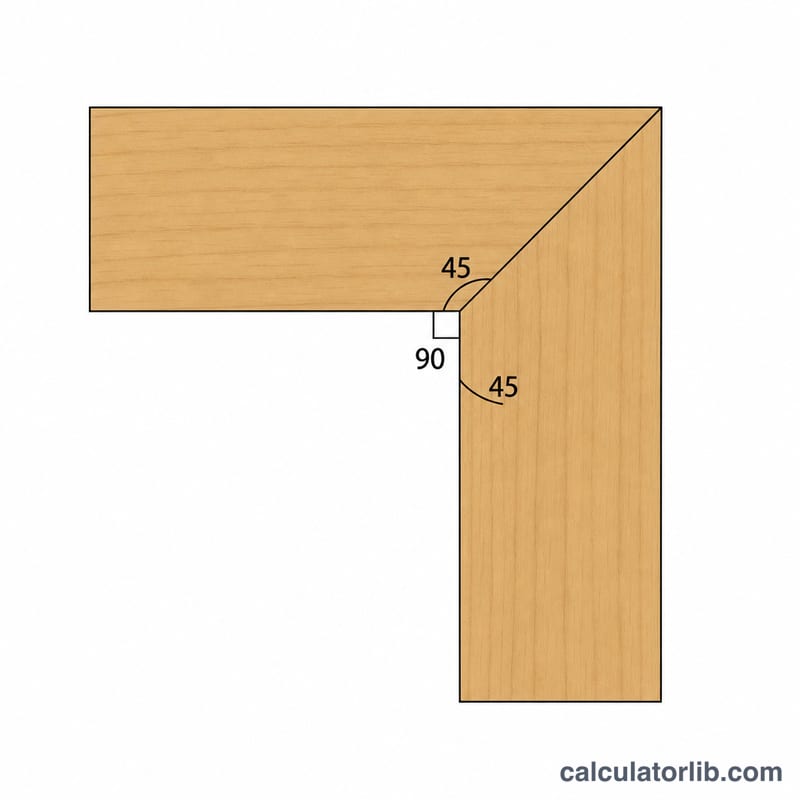
To split a corner evenly, each of the two boards takes half the total angle: \(\text{Miter} = \frac{\text{Corner Angle}}{2}\). For a 90° corner that is a 45° miter on each piece, and the two 45° cuts add up to fill the 90° space.
Because most miter saws are zeroed for a straight (90°) crosscut, the dial setting is \(\text{Saw} = 90^{\circ} - \frac{\text{Corner Angle}}{2}\). So a 45° miter is set as a 45° saw reading, while a 22.5° miter (for a flatter corner) is set at 67.5° on the dial.
$$\text{Miter} = \frac{\text{Corner Angle}}{2} \qquad \text{Saw} = 90^{\circ} - \frac{\text{Corner Angle}}{2}$$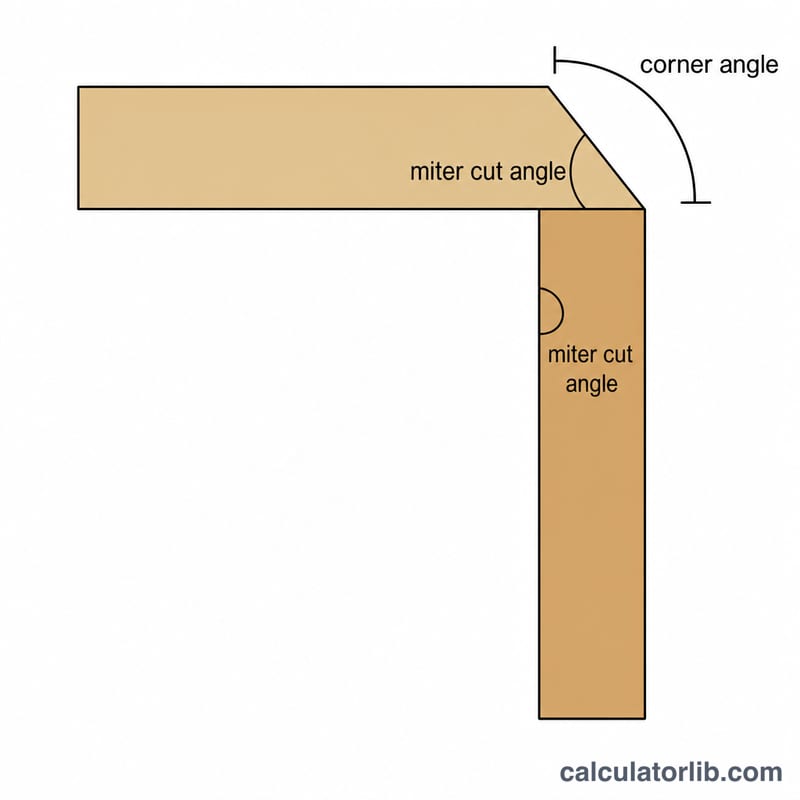
Worked Example
You are framing a hexagonal mirror. A regular hexagon has interior corners of 120°. Enter 120: the miter angle is \(120 \div 2 = 60^{\circ}\) per cut, and the miter saw setting is \(90 - 60 = 30^{\circ}\). Each of the six pieces gets a 60° miter on both ends.
FAQ
What miter for a 90° corner? 45° per board — the classic picture-frame cut.
What about an octagon? Interior corners are 135°, so the miter is 67.5° and the saw setting is 22.5°.
Does this account for walls that aren't square? Yes — just measure the true corner angle (use a protractor or bevel gauge) and enter it; the calculator halves whatever you provide.