What This Calculator Does
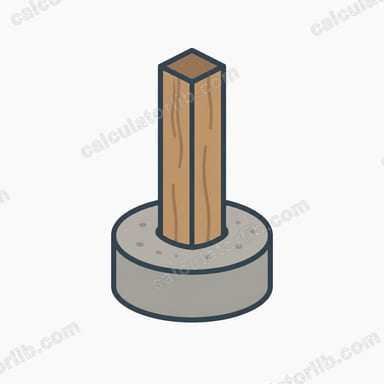
The Post Hole Concrete Calculator estimates how much concrete you need to anchor fence posts, mailbox posts, deck footings, or sign posts. It subtracts the space the post itself occupies from the volume of the hole, so you only pay for the concrete that actually fills the gap. Results are given in cubic feet, cubic yards, and the number of pre-mix bags required.

How to Use It
Enter the diameter of your hole, how deep you dig it, the width (or diameter) of the post going in, and how many holes you are setting. All measurements are in inches. The calculator returns the total concrete volume plus an estimate of 60 lb and 80 lb bags, rounded up so you don't come up short.
The Formula Explained
Each hole is a cylinder of volume \(\pi (d/2)^2 h\). The post fills a smaller cylinder \(\pi (p/2)^2 h\), so the concrete needed per hole is the difference. Multiply by the number of holes for the total. Cubic inches are converted to cubic feet (\(\div\, 1728\)) and cubic yards (\(\div\, 46656\)). A 60 lb bag yields about 0.45 cu ft and an 80 lb bag about 0.60 cu ft of mixed concrete.
$$\text{Concrete (ft}^3) = \frac{\pi \left[\left(\frac{\text{Hole Dia}}{2}\right)^2 - \left(\frac{\text{Post}}{2}\right)^2\right] \cdot \text{Depth} \cdot \text{Holes}}{1728}$$
$$\begin{gathered} \text{Bags}_{60} = \left\lceil \frac{V}{0.45} \right\rceil \qquad \text{Bags}_{80} = \left\lceil \frac{V}{0.60} \right\rceil \\[1.5em] \text{where}\quad V = \text{total concrete volume (ft}^3) \end{gathered}$$

Worked Example
For a 12 in hole, 24 in deep, with a 4 in post: hole volume = \(\pi \times 6^2 \times 24 = 2714.34\) cu in; post volume = \(\pi \times 2^2 \times 24 = 301.59\) cu in. Per hole = \(2412.74\) cu in = \(1.396\) cu ft. That's roughly 4 bags of 60 lb mix per hole.
Concrete Per Hole Quick-Reference Table
The table shows concrete needed for one round hole with a 4x4 post. A 4x4 is actually about 3.5 in wide, not 4 in. For simplicity the table treats the post as round with a 3.5 in diameter, using \(V = \pi\left[(D/2)^2 - (3.5/2)^2\right] \cdot \text{depth} / 1728\). Bag counts assume yields of 0.45 cu ft per 60 lb bag and 0.60 cu ft per 80 lb bag. Bag counts are unrounded to one decimal, so round up when buying.
| Hole diameter (in) | Depth (in) | Concrete per hole (cu ft) | 60 lb bags | 80 lb bags |
|---|---|---|---|---|
| 8 | 24 | 0.56 | 1.3 | 0.9 |
| 8 | 30 | 0.71 | 1.6 | 1.2 |
| 8 | 36 | 0.85 | 1.9 | 1.4 |
| 8 | 42 | 0.99 | 2.2 | 1.6 |
| 10 | 24 | 0.96 | 2.1 | 1.6 |
| 10 | 30 | 1.20 | 2.7 | 2.0 |
| 10 | 36 | 1.44 | 3.2 | 2.4 |
| 10 | 42 | 1.68 | 3.7 | 2.8 |
| 12 | 24 | 1.44 | 3.2 | 2.4 |
| 12 | 30 | 1.80 | 4.0 | 3.0 |
| 12 | 36 | 2.16 | 4.8 | 3.6 |
| 12 | 42 | 2.52 | 5.6 | 4.2 |
Multiply by the number of holes to get your total. Bag yields vary by brand, so check the yield printed on your bag.
Practical Tips for Ordering and Setting Post Concrete
- Order extra: add about 5–10% to the calculated volume to cover uneven hole walls, over-digging and spillage. Always round bag counts up.
- Bags or bulk: one cubic yard is 27 cu ft, which is about 60 bags of 60 lb or 45 bags of 80 lb (at the yields above). Once your total approaches 1 cubic yard or more, compare the cost and labor of bags against a ready-mix or bulk delivery. Check for minimum-load fees.
- Embedment depth: a common rule of thumb is to bury about one-third to one-half of the post length, and at least 24 in. Holes for frost-prone areas should extend below the local frost line. Check your local building code for the required depth.
- Drainage: put 4–6 in of compacted gravel at the bottom of the hole so water does not sit at the post base. Slope the top of the concrete away from the post so water runs off.
- Post and hole shape: the calculator and table treat the post as round. A square 3.5 in post has a cross-section of about 12.25 sq in, versus about 9.62 sq in for a round one. It therefore displaces slightly more concrete, so the real need is a little lower. A square hole needs more concrete than a round hole of the same width: use side² minus the post area instead of the round formula.
- Mixing and curing: follow the bag manufacturer's yield, water amount and set-time instructions. Brace the post plumb until the concrete has cured.
This is general information. Requirements vary by location, soil and structure, so follow local codes and the product instructions.
FAQ
Should the hole be 3x the post width? A common rule is a hole diameter about 3 times the post width and depth of 1/3 of the above-ground post height.
Why round bags up? Partial bags can't be bought, and a little extra accounts for spillage and uneven holes.
Does this include gravel at the bottom? No — if you add a gravel base, reduce the hole depth you enter by the gravel thickness.