
What Is the Angle of Depression?
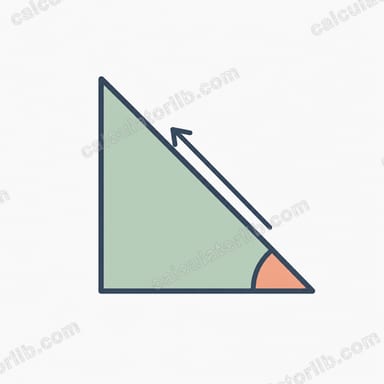
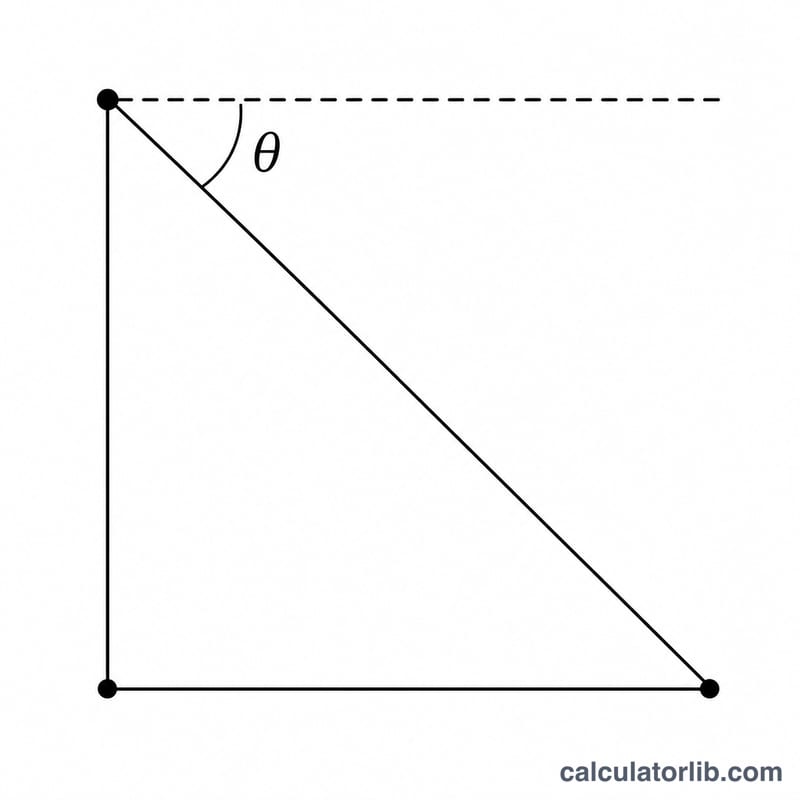
The angle of depression is the angle formed between a horizontal line of sight and the line of sight directed downward to an object below. If you stand on a cliff and look down at a boat, the angle your gaze drops below the horizontal is the angle of depression. It is a foundational concept in trigonometry, surveying, navigation, and physics.
How to Use This Calculator
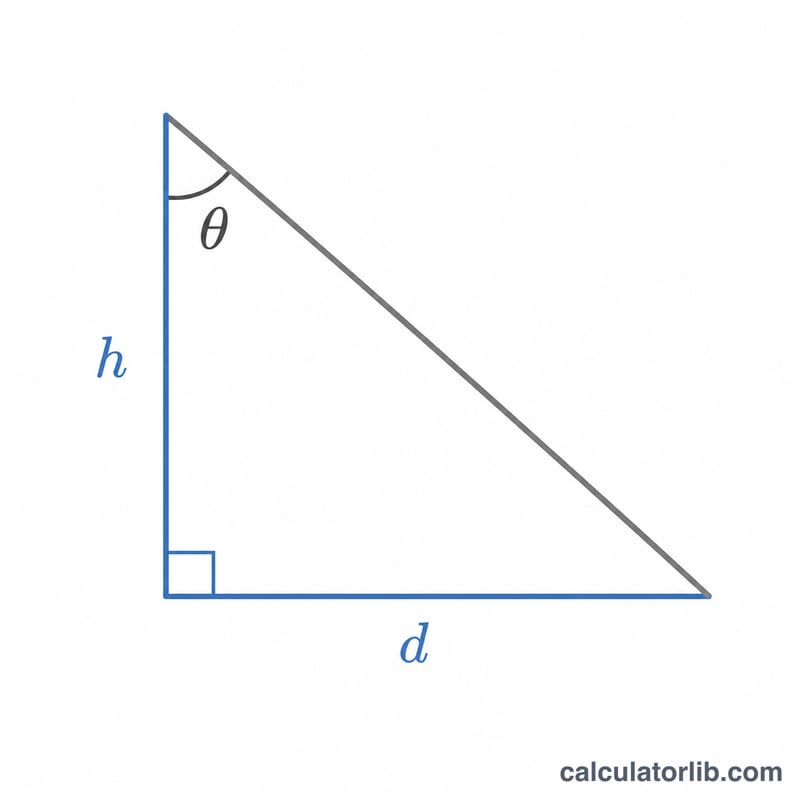
Enter the vertical height (\(h\)) — how far the observation point sits above the object — and the horizontal distance (\(d\)) between the point directly below the observer and the object. The calculator returns the angle of depression in both degrees and radians. Any consistent unit (meters, feet, etc.) works because the formula uses a ratio.
The Formula Explained
The angle is found with the arctangent (inverse tangent) of the opposite side over the adjacent side:
$$\theta = \arctan\!\left(\frac{\text{Height }(h)}{\text{Distance }(d)}\right) \times \frac{180}{\pi}$$
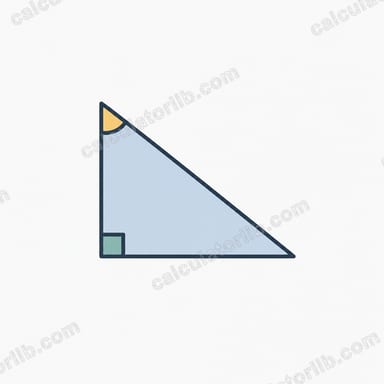
Because the height is the vertical (opposite) leg and the horizontal distance is the adjacent leg of the right triangle, their ratio gives the tangent of the angle. Taking the arctangent recovers the angle. We then multiply by \(\frac{180}{\pi}\) to express it in degrees.
Worked Example
Suppose an observer is 10 meters above the ground and the horizontal distance to an object is 20 meters. Then $$\theta = \arctan(10 / 20) = \arctan(0.5) \approx 0.4636 \text{ radians} \approx 26.57°$$ The line of sight drops about 26.57 degrees below the horizontal.
Key Terms & Variables
- Angle of depression (\(\theta\))
- The angle measured downward from a horizontal line of sight to an object located below the observer. It is always measured from the horizontal, not from the vertical.
- Horizontal line of sight
- An imaginary horizontal reference line extending outward from the observer's eye at the same elevation. The angle of depression is measured between this line and the line of sight to the target below.
- Vertical height (\(h\), opposite leg)
- The vertical drop from the observer's elevation down to the level of the object. In the right triangle it is the side opposite the angle of depression. Entered as height in the calculator.
- Horizontal distance (\(d\), adjacent leg)
- The horizontal ground distance between the point directly below the observer and the object. In the right triangle it is the side adjacent to the angle of depression. Entered as distance in the calculator.
- Tangent
- A trigonometric ratio defined as the opposite leg divided by the adjacent leg: \(\tan\theta = \tfrac{h}{d}\). It relates the angle to the ratio of the two sides.
- Arctangent (\(\arctan\) or \(\tan^{-1}\))
- The inverse of the tangent function. Given the ratio \(\tfrac{h}{d}\), it returns the angle that produces that ratio: \(\theta = \arctan\!\left(\tfrac{h}{d}\right)\). Multiplying by \(\tfrac{180}{\pi}\) converts the result from radians to degrees.
- Alternate interior angles
- When the horizontal line at the observer and the horizontal line at the object are parallel, the line of sight acts as a transversal. The angle of depression (at the observer) and the angle of elevation (at the object) are equal alternate interior angles — which is why an observer's angle of depression equals the target's angle of elevation.
FAQ
Is the angle of depression the same as the angle of elevation? They are equal in magnitude when measured between the same two points, because they are alternate interior angles formed by parallel horizontal lines.
What units should I use? Use the same unit for both height and distance. The result is a pure angle, so the units cancel out.
What if the horizontal distance is zero? The object is directly below the observer, so the angle is 90° (straight down). This calculator handles that case correctly.