
What Is the Qubit States Calculator?
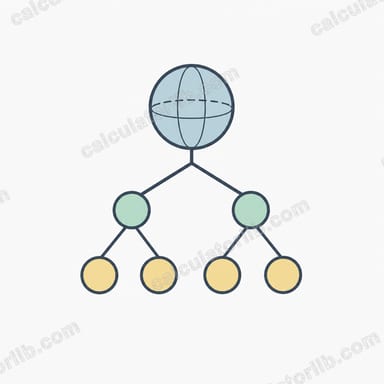
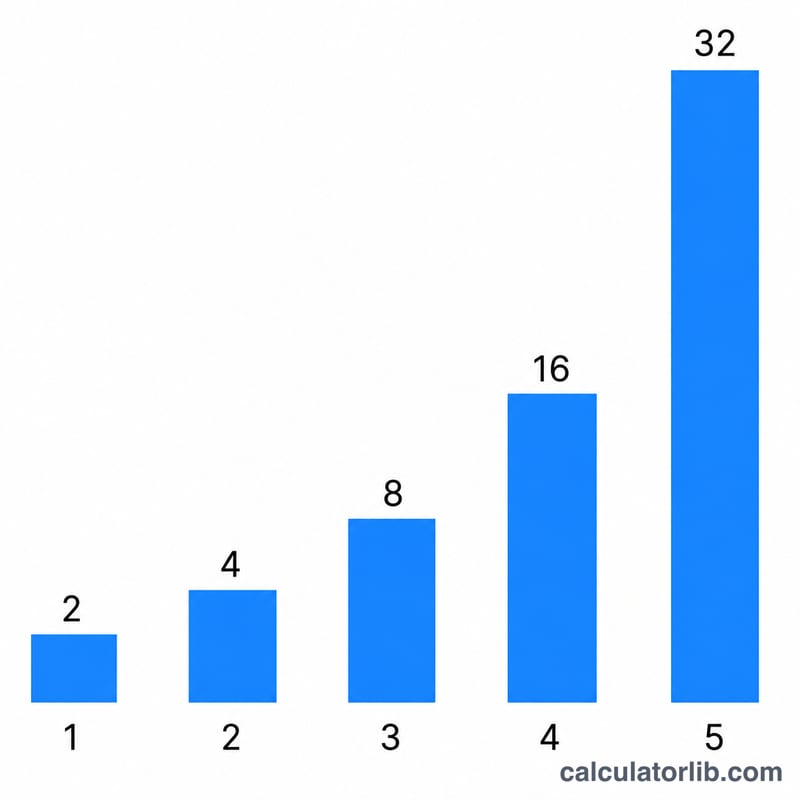
A classical bit holds one of two values, 0 or 1. A quantum bit, or qubit, can exist in a superposition of both. When you combine n qubits, the system can represent \(2^{n}\) distinct basis states at the same time. This calculator computes that number for any qubit count, illustrating why quantum computers scale so dramatically with each added qubit.
How to Use It
Enter the number of qubits (n) and the calculator returns \(2^{n}\) — the number of simultaneous quantum states. Try increasing n by one and watch the result double. This doubling behaviour is the heart of quantum computational power.
The Formula Explained
The number of states is given by:
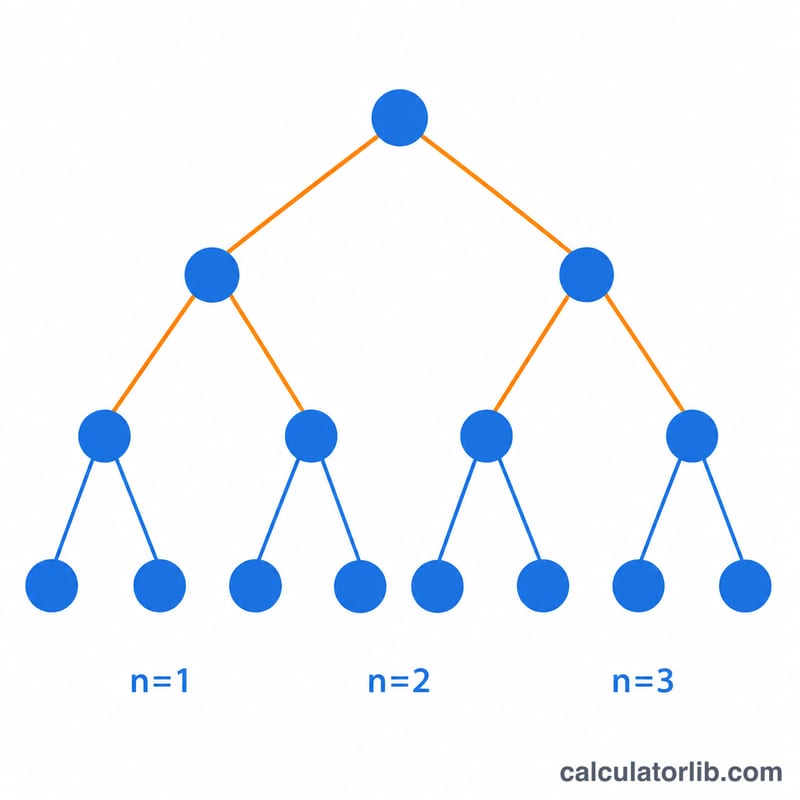
$$\text{States} = 2^{n}$$Here n is the number of qubits. Each additional qubit multiplies the number of representable states by two, producing exponential growth. With just 50 qubits a system spans over a quadrillion states — beyond what classical memory can hold.
Worked Example
Suppose you have a 10-qubit register. Then $$\text{States} = 2^{10} = 1{,}024.$$ A 20-qubit register jumps to \(2^{20} = 1{,}048{,}576\) states. Doubling the qubits squared the number of states, showing the exponential scaling.
FAQ
Why is it \(2^{n}\) and not \(n^{2}\)? Each qubit independently doubles the state space, so n qubits give \(2 \times 2 \times \ldots \times 2 = 2^{n}\).
Does a quantum computer use all states at once? Superposition lets a quantum computer hold all \(2^{n}\) amplitudes simultaneously, though measurement collapses the system to a single outcome.
Is this an exact count? Yes, \(2^{n}\) is the exact dimension of the quantum state space for n qubits. For very large n the displayed figure is limited by floating-point precision.