
What Is the Carbon Offset Trees Calculator?
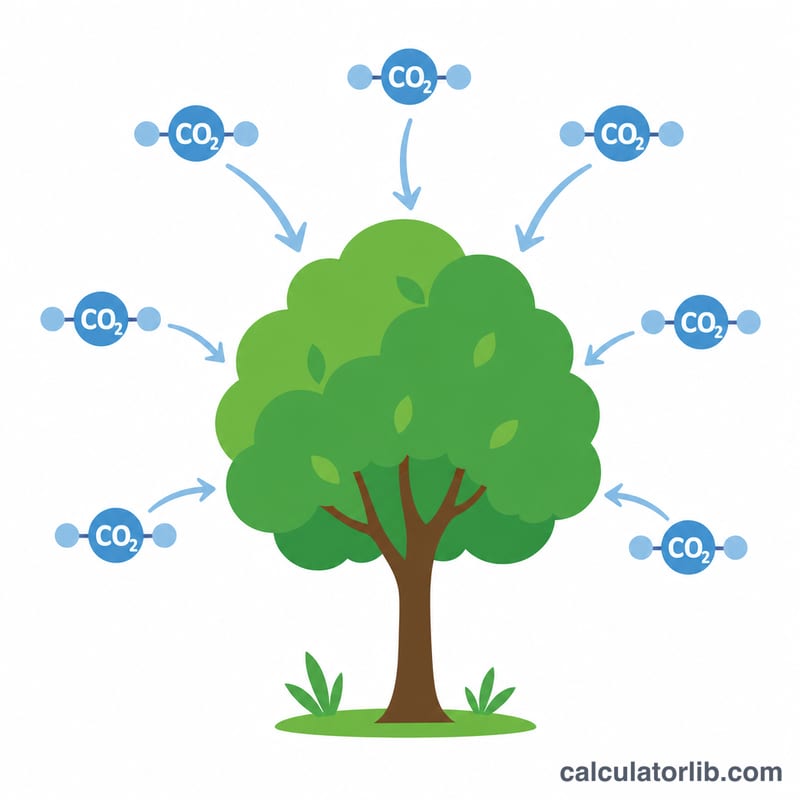
This calculator estimates how many trees you would need to plant to absorb a given amount of carbon dioxide (CO₂) each year. Trees pull CO₂ out of the atmosphere through photosynthesis, locking carbon into their wood, roots and soil. A commonly cited average is that a mature tree absorbs roughly 21 kilograms of CO₂ per year, though this varies widely by species, climate, age and growing conditions.
How to Use It
Enter your total annual CO₂ emissions in kilograms (a typical person's footprint ranges from about 4,000 to 16,000 kg per year depending on country and lifestyle). Adjust the "CO₂ absorbed per tree" value if you have a more specific figure for your region or species. The calculator then divides your emissions by the per-tree absorption rate and rounds up, since you can't plant a fraction of a tree.
The Formula Explained
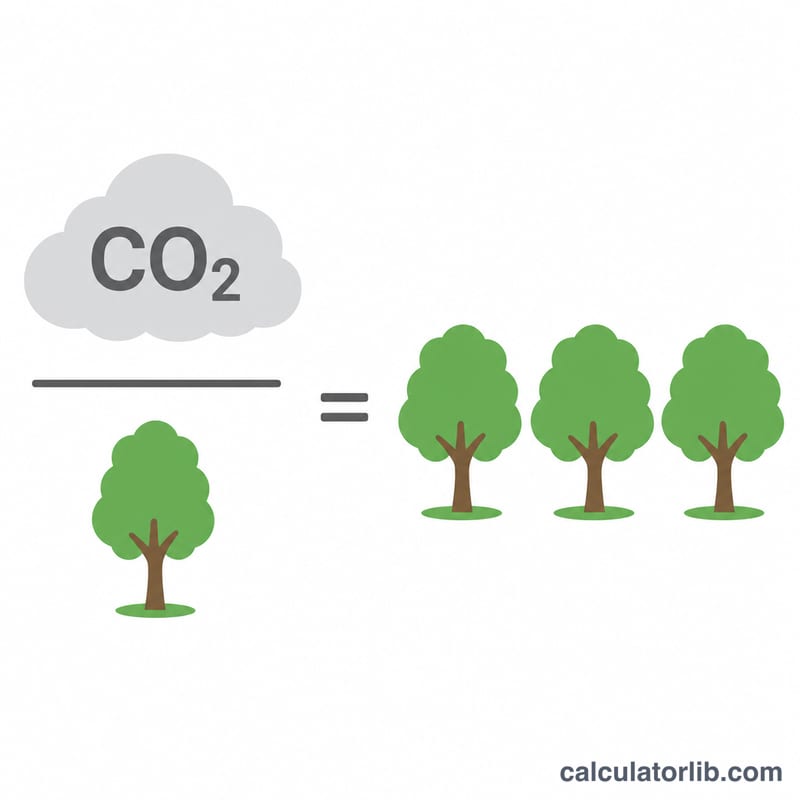
The core equation is simply:
$$\text{Trees} = \left\lceil \frac{\text{CO}_2\text{ (kg/yr)}}{\text{Absorbed per Tree (kg/yr)}} \right\rceil$$
For example, if you emit 4,200 kg of CO₂ per year and each tree absorbs 21 kg, you would need \(4{,}200 \div 21 = 200\) trees grown for one year to offset those emissions. Note this assumes each tree is mature and absorbing at its annual rate — newly planted saplings absorb far less in their early years.
Worked Example
Suppose your annual emissions are 5,000 kg and you use the default 21 kg/tree rate. \(\text{Trees} = 5{,}000 \div 21 \approx 238.1\), which rounds up to 239 trees. Those 239 trees would offset about 5,019 kg of CO₂ per year.
FAQ
How much CO₂ does one tree absorb? Estimates commonly range from 10 to 40 kg per year for an established tree; 21 kg is a widely used average. A tree's lifetime sequestration can total around 1 tonne (1,000 kg).
Does a newly planted tree offset my emissions immediately? No. Young trees absorb very little at first and reach their full absorption rate only after years of growth, so real-world offsetting takes time.
Is planting trees enough to be carbon neutral? Trees are a helpful natural offset, but reducing emissions at the source is far more effective and permanent than relying on tree planting alone.