
What is the Streaming Carbon Footprint Calculator?
Every hour of video you watch online moves data across networks and data centres that consume electricity. This calculator estimates the carbon dioxide (CO₂) produced by your streaming based on four inputs: how long you stream, how much data each hour uses, how much energy the network uses per gigabyte, and how clean (or dirty) your electricity grid is. It is a universal tool — you supply the grid intensity for your own country or region, so it works anywhere.

How to use it
Enter your total streaming hours for the period you want to measure (a day, a week, a month). Pick a data rate in GB per hour — roughly 1 GB/hr for standard definition, 3 GB/hr for HD, and 7 GB/hr for 4K Ultra HD. Set the network energy per GB (a commonly cited figure is about 0.077 kWh/GB) and your grid intensity in grams of CO₂ per kWh (the global average is around 475; many European grids are far lower, some coal-heavy grids much higher). The result shows grams and kilograms of CO₂, total data and energy, plus an equivalent in kilometres driven by an average car.
The formula explained
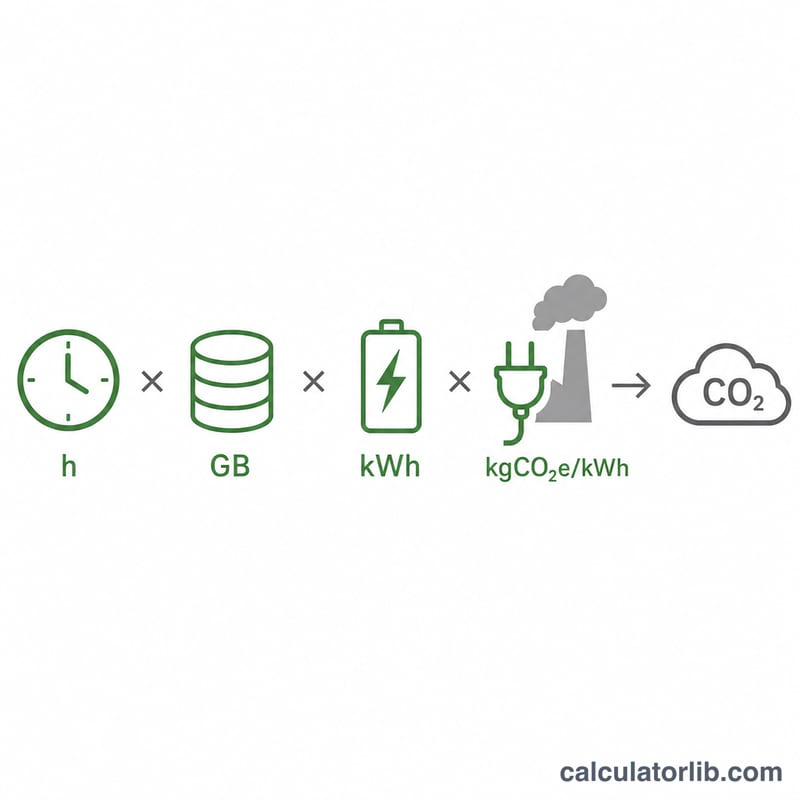
The model multiplies four factors:
$$\text{CO}_2\ (\text{g}) = \text{hours} \times \text{GB per hour} \times \text{kWh per GB} \times \text{gCO}_2\text{ per kWh}.$$
Hours × GB/hr gives total data. Multiplying by kWh/GB converts data into electricity consumed. Multiplying by the grid's carbon intensity converts electricity into emissions. The result is divided by 1,000 to show kilograms.
Worked example
Suppose you watch 10 hours of HD video (3 GB/hr) on a network using 0.077 kWh/GB, with a grid intensity of 475 gCO₂/kWh:
$$10 \times 3 \times 0.077 \times 475 = 1{,}097.25 \text{ g CO}_2$$ or about 1.097 kg — roughly the same as driving 6.5 km in an average car.
FAQ
Are these numbers exact? No — they are estimates. Real emissions depend on device, network type (Wi‑Fi vs mobile), data centre efficiency and the exact grid mix at the time, so treat the output as a ballpark.
What grid intensity should I use? Use your country's published average. Cleaner grids (lots of renewables/nuclear) can be under 100 gCO₂/kWh; fossil-heavy grids can exceed 800.
Does lowering resolution help? Yes — dropping from 4K to HD or SD sharply reduces data and therefore energy and emissions, which is often the easiest lever.