What is the EV Battery Range Calculator?
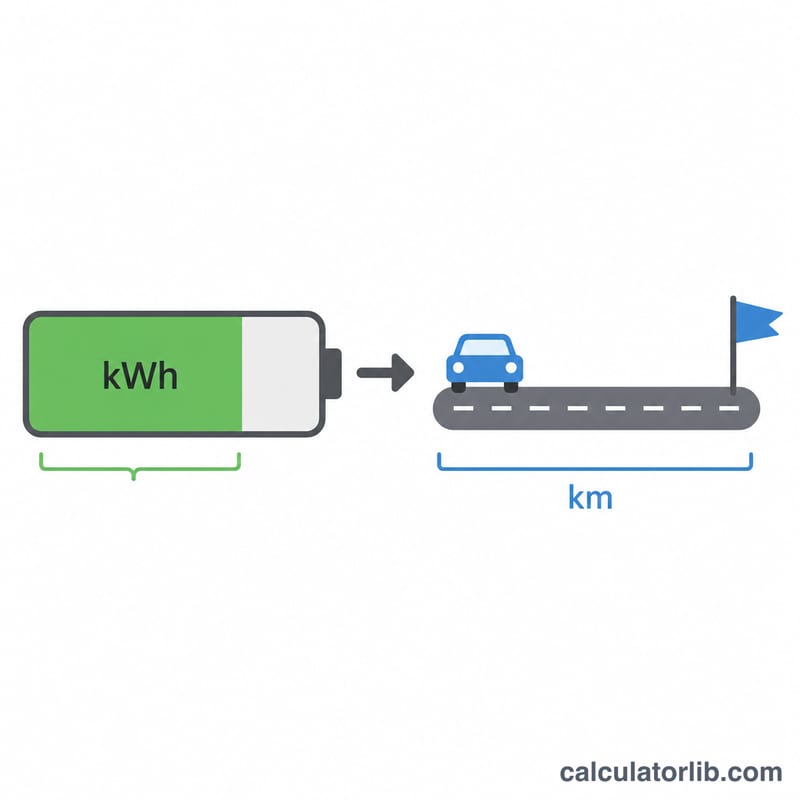
This calculator estimates how far an electric vehicle (EV) can travel on a single charge. It combines three key numbers: the battery's total capacity in kilowatt-hours (kWh), the usable fraction of that capacity, and how much energy the car consumes per kilometer driven. The result is an estimated range in both kilometers and miles.
How to use it
Enter your battery's rated capacity (for example 60 kWh). Set the usable fraction — manufacturers rarely allow 100% of the pack to be discharged, so 90–95% is typical. Finally enter your real-world energy consumption in kWh per km (around 0.15–0.20 kWh/km for many passenger EVs). Press calculate to see your estimated range.
The formula explained
The math is straightforward: usable energy equals battery capacity times the usable fraction, and range equals that usable energy divided by consumption per kilometer.
$$\text{Range (km)} = \frac{\text{Battery (kWh)} \times \dfrac{\text{Usable (\%)}}{100}}{\text{Consumption (kWh/km)}}$$
A lower consumption figure (efficient driving, mild weather, flat roads) gives more range, while highway speeds, cold weather and heavy loads increase consumption and shorten range.
Worked example
Suppose you have a 60 kWh battery with a 95% usable fraction and your car consumes 0.16 kWh/km. Usable energy = \(60 \times 0.95 = 57\) kWh. Range = \(57 \div 0.16 = 356.25\) km, which is about 221.4 miles.
Typical EV Consumption and Battery Sizes
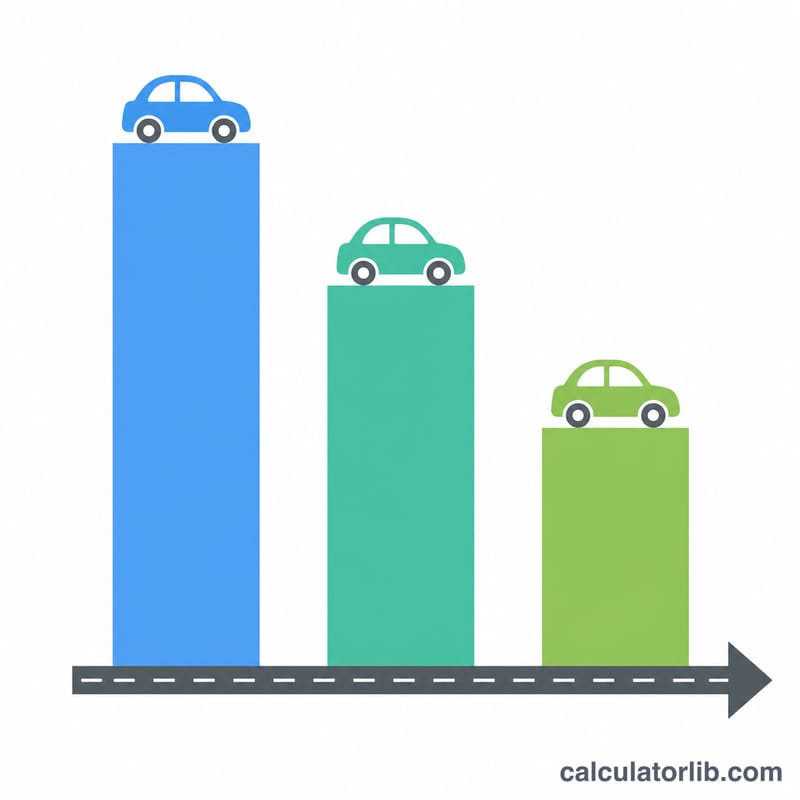
If you do not know your own numbers yet, these broad class figures give a starting point. Consumption is shown both as kWh/100 km (the usual European convention) and as kWh/km (the unit this calculator expects — simply divide by 100).
| Vehicle class | Typical usable battery (kWh) | Typical consumption (kWh/100 km) | Same value (kWh/km) | Approximate range |
|---|---|---|---|---|
| Small city EV | 20–40 | 13–16 | 0.13–0.16 | ~150–280 km (95–175 mi) |
| Compact hatchback | 45–60 | 15–18 | 0.15–0.18 | ~260–390 km (160–240 mi) |
| Mid-size sedan | 60–85 | 15–19 | 0.15–0.19 | ~330–540 km (205–335 mi) |
| Compact SUV | 60–85 | 17–21 | 0.17–0.21 | ~300–480 km (185–300 mi) |
| Large SUV / pickup | 90–135 | 22–30 | 0.22–0.30 | ~310–560 km (195–350 mi) |
| Van / light commercial | 40–85 | 19–27 | 0.19–0.27 | ~170–420 km (105–260 mi) |
These are broad class averages in the spirit of published WLTP (Europe) and EPA (United States) style figures, not values for any one model — and note that WLTP and EPA test cycles are not interchangeable, with EPA numbers generally the more conservative of the two. Real consumption for a given car varies widely with wheel and tyre size, aerodynamic options, payload, average speed, terrain, ambient temperature and how much charging loss you include. Where a manufacturer quotes only gross (nominal) battery capacity, the usable figure is typically a few percent lower because a buffer is reserved at the top and bottom of the pack.
FAQ
Why is my real range lower than the rated WLTP/EPA figure? Official ratings use controlled cycles. Highway speed, climate control, cold batteries and terrain all raise consumption.
What usable fraction should I use? If unsure, 90–95% is a safe assumption for most modern EVs that reserve a buffer to protect the battery.
How do I find my consumption? Most EVs display average energy use (kWh/100 km). Divide that figure by 100 to get kWh/km.