
What Is PUE?
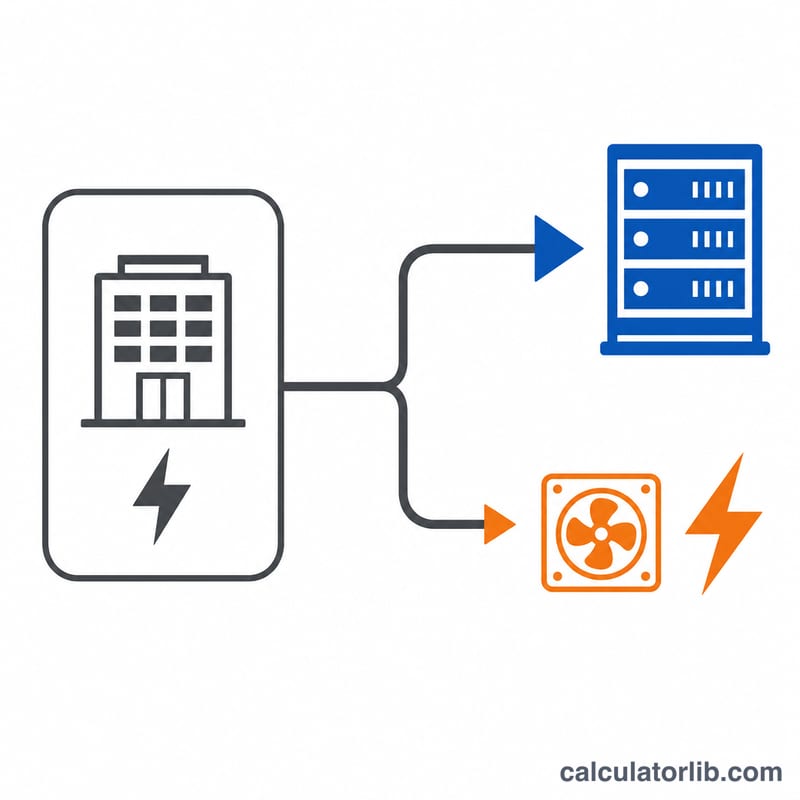
Power Usage Effectiveness (PUE) is the industry-standard metric for measuring data center energy efficiency, developed by The Green Grid. It compares the total amount of power entering a data center facility with the power actually used to run the IT equipment — servers, storage, and networking gear. The remaining energy is consumed by cooling, lighting, power distribution losses, and other infrastructure overhead.
How to Use This Calculator
Enter your Total Facility Power (the full power draw of the building or data hall, in kilowatts) and your IT Equipment Power (the power consumed by computing hardware only). The calculator instantly returns your PUE, your DCiE (Data Center Infrastructure Efficiency, the inverse expressed as a percentage), and the non-IT overhead power.
The Formula Explained
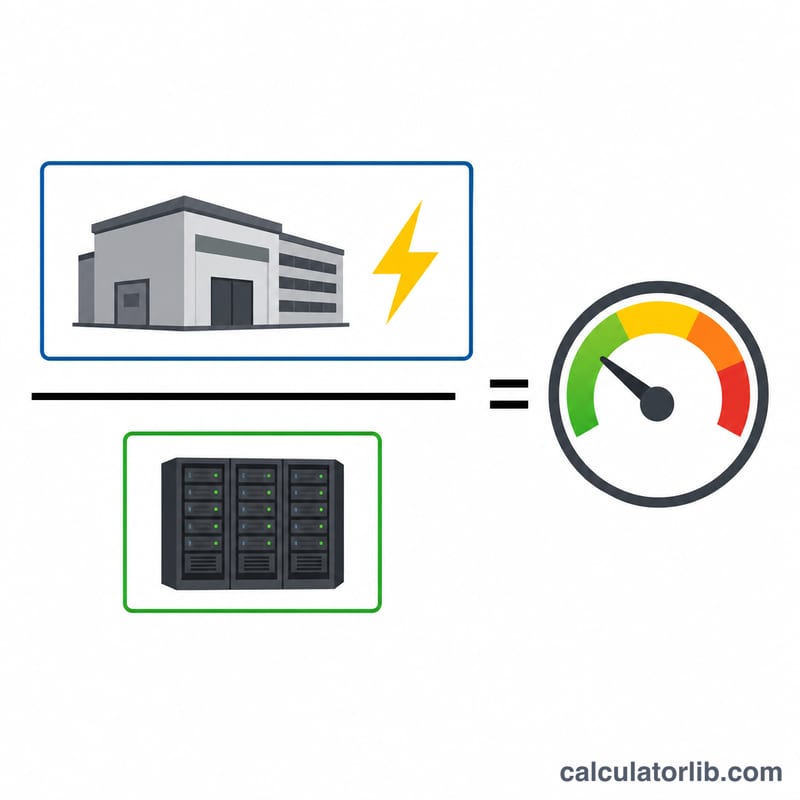
$$\text{PUE} = \frac{\text{Total Facility Power (kW)}}{\text{IT Equipment Power (kW)}}$$ A perfect PUE of 1.0 would mean every watt entering the facility goes straight to IT equipment with zero overhead — physically impossible in practice. A PUE of 2.0 means the facility uses twice as much power as the IT load alone. The global average sits around 1.5–1.6, while hyperscale operators achieve 1.1 or lower.
Worked Example
Suppose a data center draws 1,500 kW total and its servers consume 1,000 kW. $$\text{PUE} = 1{,}500 \div 1{,}000 = \mathbf{1.5}$$ The DCiE = \((1 \div 1.5) \times 100 = \mathbf{66.67\%}\), meaning two-thirds of the incoming power reaches the IT load. The overhead power is \(1{,}500 - 1{,}000 = 500\) kW spent on cooling and infrastructure.
FAQ
What is a good PUE? Below 1.5 is considered efficient; 1.2 or lower is excellent and typical of modern, well-designed facilities.
Can PUE be below 1.0? No. Since total power always includes IT power plus overhead, PUE is always 1.0 or greater.
What's the difference between PUE and DCiE? DCiE is simply the reciprocal of PUE shown as a percentage; a PUE of 1.25 equals a DCiE of 80%.