
What This Calculator Does
The Car Center of Mass Calculator pinpoints the longitudinal location of your vehicle's center of gravity (CG) along the wheelbase. By weighing each axle and measuring the wheelbase, you can determine exactly how far behind the front axle the mass is concentrated — a key figure for handling balance, braking, and weight-transfer analysis.
How to Use It
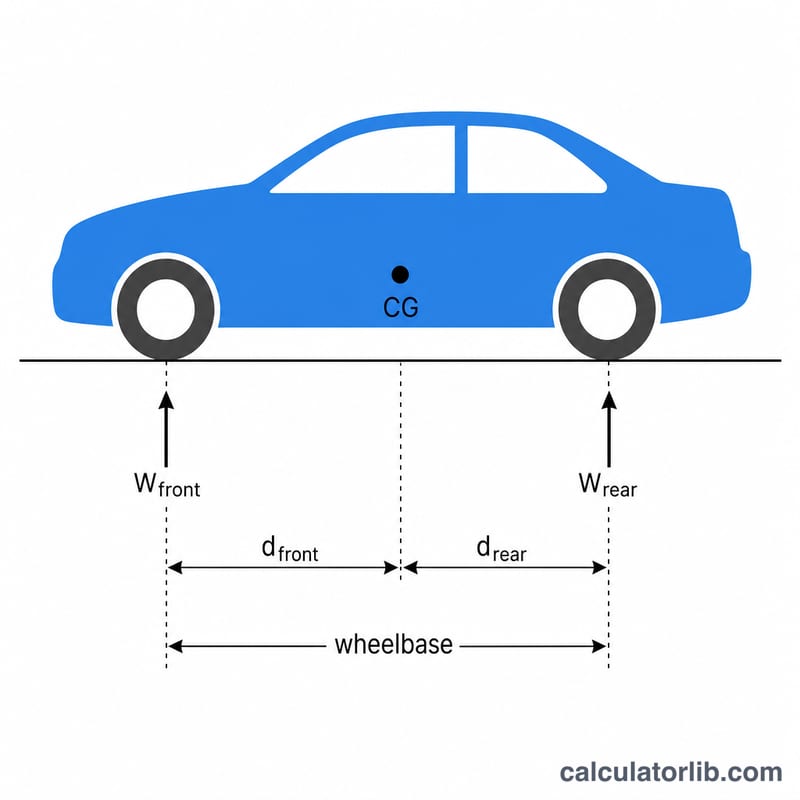
Place the car on corner or axle scales and record the total weight on the front axle and the total on the rear axle. Measure the wheelbase (the center-to-center distance between the front and rear wheels). Enter all three values and the calculator returns the CG distance from each axle and the front/rear weight split.
The Formula Explained
Because moments about the front axle must balance, the center of mass sits closer to the heavier end. The distance from the front axle equals the fraction of weight on the rear axle times the wheelbase:
$$d_{\text{front}} = \frac{\text{W}_{\text{rear}}}{\text{W}_{\text{total}}} \times \text{wheelbase}$$
The distance from the rear axle is simply the wheelbase minus that value, equivalently \(\frac{\text{W}_{\text{front}}}{\text{W}_{\text{total}}} \times \text{wheelbase}\).
Worked Example
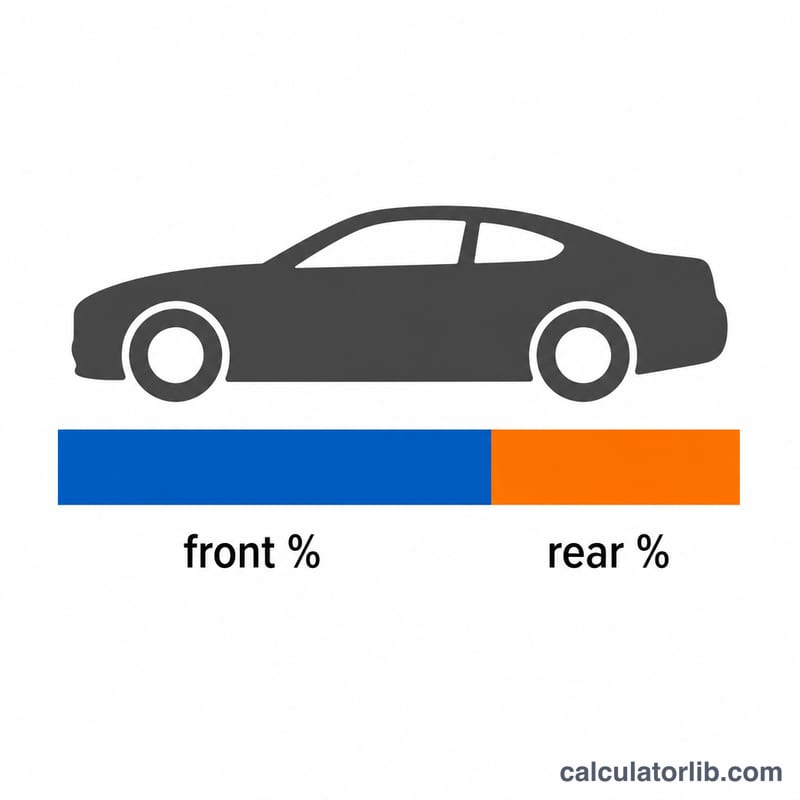
Suppose a car has 850 kg on the front axle, 650 kg on the rear axle, and a 2600 mm wheelbase. Total weight is 1500 kg. The CG sits $$\frac{650}{1500} \times 2600 = 1126.67 \text{ mm}$$ behind the front axle, and $$\frac{850}{1500} \times 2600 = 1473.33 \text{ mm}$$ ahead of the rear axle. Weight distribution is about 56.7% front / 43.3% rear.
FAQ
Does this give the CG height? No — this calculates only the longitudinal (front-to-rear) position. CG height requires a tilt or jacked-axle test.
What units should I use? Use any consistent weight unit (kg or lb) for the axles; the distance result comes out in the same unit you used for the wheelbase (mm, cm, or inches).
Why does weight distribution matter? It affects traction, braking balance, and cornering. A near 50/50 split is often prized for balanced handling.