
What Is the Weight on Other Planets Calculator?
Your mass never changes when you travel through space, but your weight does. Weight is the force gravity exerts on your mass, so on a world with stronger or weaker surface gravity than Earth's, the bathroom scale reads a different number. This calculator instantly converts your Earth weight into the weight you would register on Mercury, Venus, the Moon, Mars, Jupiter, Saturn, Uranus, Neptune, Pluto, or even the surface of the Sun.
How to Use It
Enter your weight on Earth, pick whether you measure in kilograms or pounds, and choose a destination. The result shows your equivalent weight there, the body's surface gravity relative to Earth, and its gravity in m/s². The unit you choose is preserved — the math is a simple proportion, so weight in kg returns kg and weight in lb returns lb.
The Formula Explained
The calculation is a straight ratio:
$$W_{\text{planet}} = W_{\text{earth}} \times \left( g_{\text{planet}} / g_{\text{earth}} \right)$$
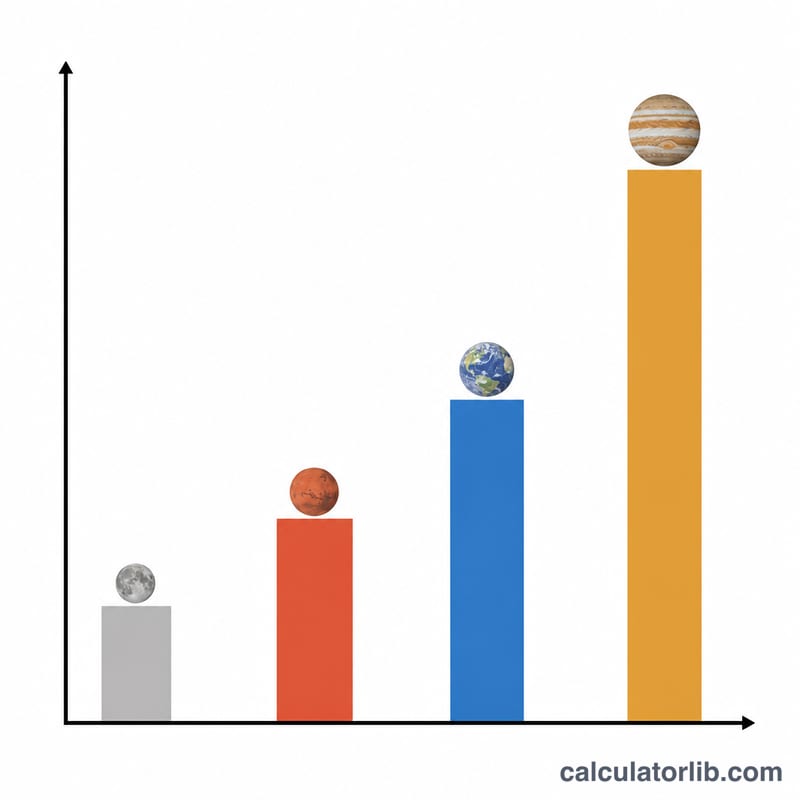
Each body has a known surface gravity ratio. For example, Mars is about 0.379 (its gravity is ~38% of Earth's), the Moon is 0.165, and Jupiter is 2.528. Multiply your Earth weight by that ratio and you have your weight on the new world.
Worked Example
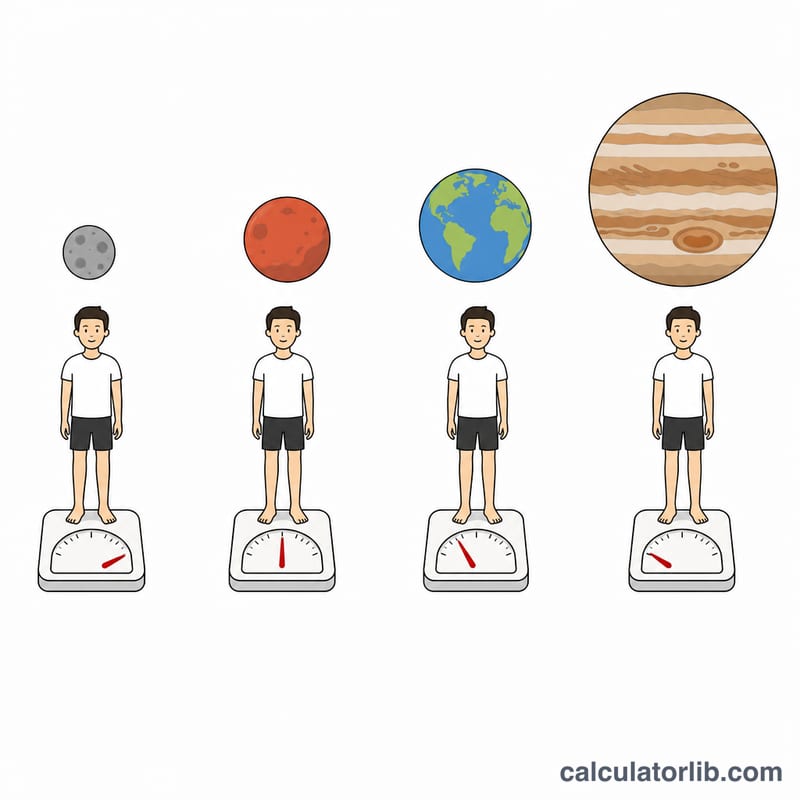
Suppose you weigh 70 kg on Earth and want to know your weight on Mars. Mars's gravity ratio is 0.379, so:
$$70 \times 0.379 = 26.53 \text{ kg}$$ You would weigh just over a quarter as much. On the Moon (ratio 0.165) the same person weighs only 11.55 kg.
FAQ
Does my mass change on another planet? No. Mass stays constant; only weight (the gravitational force on that mass) changes.
Why is Jupiter's weight higher than Earth's? Jupiter is far more massive, giving it about 2.5 times Earth's surface gravity, so you would weigh roughly 2.5× more.
Are these gravity values exact? They are standard accepted surface-gravity ratios. Real values vary slightly with latitude and altitude, but they are accurate for everyday comparisons.