
What this calculator does
This tool computes weight — the gravitational force acting on an object — from its mass and the local gravitational acceleration. While mass (in kilograms) is a constant property of an object, weight is a force measured in newtons (N) and depends on where you are. This calculator is universal physics and applies anywhere in the universe.
The formula explained
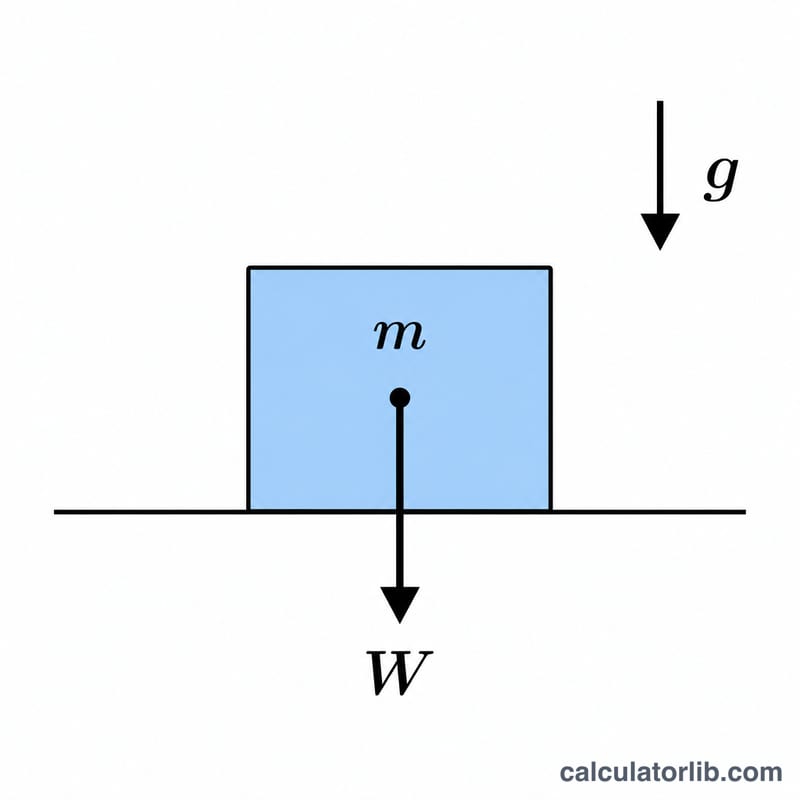
The relationship comes from Newton's second law, \(F = ma\), applied to gravity:
$$W = m \cdot g$$
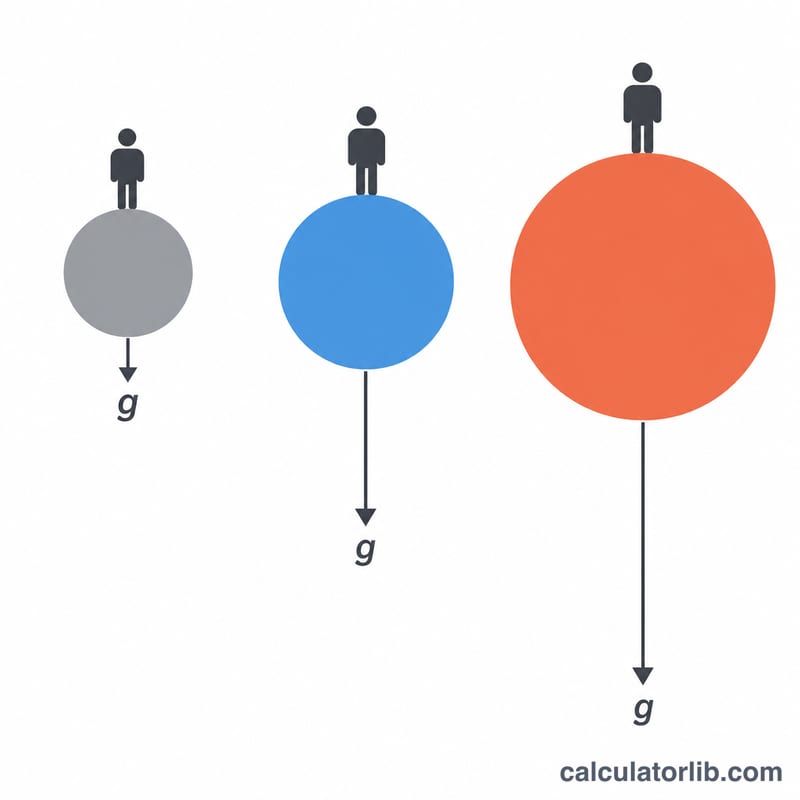
where W is weight (newtons), m is mass (kilograms), and g is gravitational acceleration (m/s²). On Earth, the standard value of g is 9.80665 m/s². On the Moon it is about 1.62 m/s², and on Mars about 3.71 m/s².
How to use it
Enter the object's mass in kilograms and the gravitational acceleration. The default g is Earth's standard gravity, but you can change it to model any planet, moon, or environment. The result is the weight as a force in newtons.
Worked example
A person with a mass of 70 kg on Earth: $$W = 70 \times 9.80665 = 686.47 \text{ N}$$ The same person on the Moon (g ≈ 1.62): $$W = 70 \times 1.62 = 113.4 \text{ N}$$ — about one-sixth their Earth weight, even though their mass never changed.
FAQ
Is weight the same as mass? No. Mass is the amount of matter (kg) and stays constant; weight is the force gravity exerts on that mass (N) and varies with g.
Why use 9.80665? That is the internationally defined standard gravity at Earth's surface. Local g varies slightly (about 9.78 at the equator to 9.83 at the poles).
How do I convert newtons to kilograms-force? Divide newtons by 9.80665. So \(686.47 \text{ N} \approx 70 \text{ kgf}\), which is why scales calibrated in kg show your mass even though they measure force.