
What Is Rainfall Intensity?
Rainfall intensity is the rate at which rain falls over a given period, usually expressed in millimetres per hour (mm/hr). It is a fundamental value in hydrology, drainage design, agriculture, and flood-risk assessment. Knowing intensity—rather than just total rainfall—tells you how quickly water accumulates, which determines whether soil, gutters, or storm drains can cope.
How to Use This Calculator
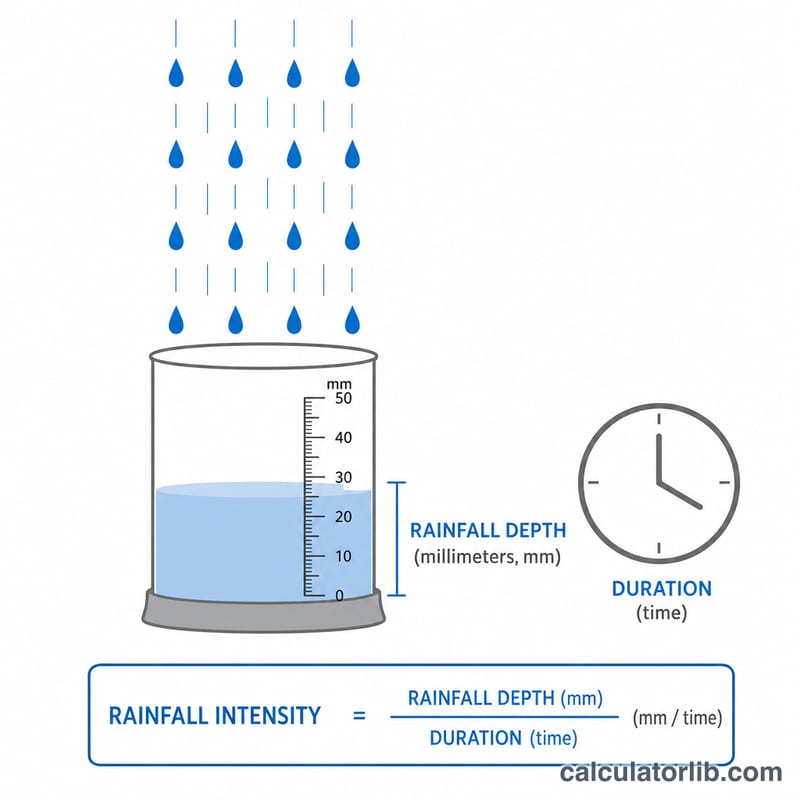
Enter the total rainfall depth in millimetres and the duration in hours over which it was measured. The calculator divides depth by duration to give the average intensity in mm/hr, shows the equivalent duration in minutes, and classifies the result into a familiar meteorological category.
The Formula Explained
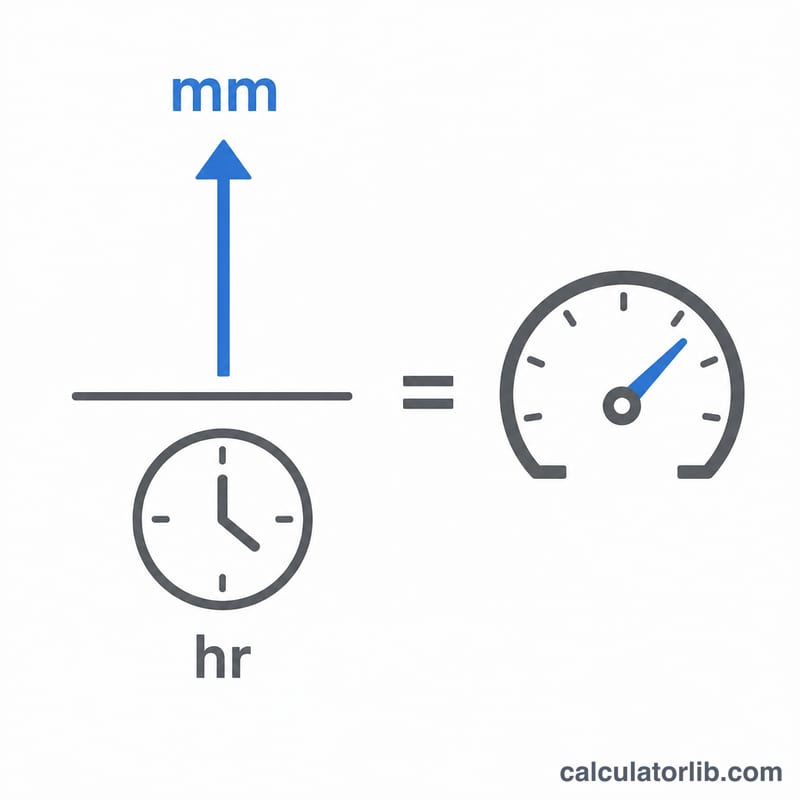
The relationship is simply:
$$i = \frac{P}{t}$$
where i is intensity (mm/hr), P is rainfall depth (mm), and t is duration (hours). If 20 mm of rain fell over 4 hours, the intensity is \(20 \div 4 = 5\) mm/hr. This is an average; real storms have bursts that exceed the mean.
Worked Example
Suppose a gauge recorded 25 mm of rain over 2 hours. $$\text{Intensity} = 25 \div 2 = 12.5 \text{ mm/hr}$$ Since this falls between 7.6 and 50 mm/hr, it is classified as heavy rain. The 2-hour period equals 120 minutes.
FAQ
What counts as heavy rain? A common classification: light rain < 2.5 mm/hr, moderate 2.5–7.6 mm/hr, heavy 7.6–50 mm/hr, and violent > 50 mm/hr.
Can I use minutes instead of hours? Convert minutes to hours first (divide by 60) before entering the duration, or enter a fractional hour (e.g. 30 minutes = 0.5 hr).
Is this average or peak intensity? This tool gives the average intensity over the whole period. Peak (short-burst) intensity is usually higher and requires finer time-resolution data.