
What is the Wind Speed at Altitude Calculator?
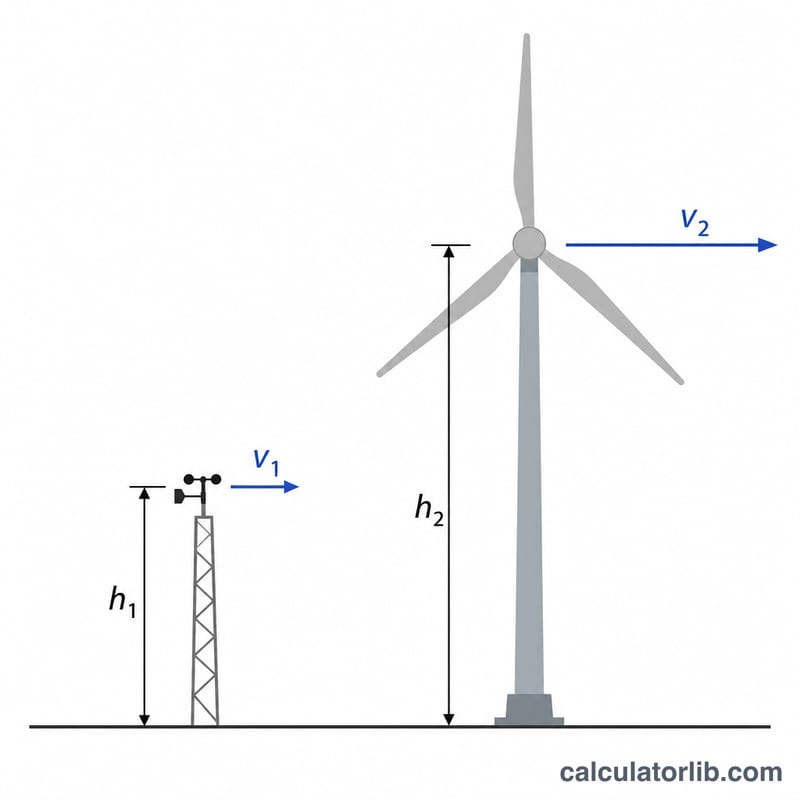
This tool estimates how wind speed changes with height above the ground using the wind shear power law. Wind is slower near the surface because of friction with terrain and obstacles, and it speeds up as you climb. Engineers, wind-turbine planners, and meteorologists use this relationship to scale a measured wind speed from one height (such as a 10 m weather mast) to a target height (such as a turbine hub at 50 m or higher).
How to use it
Enter a known wind speed and the height at which it was measured (h₁). Then enter the target height (h₂) you want the speed for, and the wind shear exponent α for your terrain. The calculator returns the projected wind speed, the height ratio, and the percentage change relative to the reference speed.
The formula explained
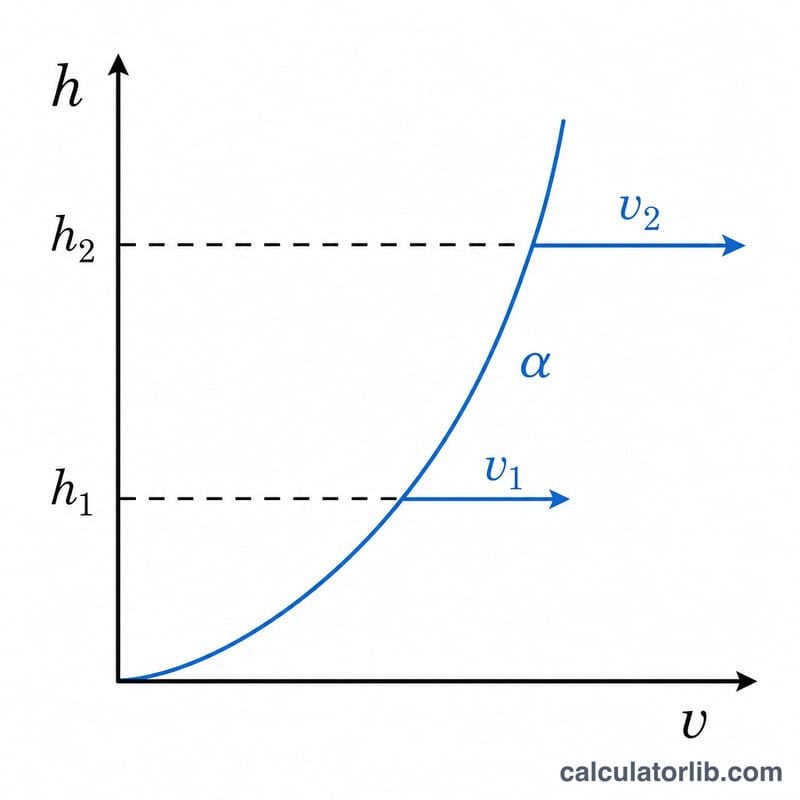
The power law is $$v_2 = v_1 \cdot \left( \frac{h_2}{h_1} \right)^{\alpha}$$ The exponent \(\alpha\) (the Hellmann or wind-shear exponent) captures surface roughness: about 0.10 over open water or ice, 0.143 (the common "1/7 power law") over open terrain, 0.20 for suburbs, and 0.27 or more for woodland and dense cities. The percentage change in speed equals \(\left( h_2/h_1 \right)^{\alpha} - 1\) and does not depend on \(v_1\).
Worked example
Suppose wind is measured at 5 m/s at 10 m over open terrain (\(\alpha = 0.143\)) and you want the speed at 50 m. The ratio is \(50/10 = 5\), and \(5^{0.143} \approx 1.2588\), so $$v_2 \approx 5 \times 1.2588 = 6.29 \text{ m/s}$$ — about 25.88% faster than at the reference height.
FAQ
Is this an exact value? No. The power law is an empirical approximation; actual profiles vary with stability, time of day, and terrain.
What \(\alpha\) should I use? Use 0.143 as a neutral open-terrain default, and increase it for rougher surfaces. Site-specific \(\alpha\) can be derived from two measured heights.
Does it work for extrapolating downward? Yes — set h₂ below h₁ and the result will be a lower wind speed.