
What is the Signal-to-Noise Ratio (SNR)?
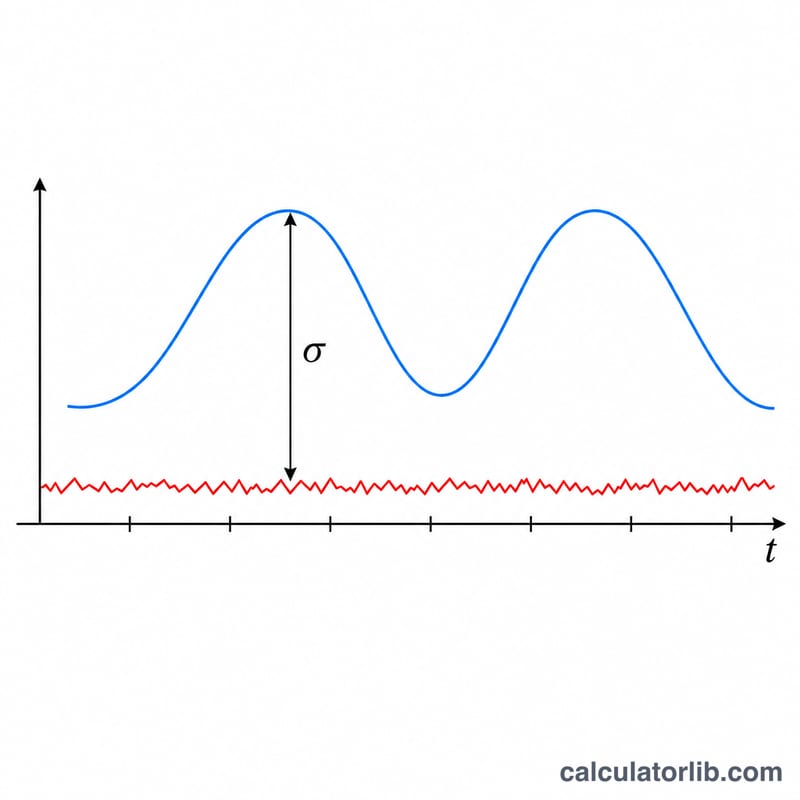
The signal-to-noise ratio compares the level of a desired signal to the level of background noise. It is a fundamental measure of quality in electronics, audio, telecommunications, and imaging. A higher SNR means a cleaner, clearer signal; a low SNR means noise begins to obscure the information you care about. SNR is most often expressed in decibels (dB) because signal and noise levels can span many orders of magnitude.
How to use this calculator
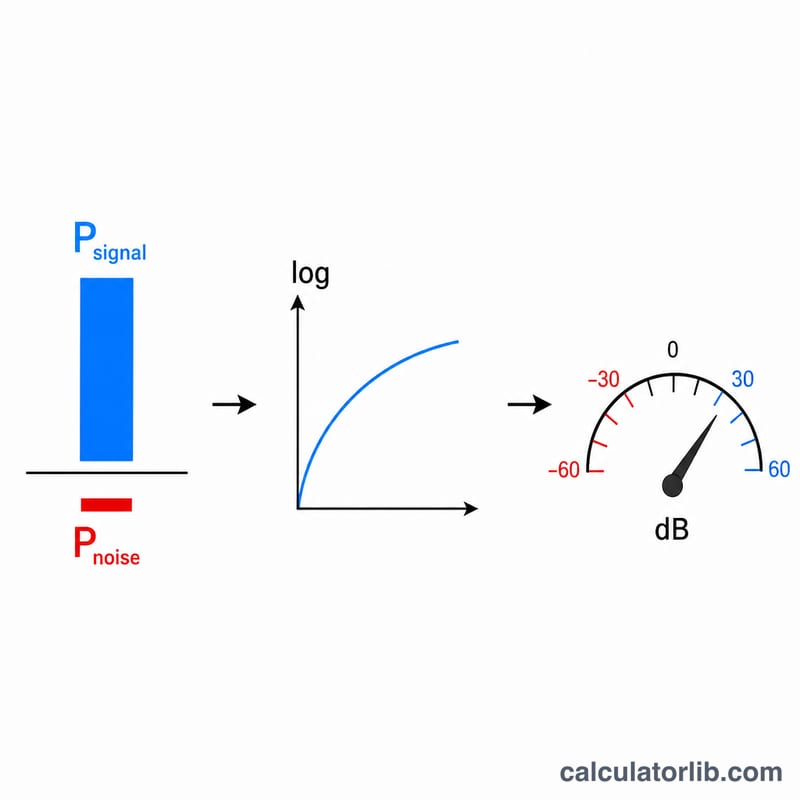
Enter the signal power (\(P_{\text{signal}}\)) and the noise power (\(P_{\text{noise}}\)) in the same units — milliwatts, watts, or any consistent power unit. The calculator divides the two to get the linear power ratio, then converts it to decibels. Both inputs must be positive numbers and the noise power cannot be zero.
The formula explained
The calculation uses $$\text{SNR}_{\text{dB}} = 10 \cdot \log_{10}\!\left(\frac{P_{\text{signal}}}{P_{\text{noise}}}\right)$$ Because decibels are a logarithmic, ratio-based unit, every 10 dB represents a tenfold increase in power. Note the factor of 10 applies to power ratios; if you are working with amplitude or voltage instead, you would use a factor of 20.
Worked example
Suppose the signal power is 100 mW and the noise power is 1 mW. The power ratio is \(100/1 = 100\). Then $$\text{SNR}_{\text{dB}} = 10 \cdot \log_{10}(100) = 10 \cdot 2 = 20\ \text{dB}$$ This indicates a strong, clean signal.
FAQ
What is a good SNR? It depends on the application. For audio, 60+ dB is excellent; for many digital communications, even 10–20 dB can be acceptable with error correction.
Can SNR be negative? Yes. If the noise power exceeds the signal power, the ratio is below 1 and the dB value becomes negative, meaning the signal is buried in noise.
Do I need to use watts? No — any consistent power unit works because SNR is a ratio. Just make sure both inputs use the same unit.