
What is impact energy?
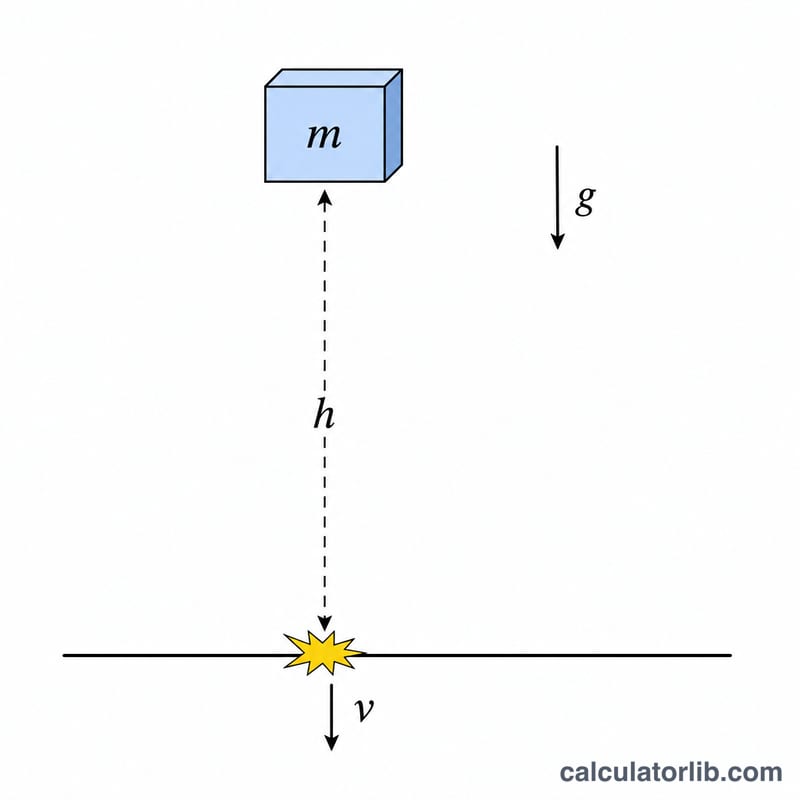
Impact energy is the kinetic energy an object carries at the moment it strikes a surface. For a dropped object this energy comes from gravity: an object held at height h has gravitational potential energy that converts to kinetic energy as it falls. At impact the energy delivered equals \(E = m \cdot g \cdot h\). For something already moving, the energy is its kinetic energy, \(E = \tfrac{1}{2} \cdot m \cdot v^{2}\). Both are measured in joules (J).
How to use this calculator
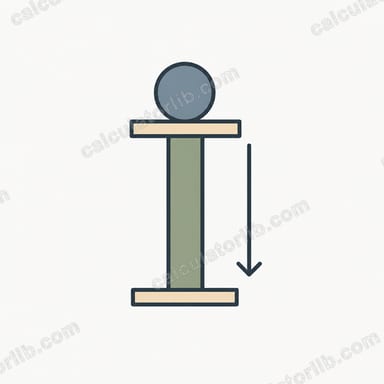
Pick a method. Choose Falling object and enter the mass (kg) and drop height (m); the tool uses \(E = m \cdot g \cdot h\) and also reports the impact speed \(\sqrt{2gh}\). Or choose Moving object and enter mass and speed (m/s) to get \(\tfrac{1}{2}mv^{2}\). You can override gravity (default 9.81 m/s²) for other planets or scenarios.
The formula explained
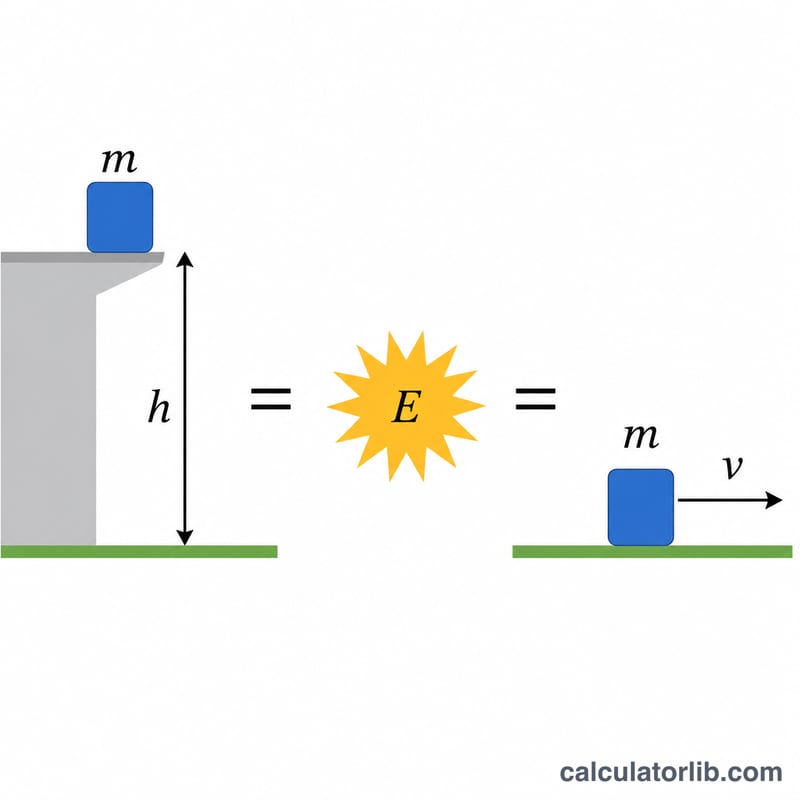
In the falling case, gravitational potential energy \(mgh\) is fully converted to kinetic energy (ignoring air resistance). The object reaches the ground with velocity \(v = \sqrt{2gh}\), at which point its kinetic energy \(\tfrac{1}{2}mv^{2}\) exactly equals \(mgh\). That is why both equations describe the same impact energy.
Worked example
A 10 kg mass dropped from 2 m with g = 9.81 m/s²: $$E = 10 \times 9.81 \times 2 = 196.2 \ \text{J}$$ (0.1962 kJ). It hits the ground at \(\sqrt{2 \times 9.81 \times 2} \approx 6.26\) m/s.
FAQ
Does air resistance matter? For dense, compact objects over short drops it is negligible; for light or fast objects, real impact energy is lower than \(mgh\) predicts.
What units does it use? SI units: mass in kilograms, height in metres, speed in metres per second, energy in joules.
Why are both formulas the same? Energy is conserved during a free fall, so potential energy at the top equals kinetic energy at the bottom.