
What is the Car Crash Calculator?
This calculator estimates the average force experienced during a vehicle collision. It uses the work–energy principle: the kinetic energy of a moving car must be absorbed over the distance the vehicle (or occupant) takes to stop. A shorter stopping distance means a far larger force — which is exactly why crumple zones, airbags and seatbelts are designed to extend that distance.
How to use it
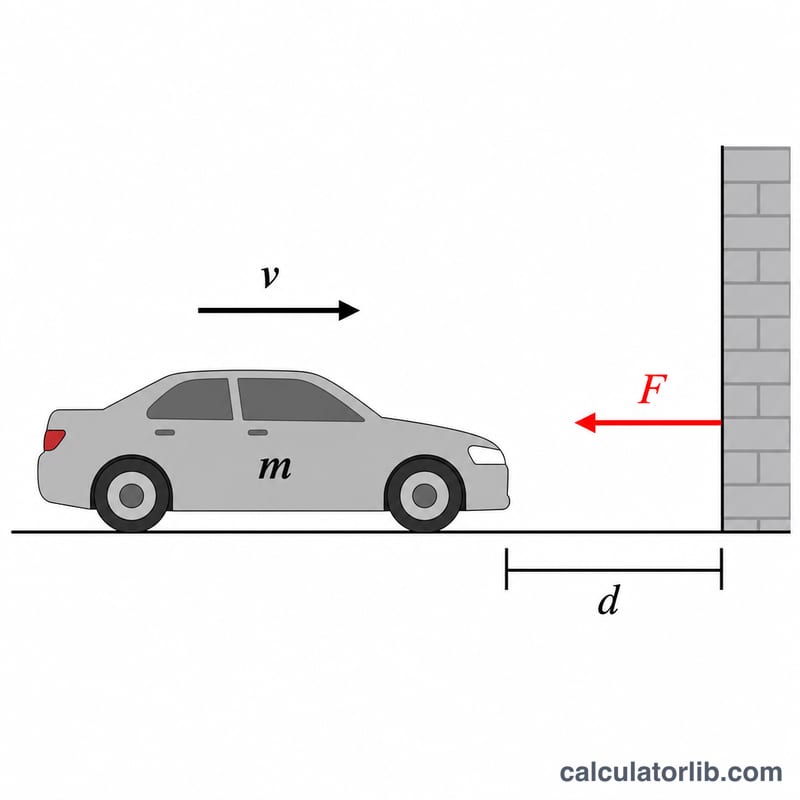
Enter three values: the mass of the vehicle (or occupant) in kilograms, the impact speed in metres per second, and the stopping distance in metres — the distance over which the object decelerates to rest (for example, the depth of crumple or the give of a barrier). The tool returns the average impact force in newtons, the kinetic energy, the deceleration, and the equivalent g-force.
The formula explained
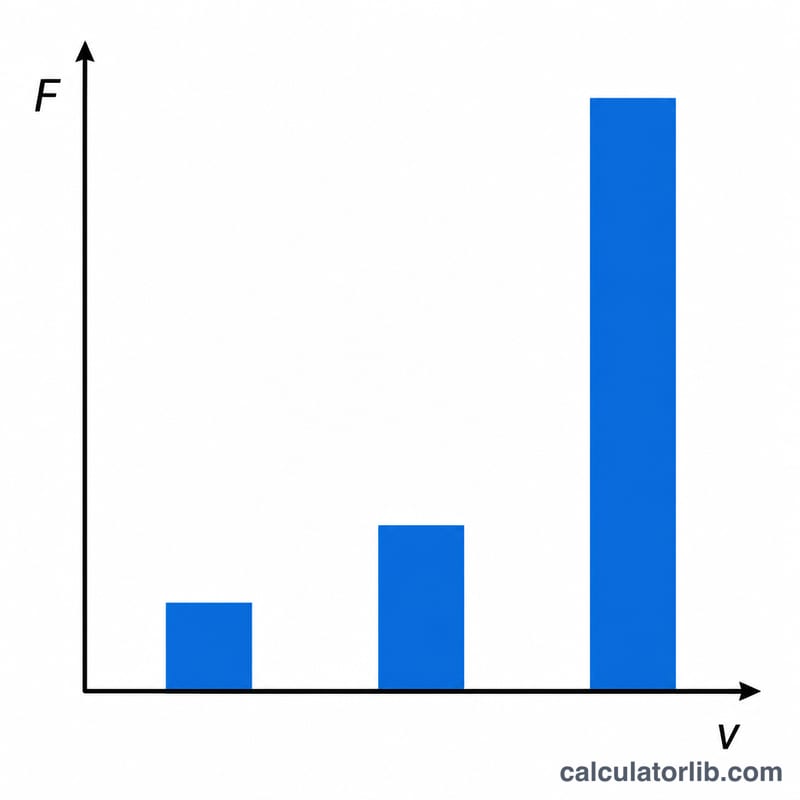
The kinetic energy of the moving body is \(E = \tfrac{1}{2}\,m \cdot v^{2}\). If that energy is dissipated uniformly over a stopping distance \(d\), the average force is $$F = \frac{E}{d} = \frac{m \cdot v^{2}}{2 \cdot d}.$$ Deceleration follows from \(a = \dfrac{v^{2}}{2 \cdot d}\), and g-force is \(F\) divided by the body's weight (\(m \cdot g\), with \(g \approx 9.81\ \text{m/s}^{2}\)).
Worked example
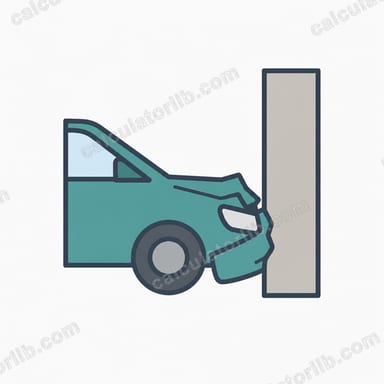
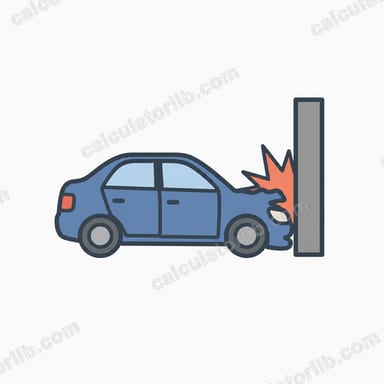
A 1000 kg car hits a wall at 20 m/s (72 km/h) and crumples over 1 m. $$F = \frac{1000 \times 20^{2}}{2 \times 1} = \frac{400000}{2} = \mathbf{200{,}000\ \text{N}}.$$ The kinetic energy is \(\tfrac{1}{2} \times 1000 \times 400 = 200{,}000\ \text{J}\), the deceleration is \(\tfrac{400}{2} = 200\ \text{m/s}^{2}\), and the g-force is \(\dfrac{200000}{1000 \times 9.81} \approx 20.4\ \text{g}\).
FAQ
Is this an exact crash force? No. It is an idealised average assuming constant deceleration; real impacts have peaks much higher than the average.
How do I convert km/h to m/s? Divide by 3.6 (e.g. 72 km/h ÷ 3.6 = 20 m/s).
Why does stopping distance matter so much? Force is inversely proportional to distance — doubling the crumple distance halves the force, which is the core safety principle behind crumple zones.