
What Is Newton's Second Law?
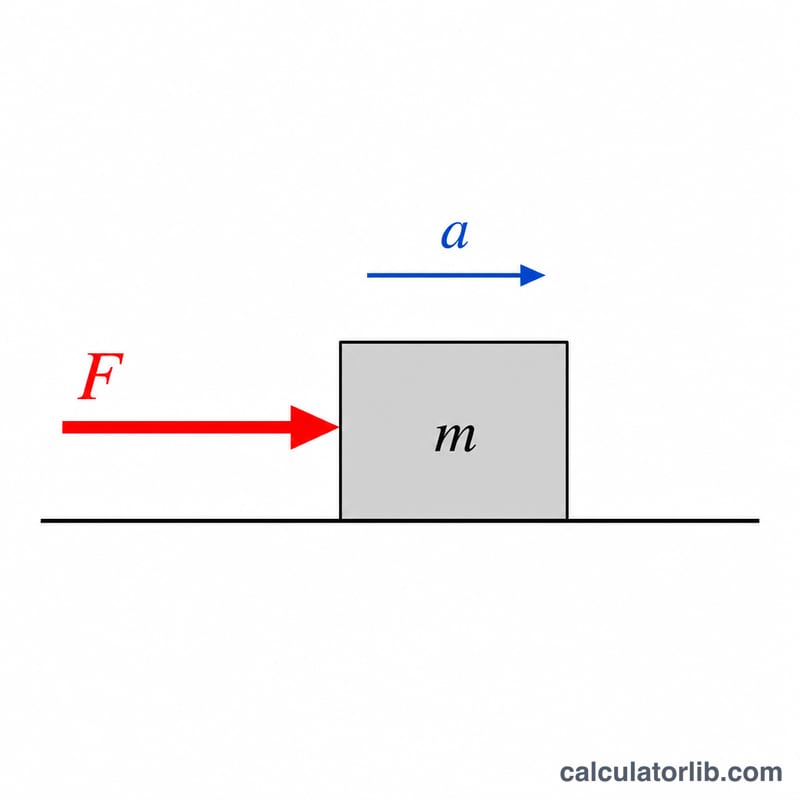
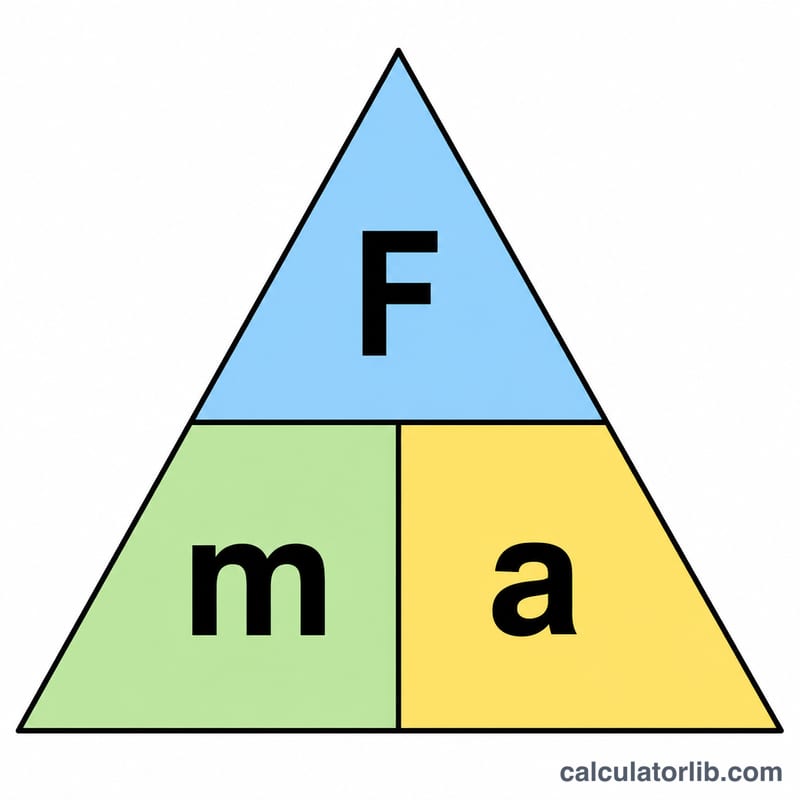
Newton's Second Law of Motion states that the net force acting on an object equals the product of its mass and its acceleration: \(F = m \cdot a\). It is one of the most fundamental relationships in classical mechanics and is universal — it applies anywhere in the universe with no country-specific assumptions. This calculator gives you the force (in newtons) produced when a given mass accelerates at a given rate.
How to Use This Calculator
Enter the object's mass in kilograms (kg) and its acceleration in meters per second squared (m/s²). The calculator multiplies the two values and returns the net force in newtons (N), where \(1\ \text{N} = 1\ \text{kg}\cdot\text{m/s}^2\). Use the standard gravity value 9.81 m/s² for acceleration if you want to find an object's weight.
The Formula Explained
The equation $$F = m \cdot a$$ links three quantities. Force (\(F\)) is measured in newtons, mass (\(m\)) in kilograms, and acceleration (\(a\)) in meters per second squared. Because force scales linearly with both inputs, doubling the mass or doubling the acceleration doubles the resulting force. You can rearrange the formula to solve for acceleration (\(a = F / m\)) or for mass (\(m = F / a\)).
Worked Example
Suppose a 1,500 kg car accelerates at 3 m/s². The net force required is $$F = 1{,}500 \times 3 = 4{,}500\ \text{N}.$$ That is the force the engine and tires must supply (ignoring friction and drag) to achieve that acceleration.
FAQ
What unit is force measured in? The SI unit of force is the newton (N), equal to \(\text{kg}\cdot\text{m/s}^2\).
Can I calculate weight with this? Yes. Weight is a force: enter the mass and use 9.81 m/s² for acceleration to get the object's weight on Earth.
Does this account for friction? No. \(F = m \cdot a\) gives the net force. To find applied force you must add forces lost to friction, drag, or other resistances.