
What Is Newton's Law of Cooling?
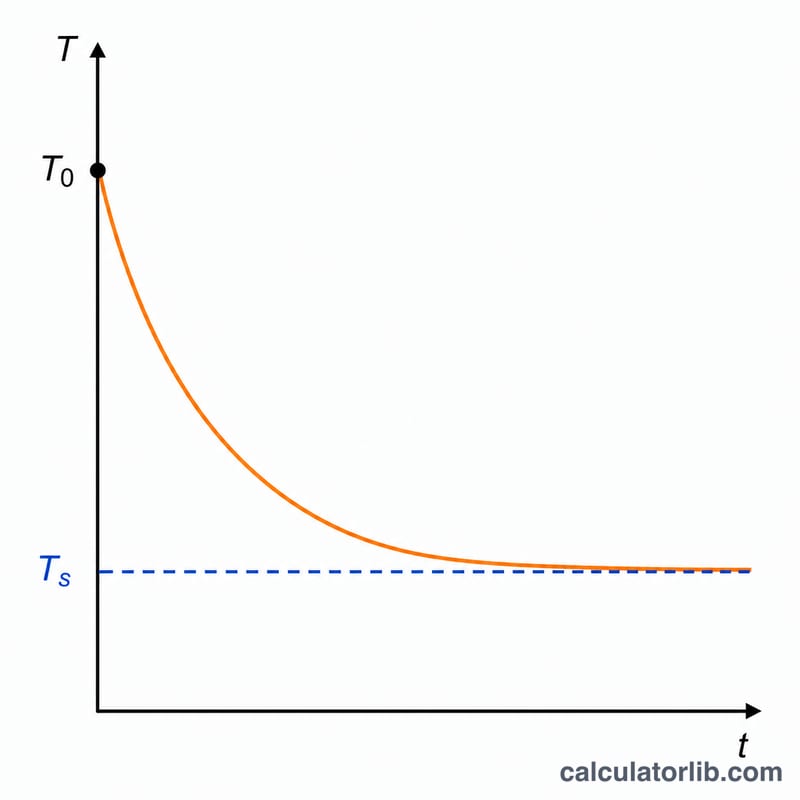
Newton's Law of Cooling describes how the temperature of an object changes as it exchanges heat with its surroundings. It states that the rate of temperature change is proportional to the difference between the object's temperature and the ambient (surrounding) temperature. As that difference shrinks, the object cools (or warms) more slowly, approaching the surrounding temperature asymptotically.
The Formula
The solution to the cooling differential equation is:
$$T(t) = T_s + \left(T_0 - T_s\right) \cdot e^{-kt}$$
where T(t) is the temperature at time t, Ts is the surrounding temperature, T0 is the initial temperature, and \(k\) is the cooling constant (units of 1/time) that depends on the object and its environment. Larger values of \(k\) mean faster cooling.
How to Use This Calculator
Enter the surrounding temperature, the object's initial temperature, the cooling constant \(k\), and the elapsed time \(t\). The calculator returns the predicted temperature at that time, along with how far it remains above (or below) the surroundings. Keep your temperature and time units consistent — for example, k in 1/minutes paired with t in minutes.
Worked Example
A cup of coffee at 100° sits in a 25° room with k = 0.1 per minute. After 10 minutes: $$T = 25 + (100 - 25)\cdot e^{-0.1\cdot 10} = 25 + 75\cdot e^{-1} = 25 + 75\cdot 0.367879 \approx 52.59°.$$ So the coffee has cooled to about 52.6°, still roughly 27.6° above room temperature.
FAQ
What is the cooling constant k? It is an empirical constant capturing how quickly heat is lost, depending on surface area, material, and heat transfer conditions. You can estimate it from two measured temperatures.
Does it work for heating too? Yes. If T0 is below Ts, the same equation predicts the object warming toward the surroundings.
Why does the object never quite reach room temperature? The exponential term approaches zero but never equals it, so mathematically the temperature asymptotically nears Ts.