
What Is the Nusselt Number?
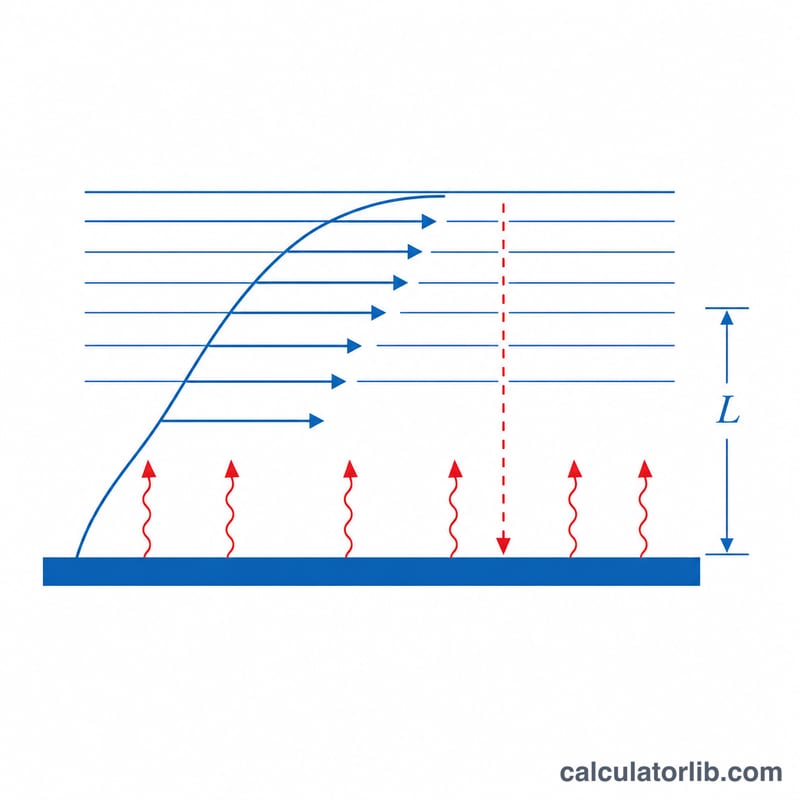
The Nusselt number (Nu) is a dimensionless quantity in heat transfer that measures the ratio of convective to purely conductive heat transfer across a fluid boundary layer. A value of \(\text{Nu} = 1\) indicates heat transfer by pure conduction (typical of stagnant fluid), while larger values indicate increasingly effective convection. It is named after German engineer Wilhelm Nusselt and is central to designing heat exchangers, electronics cooling, and HVAC systems.
How to Use This Calculator
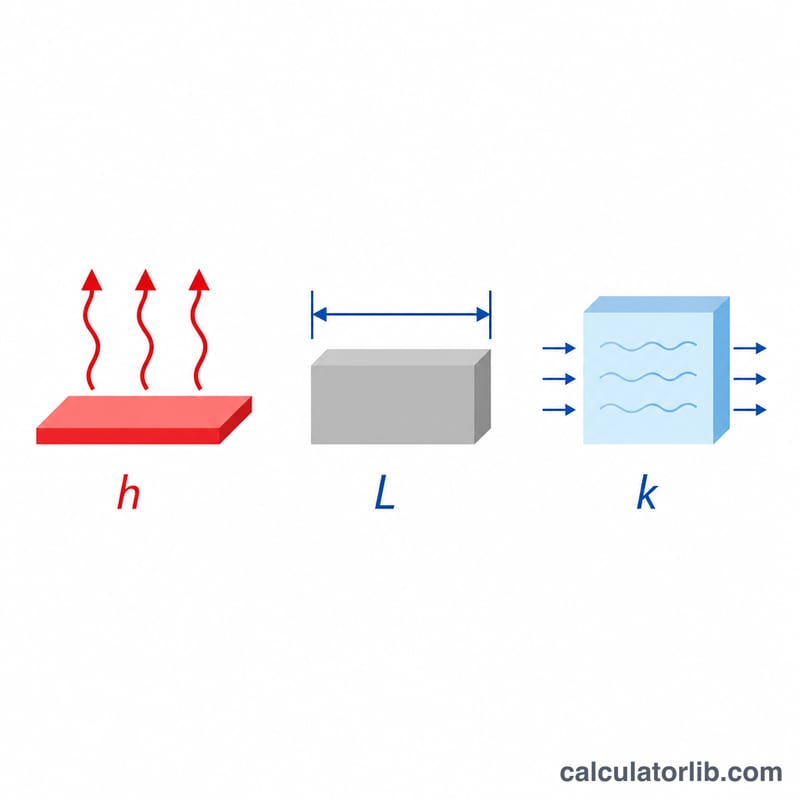
Enter the three inputs: the convective heat transfer coefficient h (W/m²·K), the characteristic length L (m) — often a diameter, plate length, or hydraulic diameter — and the fluid thermal conductivity k (W/m·K). The calculator instantly returns the dimensionless Nusselt number.
The Formula Explained
The defining equation is:
$$\text{Nu} = \frac{\text{h} \cdot \text{L}}{\text{k}}$$
Here h represents how readily heat moves between a surface and the moving fluid, L sets the relevant geometric scale, and k is the fluid's ability to conduct heat. Because the three units combine to cancel, the result is dimensionless, allowing comparison across geometries and fluids.
Worked Example
Suppose water flows over a surface with \(h = 500 \ \text{W/m}^2\cdot\text{K}\), a characteristic length \(L = 0.05 \ \text{m}\), and water's thermal conductivity \(k = 0.6 \ \text{W/m}\cdot\text{K}\). Then $$\text{Nu} = \frac{500 \times 0.05}{0.6} = \frac{25}{0.6} \approx 41.67.$$ This relatively large Nusselt number confirms convection dominates conduction in this scenario.
FAQ
Is the Nusselt number always greater than 1? For convective situations, yes — \(\text{Nu} \geq 1\), approaching 1 as convection weakens toward pure conduction.
What is the characteristic length? It depends on geometry: pipe diameter for internal flow, plate length for flat plates, or hydraulic diameter for non-circular ducts.
How does Nu relate to Reynolds and Prandtl numbers? Empirical correlations such as \(\text{Nu} = 0.023 \cdot \text{Re}^{0.8} \cdot \text{Pr}^{0.4}\) (Dittus-Boelter) often predict Nu, which then yields h via this same \(h = \frac{\text{Nu} \cdot k}{L}\) relationship.