
What Is Specific Heat?
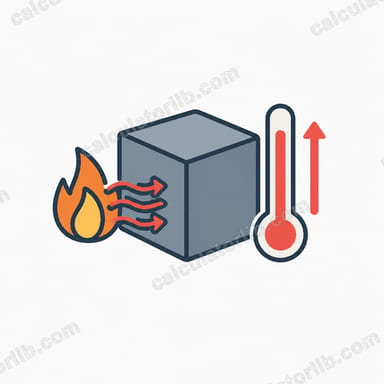
Specific heat capacity (c) is the amount of heat energy required to raise the temperature of one gram of a substance by one degree Celsius. It is a fundamental thermodynamic property that explains why water heats up slowly while metals heat quickly. This universal calculator uses the relationship between heat energy, mass, and temperature change to find c.
How to Use This Calculator
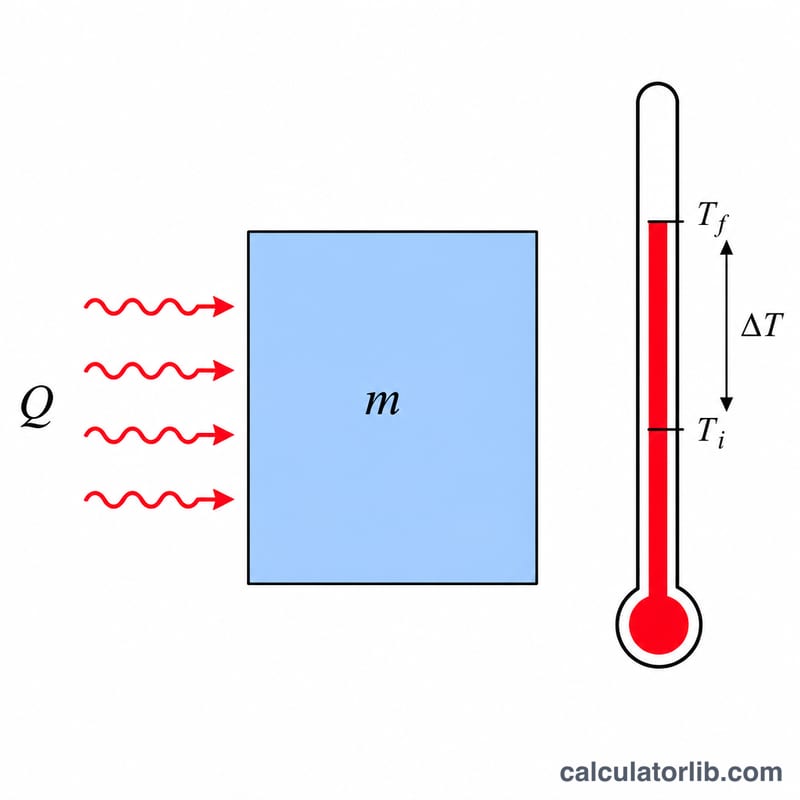
Enter three values: the heat energy Q (in joules), the mass m (in grams), and the temperature change ΔT (in degrees Celsius). The calculator divides the heat energy by the product of mass and temperature change to return the specific heat in J/(g·°C). Make sure ΔT and m are non-zero to avoid an undefined result.
The Formula Explained
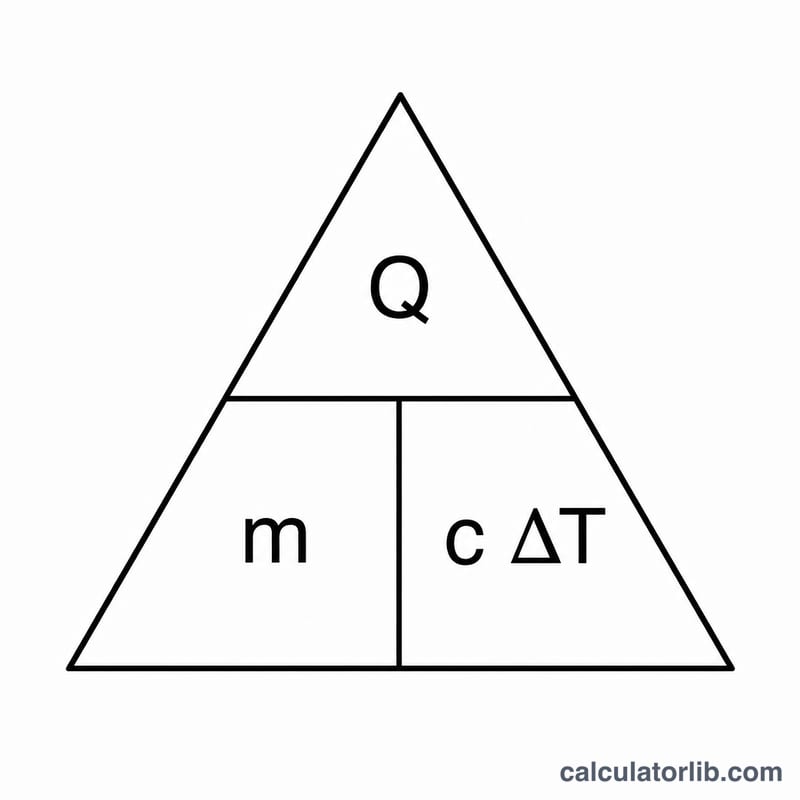
The governing equation is $$c = \frac{\text{Heat Energy } Q\text{ (J)}}{\text{Mass } m\text{ (g)} \times \Delta T\text{ (°C)}}$$. It comes from rearranging the heat transfer equation \(Q = m\cdot c\cdot \Delta T\). Here \(Q\) is the energy added or removed, \(m\) is the mass being heated, and \(\Delta T\) is the resulting change in temperature (final minus initial). A small \(c\) means a substance changes temperature easily; a large \(c\) means it resists temperature change.
Worked Example
Suppose 4,180 J of heat is added to 100 g of water and the temperature rises by 10 °C. Then $$c = \frac{4{,}180}{100 \times 10} = \frac{4{,}180}{1{,}000} = 4.18 {\text{ J/(g}\cdot\text{°C)}}$$, which is the well-known specific heat of liquid water.
FAQ
What units does this use? Heat in joules, mass in grams, temperature in °C, giving c in J/(g·°C). Because ΔT in Celsius equals ΔT in Kelvin, the value is identical in J/(g·K).
Can ΔT be negative? If heat is released the change is negative; using the magnitudes (positive Q with positive ΔT) gives the standard positive specific heat.
Why can't mass or ΔT be zero? Dividing by zero is undefined, so the calculator requires non-zero mass and temperature change.