
What Is Latent Heat?
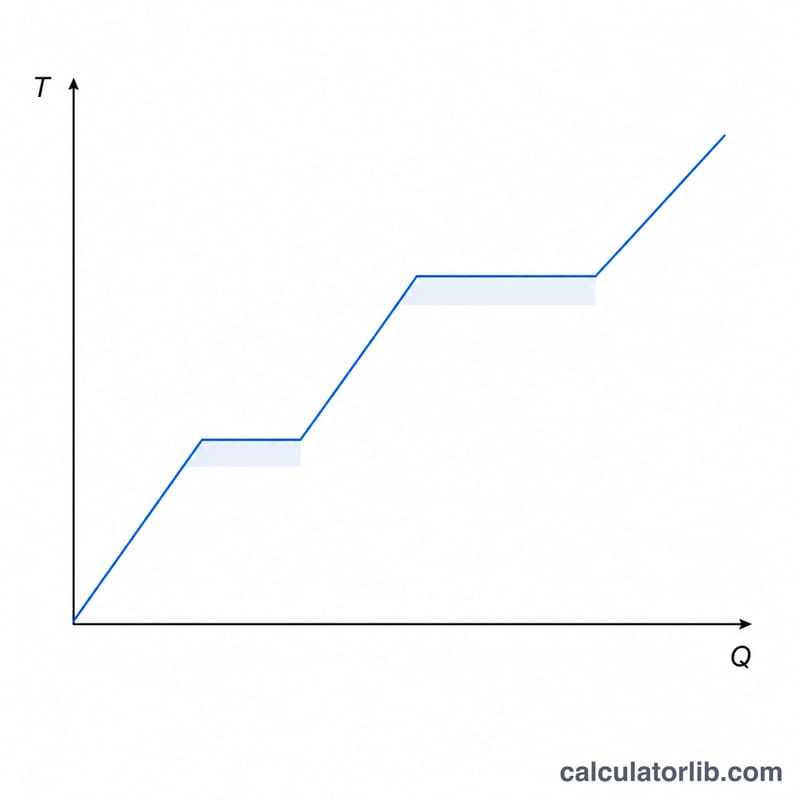
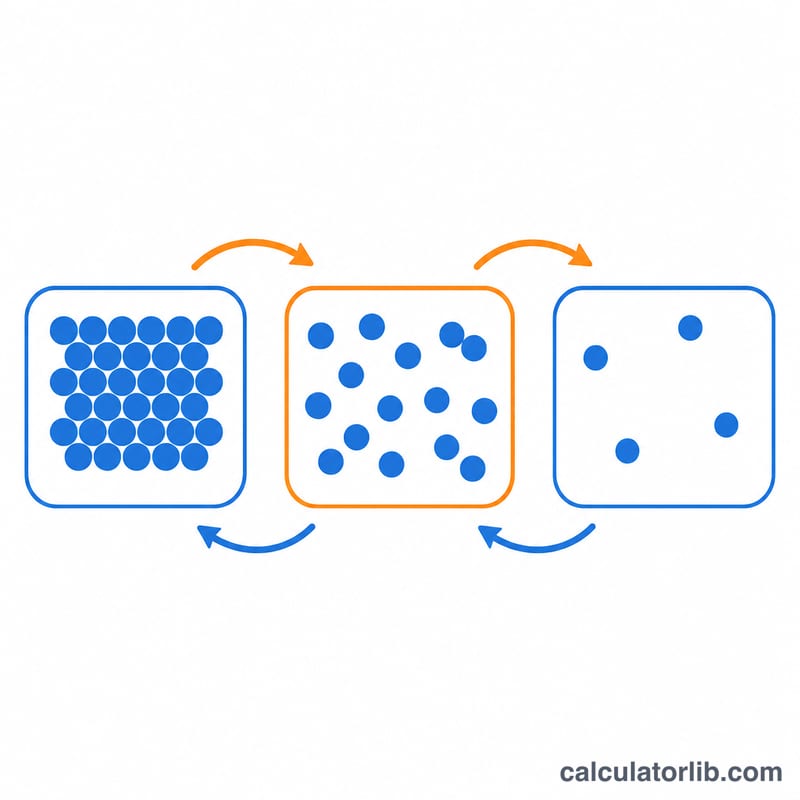
Latent heat is the energy absorbed or released by a substance during a phase change — such as melting, freezing, boiling, or condensation — while its temperature stays constant. Unlike sensible heat (which changes temperature), latent heat goes entirely into rearranging the molecular bonds of the material. This calculator uses the simple relationship \(Q = m \times L\) to find the total energy involved.
How to Use This Calculator
Enter the mass of the substance in kilograms and its specific latent heat in joules per kilogram (J/kg). The calculator multiplies the two to give the total heat energy Q in joules, and also converts it to kilojoules for convenience. Use the latent heat of fusion when dealing with melting/freezing and the latent heat of vaporization for boiling/condensing.
The Formula Explained
The equation is $$Q = m \times L$$ where Q is the heat energy in joules (J), m is mass in kilograms (kg), and L is the specific latent heat in J/kg. Common reference values include the latent heat of fusion of water (≈ 334,000 J/kg) and the latent heat of vaporization of water (≈ 2,260,000 J/kg).
Worked Example
How much energy is needed to melt 2 kg of ice at 0 °C? Using L = 334,000 J/kg: $$Q = 2 \times 334{,}000 = 668{,}000 \text{ J}$$ or 668 kJ. That is the energy required to break the bonds holding the ice in its solid state, with no temperature increase.
FAQ
What's the difference between latent and sensible heat? Latent heat changes the phase at constant temperature; sensible heat changes the temperature without a phase change.
What units should I use? Mass in kilograms and specific latent heat in J/kg give the answer in joules. Multiply by 1000 if your L value is in kJ/kg.
Does this work for any substance? Yes — just supply the correct specific latent heat (fusion or vaporization) for your material.