
What Is Heat Loss?
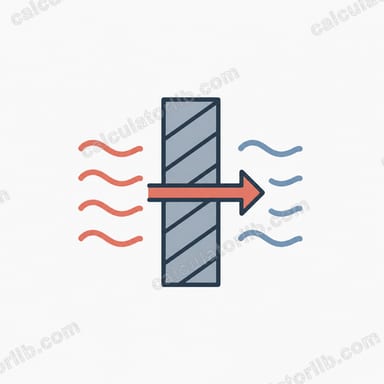
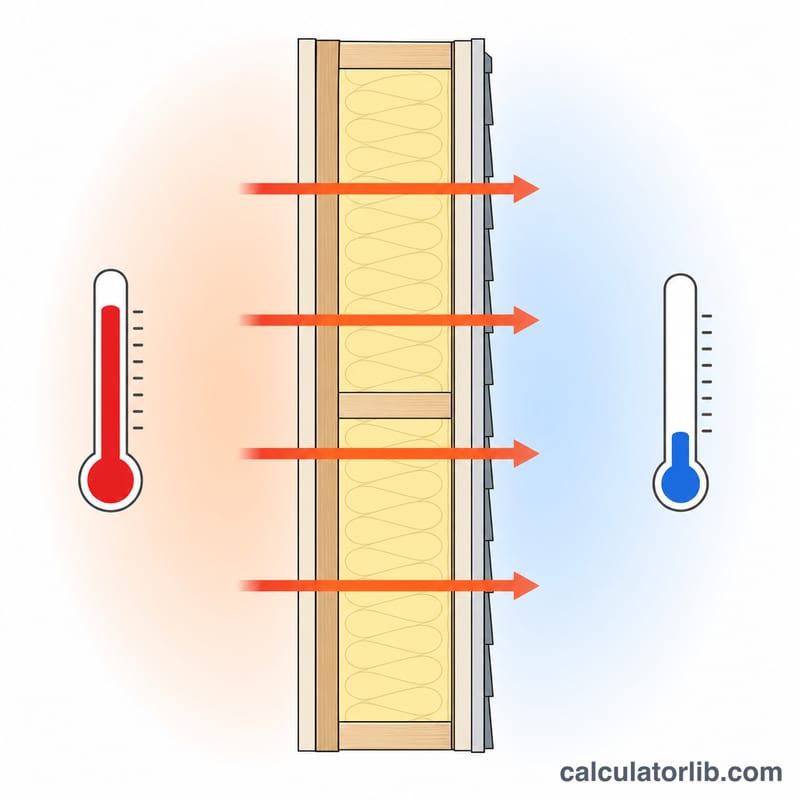
Heat loss is the rate at which thermal energy passes through a building element — a wall, roof, floor or window — from the warmer side to the colder side. This calculator estimates conductive heat loss using the classic fabric heat-transfer equation. It is a universal physics/engineering tool and applies anywhere; just use consistent metric units (SI).
How to Use It
Enter the surface area of the element in square metres, its U-value in W/m²·K (a lower U-value means better insulation), and the inside and outside temperatures in degrees Celsius. The calculator returns the heat loss rate in watts, the temperature difference (\(\Delta T\)), and the energy that would be lost over 24 hours in kilowatt-hours.
The Formula Explained
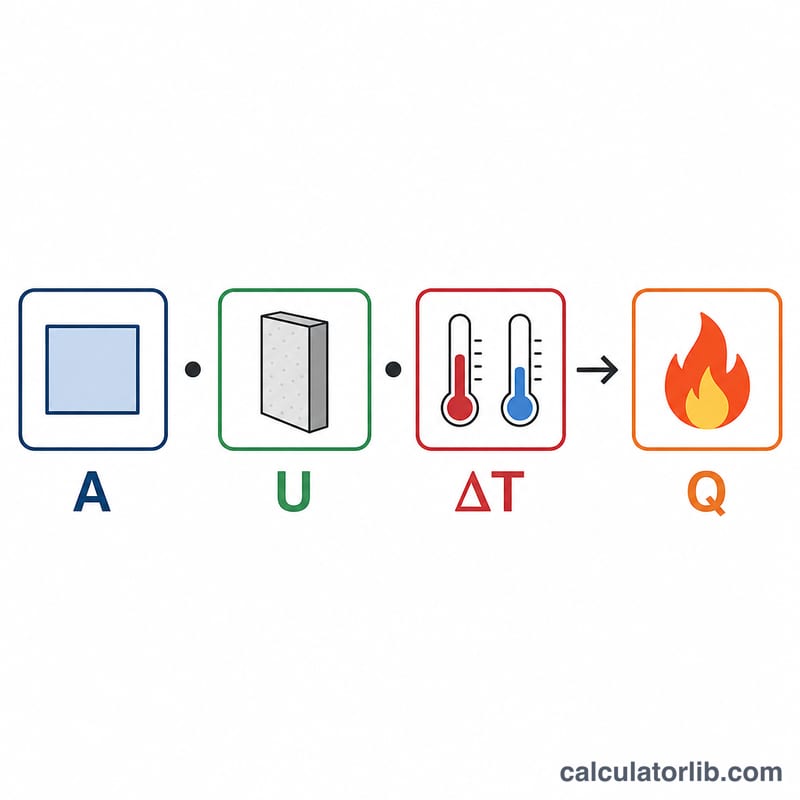
The governing equation is $$Q = A \times U \times \Delta T$$ where \(Q\) is heat loss (W), \(A\) is area (m²), \(U\) is the thermal transmittance (W/m²·K), and \(\Delta T\) is the temperature difference between inside and outside (K, which equals the difference in °C). Daily energy is $$E = \frac{Q \times 24}{1000} \text{ kWh}$$
Worked Example
A wall of 10 m² with a U-value of 0.3 W/m²·K, inside 20 °C and outside 0 °C: \(\Delta T = 20\ \text{K}\). $$Q = 10 \times 0.3 \times 20 = 60 \text{ W}$$ Over a day that is $$\frac{60 \times 24}{1000} = 1.44 \text{ kWh}$$
FAQ
What is a good U-value? Modern insulated walls aim for around 0.2–0.3 W/m²·K; older single-glazed windows can exceed 5.
Why is K used instead of °C? A temperature difference of 1 K equals a difference of 1 °C, so either gives the same result.
Does this include ventilation or air infiltration? No — this covers conductive fabric loss only. Total building heat loss also includes ventilation losses.