
What Is Sensible Heat?
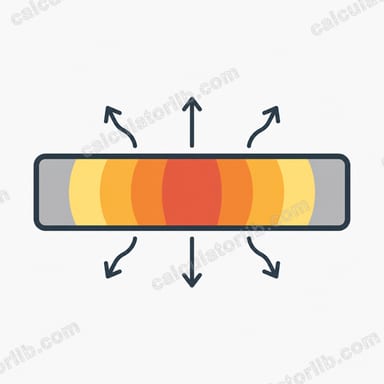
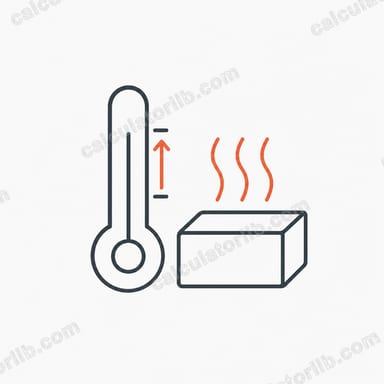
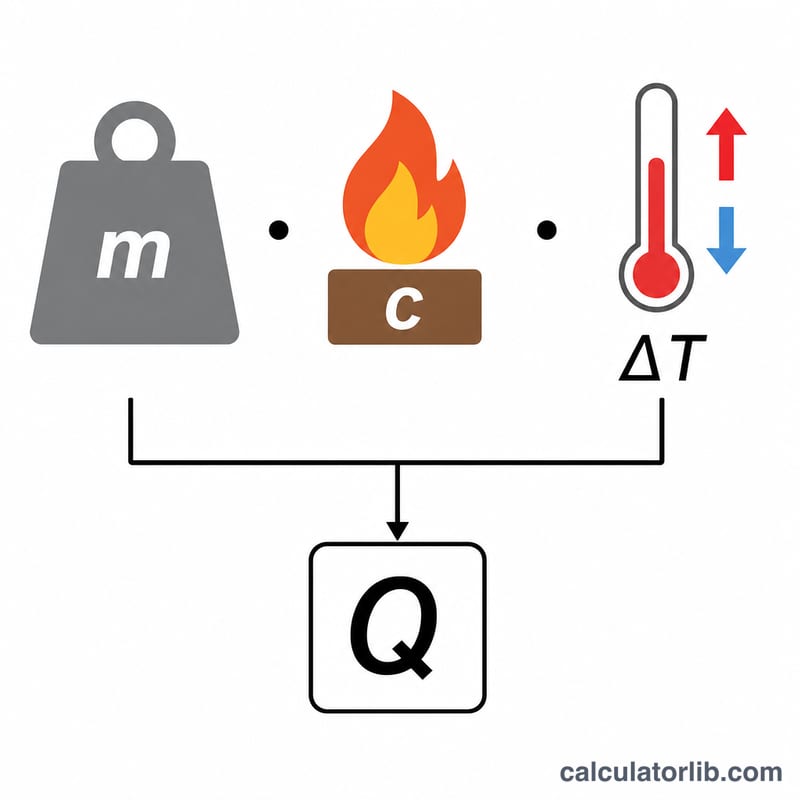
Sensible heat is the energy added to or removed from a substance that produces a measurable change in temperature, without any change of phase (no melting, boiling, or freezing). It is "sensible" because you can sense the change with a thermometer. This calculator uses the fundamental relationship \(Q = m \times c \times \Delta T\) to find the energy involved.
How to Use the Calculator
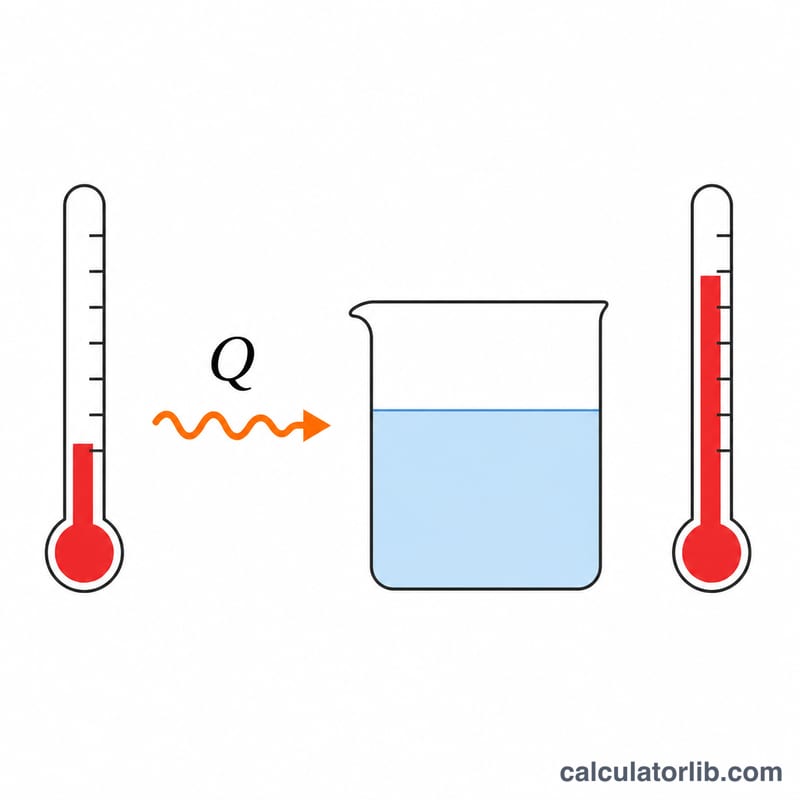
Enter the mass of the substance in kilograms, its specific heat capacity (c) in joules per kilogram per kelvin, and the initial and final temperatures in degrees Celsius. The calculator computes the temperature change (\(\Delta T = T_2 - T_1\)) and returns the sensible heat in joules and kilojoules. A positive result means heat is absorbed; a negative result means heat is released as the substance cools.
The Formula Explained
In $$Q = m \cdot c \cdot \Delta T$$, \(Q\) is heat energy (J), \(m\) is mass (kg), \(c\) is specific heat capacity (J/kg\(\cdot\)K), and \(\Delta T\) is the temperature difference (K or °C, since a 1 °C interval equals a 1 K interval). Specific heat tells you how much energy one kilogram needs to warm by one degree. Water has a high specific heat of about 4186 J/kg\(\cdot\)K, which is why it heats and cools slowly.
Worked Example
Heat 2 kg of water (\(c = 4186\) J/kg\(\cdot\)K) from 25 °C to 75 °C. \(\Delta T = 75 - 25 = 50\) °C. Then $$Q = 2 \times 4186 \times 50 = 418{,}600 \text{ J},$$ or 418.6 kJ. That's the sensible heat required.
FAQ
What's the difference between sensible and latent heat? Sensible heat changes temperature; latent heat drives a phase change (like boiling) at constant temperature.
What units should I use? Use kilograms for mass and J/kg\(\cdot\)K for specific heat to get joules. \(\Delta T\) can be in °C or K — the size of one degree is identical.
Can the result be negative? Yes. If the final temperature is lower than the initial, \(\Delta T\) is negative and \(Q\) represents heat removed (cooling).