
What Is Root Mean Square Velocity?
The root mean square (RMS) velocity is a measure of the typical speed of molecules in an ideal gas. Because gas molecules move in random directions with a wide range of speeds, we use the square root of the average of the squared speeds to characterize them. This calculator works for any gas in any system of units that follows SI — it is a universal physics tool.

How to Use This Calculator
Enter the absolute temperature of the gas in kelvin (K) and the molar mass of the gas in grams per mole (g/mol). The calculator converts the molar mass to kilograms per mole, applies the kinetic theory formula, and returns the RMS velocity in meters per second (and km/h for convenience).
The Formula Explained
The kinetic theory of gases gives:
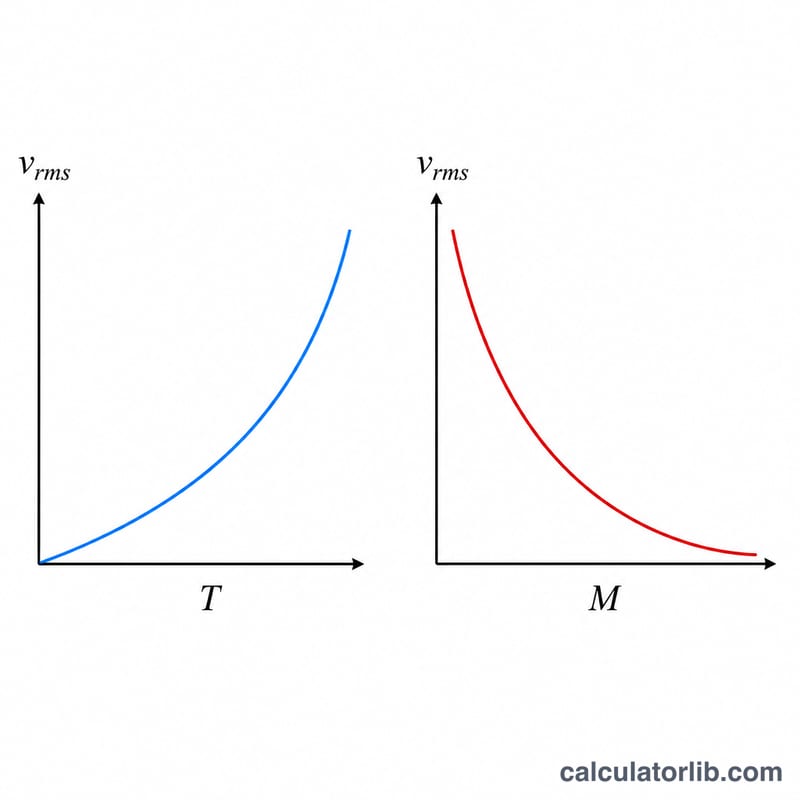
$$v_{rms} = \sqrt{\dfrac{3 \cdot R \cdot T}{M}}$$
where R = 8.314462618 J/(mol·K) is the universal gas constant, T is the absolute temperature in kelvin, and M is the molar mass in kilograms per mole. Note that molar mass entered in g/mol is divided by 1000 to obtain kg/mol, ensuring the result comes out in m/s.
Worked Example
Consider nitrogen gas (N₂, molar mass 28 g/mol) at room temperature, 298.15 K. Convert M to 0.028 kg/mol. Then $$v_{rms} = \sqrt{\frac{3 \times 8.314 \times 298.15}{0.028}} = \sqrt{265{,}651} \approx 515.4 \text{ m/s}.$$ Nitrogen molecules zip around at over 500 meters per second.
FAQ
Why do I enter temperature in kelvin? The kinetic energy of gas is proportional to absolute temperature, so kelvin must be used. Convert from Celsius by adding 273.15.
How does RMS speed differ from average speed? RMS velocity is slightly higher than the mean speed because squaring emphasizes faster molecules. For an ideal gas, \(v_{rms} = \sqrt{3RT/M}\) while the mean speed is \(\sqrt{8RT/\pi M}\).
What if I have molar mass in kg/mol? Multiply by 1000 before entering, since this tool expects g/mol.