
What this calculator does
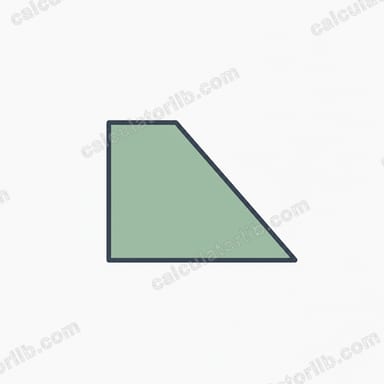
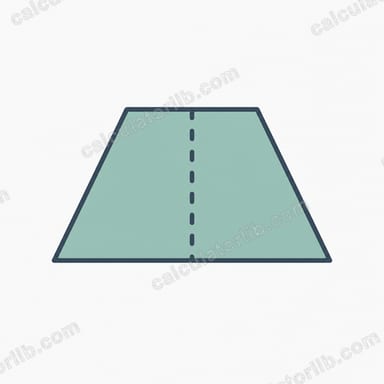
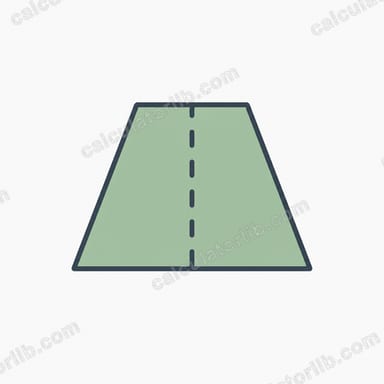
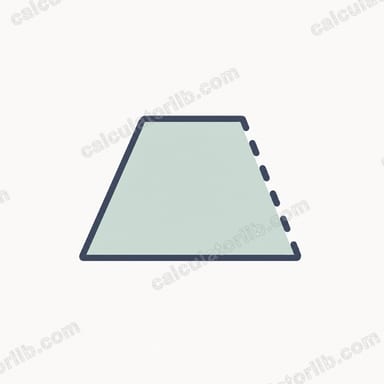
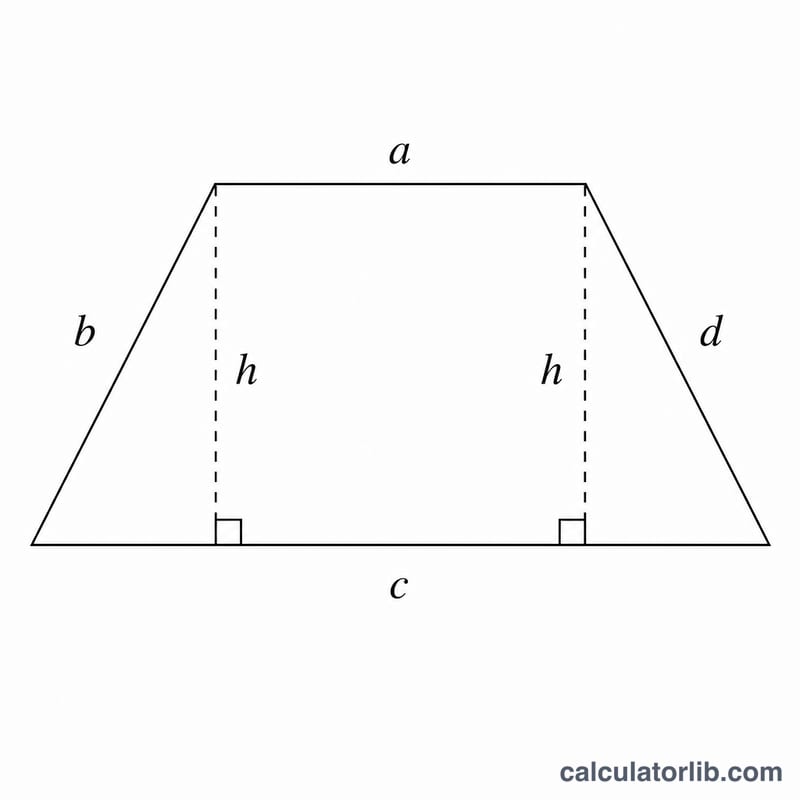
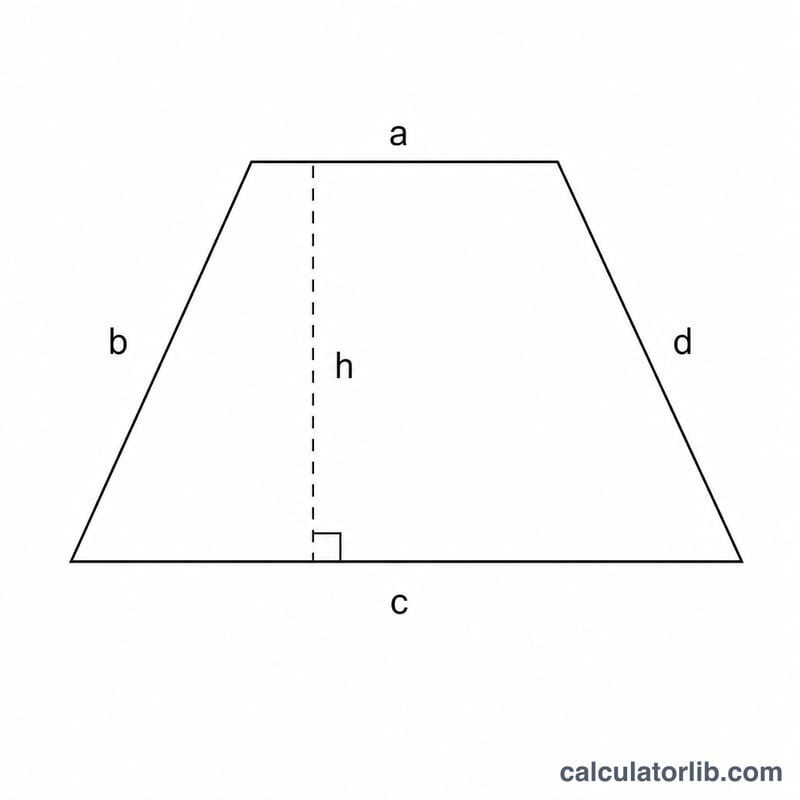
A trapezoid has two parallel sides - the upper base a and the lower base c - separated by a perpendicular height h, plus two slanting legs b and d. This tool solves for the one side you do not know, given three of the four sides and the height, and it also reports the trapezoid's area. It is a universal geometry tool: every length is in the same arbitrary unit, and the area comes out in that unit squared.
How to use it
Pick a mode. In Find the upper or lower base, enter one known base, both slant legs b and d, and the height; the tool returns the other base and the area. In Find a slant leg, enter both bases a and c, one known leg, and the height; the tool returns the other leg and the area. Enter the height first - it is required in both modes and must be greater than zero.
The formula explained
Each slant leg of length s spans a horizontal distance \(\text{run}(s) = \sqrt{s^{2} - h^{2}}\). The bases close the figure so that \(c = a + \text{run}(b) + \text{run}(d)\). To find a missing leg, the remaining horizontal run is \(R = (c - a) - \text{run}(\text{known leg})\), and the missing leg is \(\sqrt{R^{2} + h^{2}}\). The area is always \(\frac{a + c}{2}\cdot h\) once both bases are known.
Worked example
With h = 8, known base a = 9, legs b = 17 and d = 10: \(\text{run}(b) = \sqrt{289 - 64} = 15\), \(\text{run}(d) = \sqrt{100 - 64} = 6\), so the other base $$c = 9 + 15 + 6 = 30.$$ Area $$= \frac{9 + 30}{2}\cdot 8 = 156.$$
FAQ
Why must each leg be at least as long as the height? A leg shorter than the perpendicular height cannot reach across it, so \(\sqrt{\text{leg}^{2} - h^{2}}\) would not be real. If a leg equals h exactly, it is vertical and contributes zero horizontal run (a right-angle trapezoid).
Does the area depend on leg orientation? No. As long as h is the true perpendicular distance between the parallel bases, the area is \(\frac{a + c}{2}\cdot h\) regardless of how the legs slant.
What if the geometry is impossible? If the remaining horizontal run comes out negative in leg mode, the chosen bases, leg and height cannot form a trapezoid, and the tool reports an error.