
What this calculator does
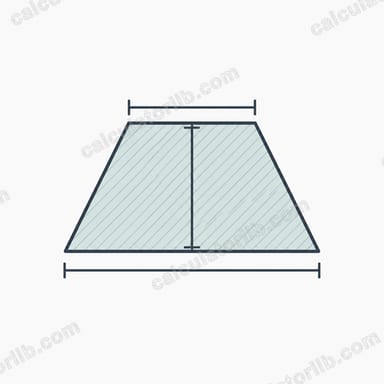
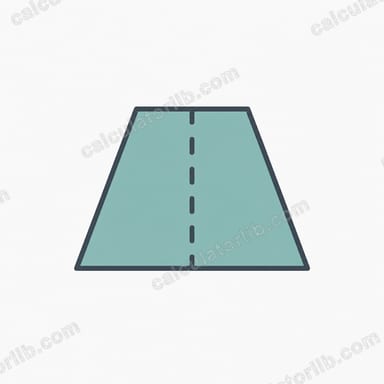
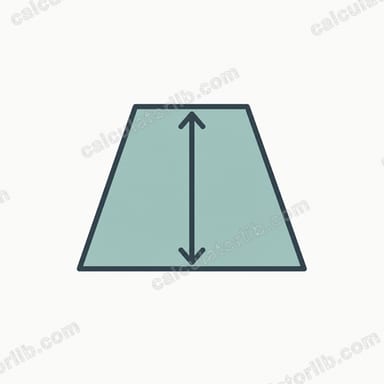
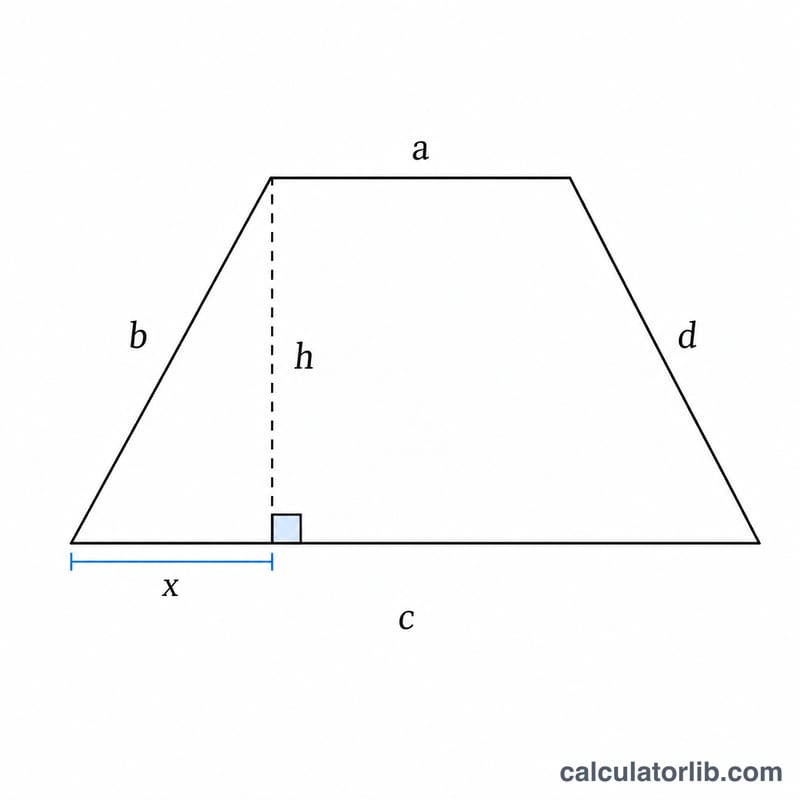
This tool finds the perpendicular height (h) and the area (S) of a trapezoid when you know all four of its side lengths: the two parallel sides (a, the top base; c, the bottom base) and the two slanted legs (b and d). It is pure plane geometry and works identically anywhere — just keep every length in the same unit, and the area comes out in that unit squared.
How to use it
Enter the top base a, the bottom base c, and the two legs b and d. Press calculate. The calculator returns the height between the parallel sides and the total area. The result does not depend on which leg you call b and which you call d — swapping them gives the same answer.
The formula explained
Slide the two legs together at the side. The horizontal "overhang" of the longer base beyond the shorter one has total width \(p = |c - a|\). Together with the two legs b and d, this width forms a triangle. Dropping the altitude of that triangle gives the trapezoid's height.
Let x be the horizontal projection of leg d. Then \(d^2 = h^2 + x^2\) and \(b^2 = h^2 + (p - x)^2\). Subtracting gives \(x = (d^2 - b^2 + p^2) / (2p)\), and \(h = \sqrt{d^2 - x^2}\). Finally the standard trapezoid area is $$S = \frac{a + c}{2} \times h.$$
Worked example
Take \(a = 9\), \(c = 30\), \(b = 17\), \(d = 10\). Then \(p = |30 - 9| = 21\), and $$x = \frac{100 - 289 + 441}{2 \cdot 21} = \frac{252}{42} = 6.$$ The height is $$h = \sqrt{100 - 36} = \sqrt{64} = 8.$$ The area is $$S = \frac{9 + 30}{2} \times 8 = 19.5 \times 8 = 156.$$
FAQ
Why does it sometimes say "no solution"? The four sides must satisfy the triangle inequality on p, b and d (each side shorter than the sum of the other two). If not, no trapezoid can be built from those lengths.
What if the two parallel sides are equal? Then \(p = 0\) and the figure is a parallelogram, which is not rigid — its height cannot be determined from the side lengths alone, so the calculator reports "not determinable."
Does the unit matter? No. Use any consistent unit; the height is in that unit and the area in that unit squared.