
What it does
This calculator estimates the calories burned during common track and field (athletics) events. It uses the MET (Metabolic Equivalent of Task) method, the standard approach for estimating energy expenditure from physical activity. The MET values for each event are drawn from the revised Compendium of Physical Activities (the METs table), but the underlying formula is universal and works for anyone, anywhere.
How to use it
Pick your event from the dropdown — each option carries its own MET value, which represents the intensity of the activity. Enter how long you exercised in minutes and your body weight in kilograms. The calculator converts the time to hours and returns both the exercise intensity (in METs) and the total calories burned (in kcal).
The formula explained
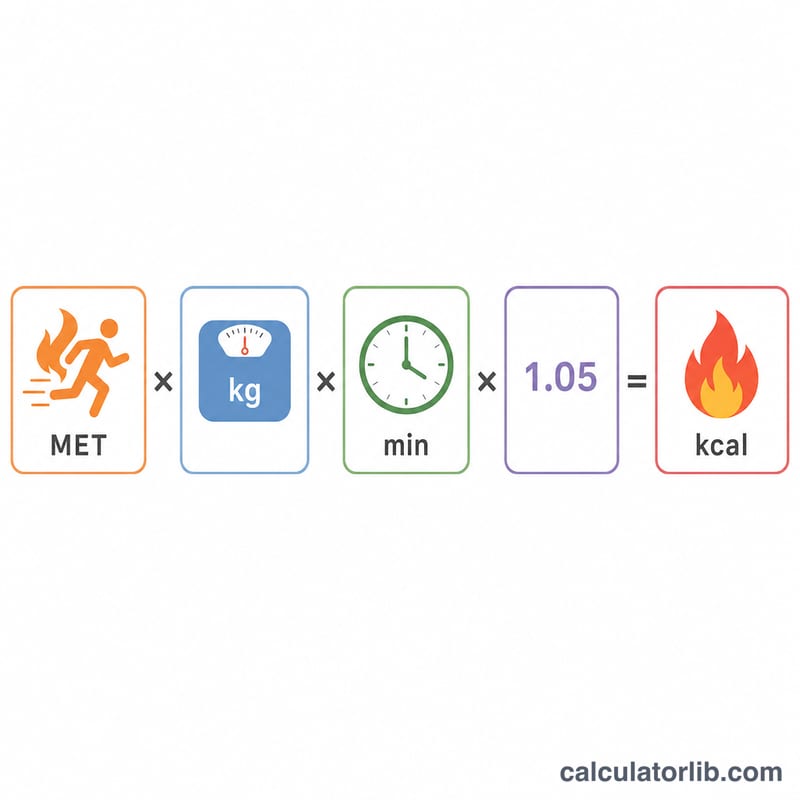
The estimate uses: $$\text{calories (kcal)} = \text{MET} \times \text{body weight (kg)} \times \text{time (hours)} \times 1.05$$ The time you enter in minutes is divided by 60 to get hours. The constant 1.05 reflects that one MET is approximately 1.05 kcal per kilogram of body weight per hour. This is the gross estimate — it does not subtract your resting metabolism, so it represents total energy used during the activity window.
Worked example
Suppose you do High jump / Pole vault (6.0 METs) for 60 minutes at a body weight of 70 kg. Time in hours = \(60 / 60 = 1.0\). Calories: $$6.0 \times 70 \times 1.0 \times 1.05 = 441 \text{ kcal}$$ For 30 minutes of Steeplechase / Hurdles (10.0 METs) at 60 kg: $$10.0 \times 60 \times 0.5 \times 1.05 = 315 \text{ kcal}$$
FAQ
What is a MET? A MET is a measure of activity intensity relative to sitting quietly (1 MET). A 6 MET activity burns roughly six times the energy of resting.
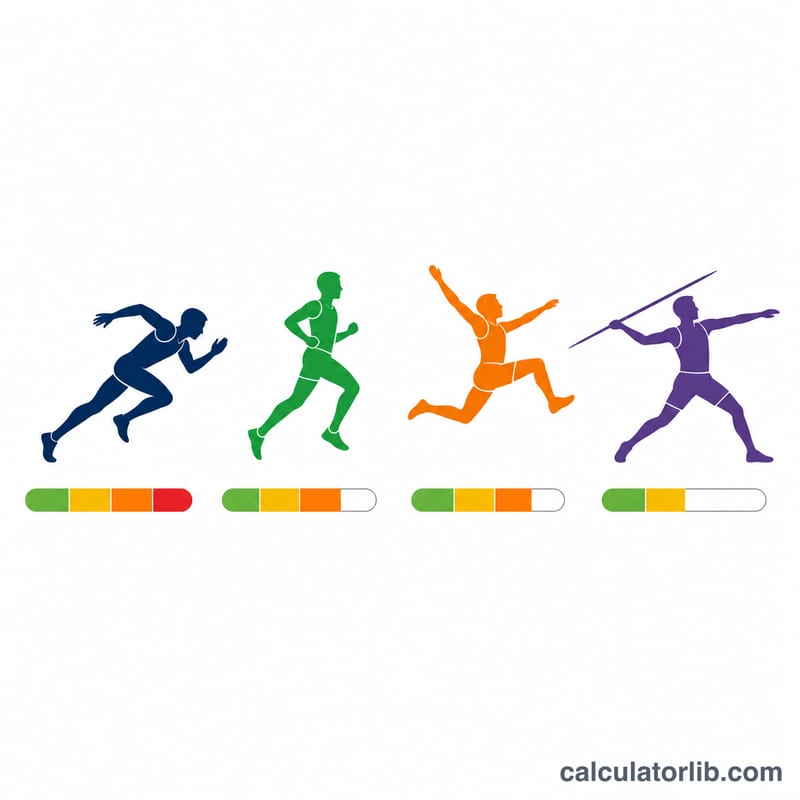
Why does throwing have a lower MET than hurdles? Throwing events involve shorter bursts and less sustained whole-body movement, so their average intensity (around 4 METs) is lower than continuous running events like the steeplechase (around 10 METs).
Is the result exact? No. MET-based estimates are approximations; actual burn varies with fitness, technique, rest intervals, and environment. Use it as a practical guide rather than a precise measurement.