
What this calculator does
The Treadmill Calories Burned Calculator estimates how many calories you burn during a treadmill session based on four inputs: your body weight, your walking or running speed, the incline (grade), and the duration of your workout. It uses the American College of Sports Medicine (ACSM) metabolic equation, which relates oxygen uptake (VO₂) to speed and incline — a widely used, science-based approach for treadmill energy expenditure.
How to use it
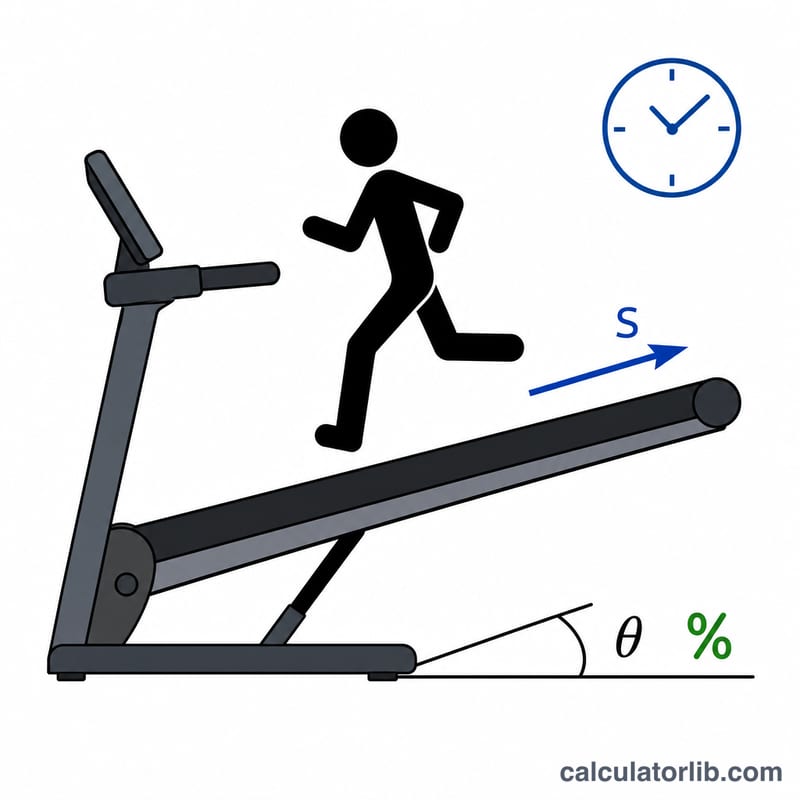
Enter your weight in kilograms, your speed in metres per minute, the grade as a decimal (for example 0.05 for a 5% incline), and how many minutes you exercised. The calculator returns the total calories burned, your estimated VO₂, and the calories burned per minute. Speed in m/min can be found from your treadmill: 1 km/h ≈ 16.67 m/min, and 1 mph ≈ 26.82 m/min.
The formula explained
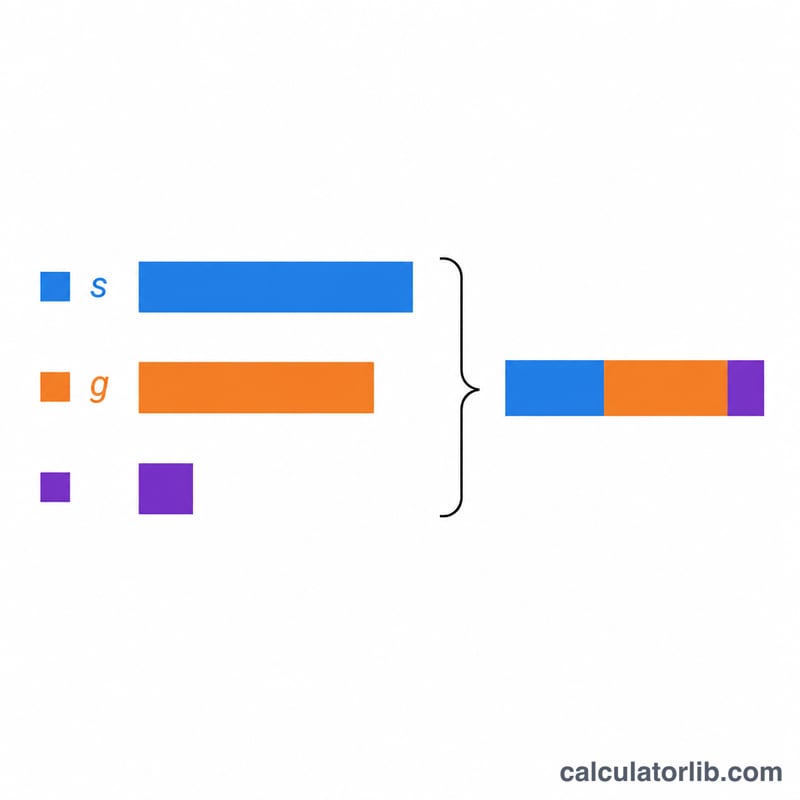
First the calculator finds VO₂ in millilitres of oxygen per kilogram per minute: $$VO_2 = 0.1 \times \text{speed} + 1.8 \times \text{speed} \times \text{grade} + 3.5$$. The 0.1 term is the horizontal cost of movement, the 1.8 term is the vertical cost of climbing, and 3.5 is resting oxygen uptake. Total calories are then $$\text{kcal} = VO_2 \times \frac{\text{weight}}{1000} \times 5 \times \text{minutes},$$ where 5 kcal is liberated per litre of oxygen consumed.
Worked example
A 70 kg person walks at 100 m/min on a 5% (0.05) incline for 30 minutes. $$VO_2 = 0.1 \times 100 + 1.8 \times 100 \times 0.05 + 3.5 = 10 + 9 + 3.5 = 22.5 \text{ ml/kg/min}.$$ $$\text{Calories} = 22.5 \times \frac{70}{1000} \times 5 \times 30 = 236.25 \text{ kcal},$$ or about 7.88 kcal per minute.
FAQ
Is this exact? No — it's an estimate. Individual metabolism, fitness, and treadmill calibration cause real-world variation of 10–20%.
Why metres per minute? The ACSM equation is defined for speed in m/min and grade as a decimal fraction, so we use those units directly.
Does the calculator account for running vs walking? This implementation uses the standard walking coefficients; faster running speeds use a different ACSM constant, so treat high-speed results as approximate.