
What This Calculator Does
The Running Calories Burned Calculator estimates how much energy you expend during a run based on your body weight, running pace, and how long you run. It uses the widely accepted MET (Metabolic Equivalent of Task) method, which is a standardized way to express the intensity of physical activities relative to resting metabolism.
How to Use It
Enter your body weight in kilograms, select the running pace that best matches your effort, and type in your running duration in minutes. The calculator converts minutes to hours, multiplies by the MET value of your chosen pace and your weight, and returns total calories burned along with calories per minute.
The Formula Explained
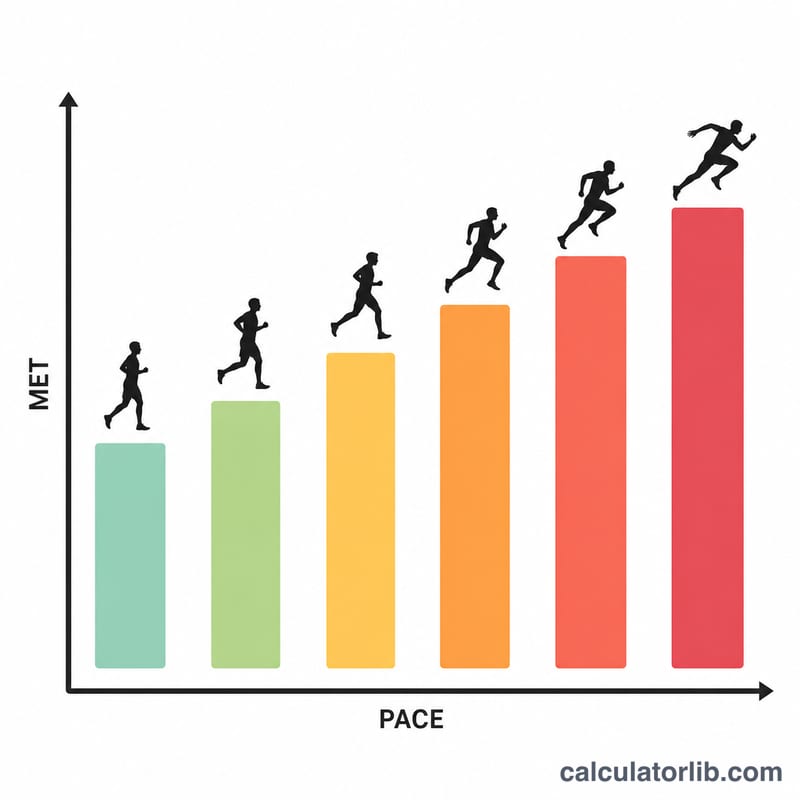
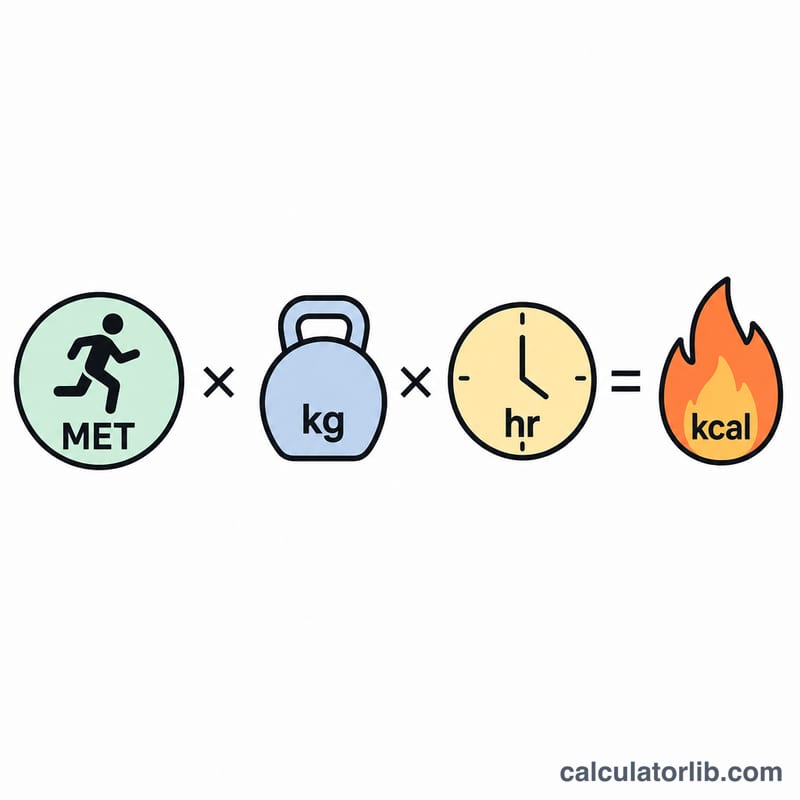
The core equation is $$\text{kcal} = \text{MET} \times \text{weight(kg)} \times \text{duration(hours)}$$ One MET equals roughly 1 kcal burned per kilogram of body weight per hour at rest. Running multiplies that baseline: a slow jog is about 6 METs, moderate running ~9.8 METs, and fast running 11.5 METs or more. Because the formula needs hours, the duration in minutes is divided by 60 first.
Worked Example
A 70 kg runner jogs at a moderate pace (9.8 MET) for 30 minutes. First convert time: \(30 \div 60 = 0.5\) hours. Then $$\text{kcal} = 9.8 \times 70 \times 0.5 = 343 \text{ kcal}$$ That works out to about 11.4 kcal per minute.
FAQ
Is this estimate accurate? MET-based estimates are good general approximations but don't account for individual fitness, terrain, or wind. Treat the result as a guide.
Why does weight matter so much? Heavier bodies require more energy to move, so calories burned scale directly with body weight.
Should I subtract resting calories? The MET formula includes resting metabolism. For "net" exercise calories, subtract roughly 1 MET worth of energy, though most people use the gross value shown here.