
What This Calculator Does
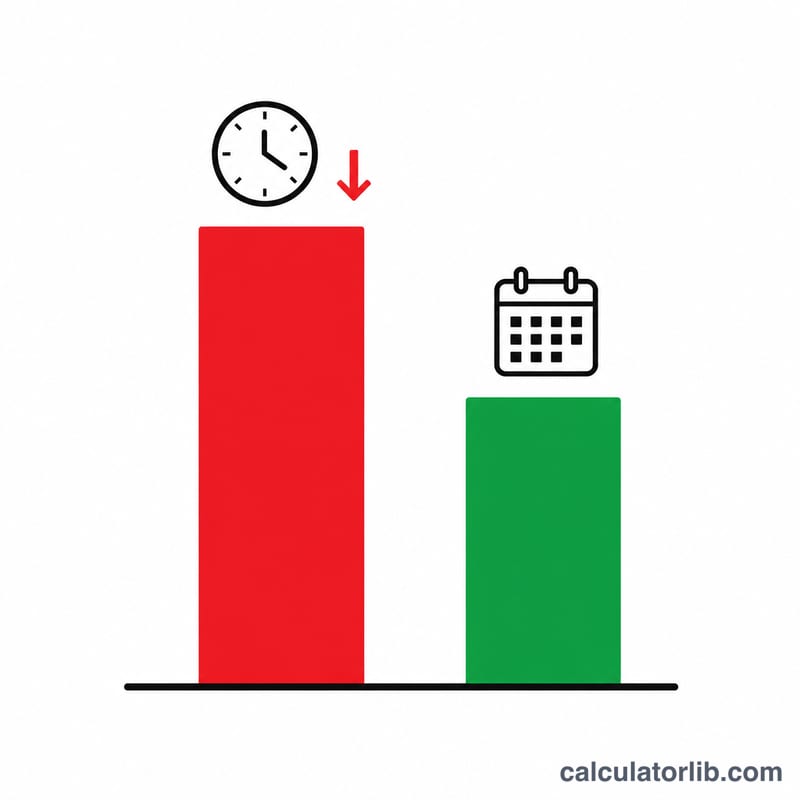
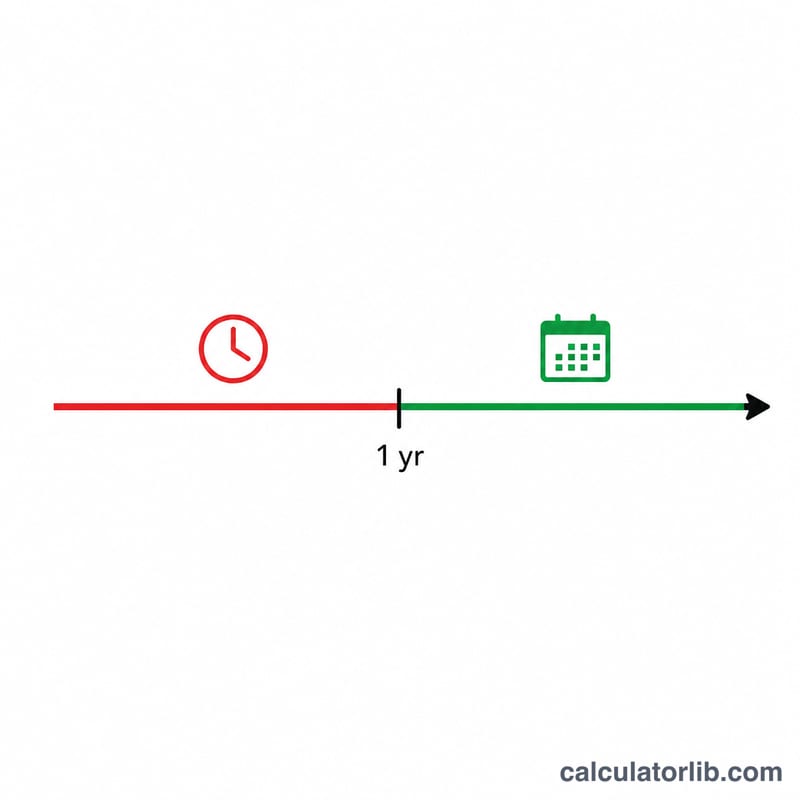
This tool applies to United States federal capital gains taxation. In the US, profits from selling an asset held for one year or less are short-term gains, taxed at your ordinary income tax rate (10%–37% for 2024). Profits from assets held more than one year are long-term gains, taxed at preferential rates of 0%, 15%, or 20% depending on income. This calculator shows the tax under each scenario and how much you save by waiting. State taxes and the 3.8% Net Investment Income Tax are not included.
How to Use It
Enter your total capital gain (sale price minus cost basis), your ordinary income tax rate that would apply to a short-term gain, and your long-term capital gains rate. The calculator returns the tax owed in each case, the after-tax proceeds, and your total savings from long-term treatment.
The Formula
The math is straightforward: ShortTax = Gain × OrdinaryRate and LongTax = Gain × LTCGRate. Your Savings = ShortTax − LongTax. Because long-term rates are almost always lower, holding past the one-year mark typically reduces your tax bill substantially.
$$\text{Tax Savings} = \text{Gain} \times \left( \frac{\text{Short-Term Rate}}{100} - \frac{\text{Long-Term Rate}}{100} \right)$$
Worked Example
Suppose you have a $10,000 gain, a 24% ordinary rate, and a 15% LTCG rate. Short-term tax = \(10{,}000 \times 0.24 = \textbf{\$2{,}400}\). Long-term tax = \(10{,}000 \times 0.15 = \textbf{\$1{,}500}\). Savings = \(2{,}400 - 1{,}500 = \textbf{\$900}\). By holding just past one year, you keep an extra $900.
FAQ
What counts as the holding period? The clock starts the day after you acquire the asset and ends on the day you sell. More than 365 days qualifies as long-term.
Where do I find my long-term rate? For 2024 it is 0% for lower incomes, 15% for most middle-income filers, and 20% for high earners. Check your taxable income against IRS brackets.
Does this include state tax? No. Many states tax capital gains as ordinary income, so your real savings may differ. This tool covers federal rates only.