What is the UK Capital Gains Tax Calculator?
This tool applies to the United Kingdom. Capital Gains Tax (CGT) is charged when you sell or dispose of an asset — such as shares, a second property, or other investments — for more than you paid for it. This calculator estimates the CGT due on your gain after deducting your annual exempt amount. Figures use the 2026/27 rules, where the annual exempt amount is £3,000 and CGT on gains above it is charged at 18% (basic rate) or 24% (higher/additional rate) for both residential property and other assets.
How to use it
Enter your total capital gain for the year, your annual exempt amount (£3,000 for 2026/27), choose whether your taxable income places you in the basic or higher rate band, and select the asset type. The calculator subtracts the exemption, applies the appropriate rate, and shows the tax due and your net gain.
The formula explained
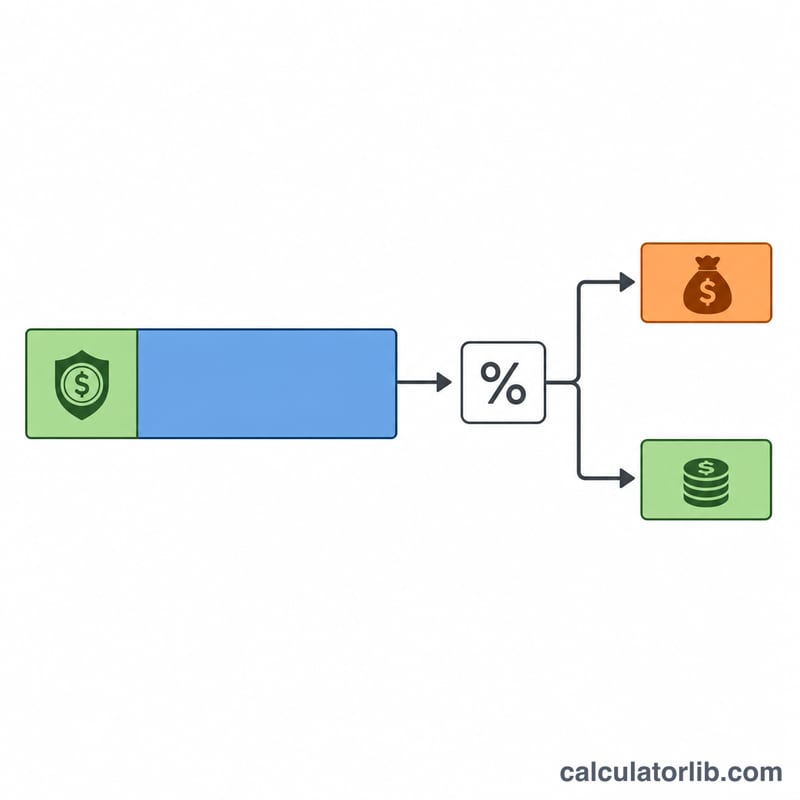
The core calculation is $$\text{CGT} = \max\!\left(0,\ \text{gain} - \text{annual exemption}\right) \times \text{rate}$$ The \(\max(0, \ldots)\) ensures that if your gain is below the exempt amount, no tax is due. The remaining taxable gain is multiplied by your CGT rate. Note that in reality the gain is added on top of your income to determine how much falls into the basic vs higher band; this calculator uses a single chosen band for a quick estimate.
Worked example
Suppose you make a £20,000 gain on shares, with a £3,000 annual exemption, and you are a higher-rate taxpayer. Taxable gain = \(£20{,}000 - £3{,}000 = £17{,}000\). $$\text{CGT} = £17{,}000 \times 24\% = £4{,}080$$ Your net gain after tax is \(£20{,}000 - £4{,}080 = £15{,}920\).
Comparing CGT on Different Gains and Tax Bands
The table assumes a £3,000 annual exempt amount that has not been used elsewhere, and a single disposal. The taxable gain is the gain minus £3,000, and the tax is that amount multiplied by the rate. Net gain is the gain minus the CGT due.
| Total gain | Taxable gain | CGT at 18% | CGT at 24% | Net gain at 18% | Net gain at 24% |
|---|---|---|---|---|---|
| £3,000 | £0 | £0 | £0 | £3,000 | £3,000 |
| £5,000 | £2,000 | £360 | £480 | £4,640 | £4,520 |
| £10,000 | £7,000 | £1,260 | £1,680 | £8,740 | £8,320 |
| £20,000 | £17,000 | £3,060 | £4,080 | £16,940 | £15,920 |
| £50,000 | £47,000 | £8,460 | £11,280 | £41,540 | £38,720 |
Example for a £20,000 gain: \(20{,}000 - 3{,}000 = 17{,}000\); then \(17{,}000 \times 18\% = 3{,}060\) and \(17{,}000 \times 24\% = 4{,}080\).
A gain at or below the £3,000 exemption produces £0 tax. In practice, part of a gain can fall in the basic rate band and part in the higher rate band, depending on your taxable income. In that case the tax lies between the two columns.
Key CGT Terms Explained
- Capital gain: the profit when you sell or otherwise dispose of an asset for more than its cost (its base cost), after allowable costs.
- Disposal: selling, gifting, swapping or otherwise giving up ownership of an asset. This can trigger CGT.
- Annual exempt amount: the amount of total gains in a tax year that is free of CGT. It is £3,000 for 2024/25 and 2025/26, and this calculator uses £3,000 for 2026/27.
- Taxable gain: your total gains minus any allowable losses and the annual exempt amount, if the result is above zero.
- Basic rate vs higher rate band: the CGT rate depends on how much of your gain falls within your remaining basic rate income tax band. The calculator uses 18% for the basic rate and 24% for the higher rate.
- Allowable costs: certain costs that can be deducted when working out a gain, such as purchase price, improvement costs and fees for buying or selling.
- Capital losses: losses on disposals that can be set against gains in the same year, or carried forward if they are properly reported to HMRC.
This tool gives an estimate for general information only. It is not tax advice. Your own circumstances, reliefs and reporting duties may differ, so check GOV.UK or consult a qualified adviser.
FAQ
Is the annual exempt amount really £3,000? Yes, for the 2026/27 tax year. It was £6,000 in 2023/24 and £12,300 before that, so check the current allowance.
Are property and share rates different? From 30 October 2024 both residential property and other assets share the same rates of 18% and 24%.
Is this an official HMRC figure? No — this is an estimate. Your actual liability depends on your total income, losses brought forward, and reliefs. Consult HMRC or an adviser for confirmation.