
What Is Capital Gains Yield?
Capital gains yield (CGY) measures the appreciation (or depreciation) in the price of a security — such as a stock, bond, or fund — over a holding period, expressed as a percentage of the original price. It captures only the change in market price and deliberately excludes any income (like dividends or interest). When you add CGY to the dividend yield, you get the total return on the investment.
How to Use This Calculator
Enter the beginning price (the price you paid or the price at the start of the period) and the ending price (the current price or the price at the end of the period). The calculator returns the capital gains yield as a percentage along with the raw dollar gain.
The Formula Explained
The capital gains yield is calculated as:
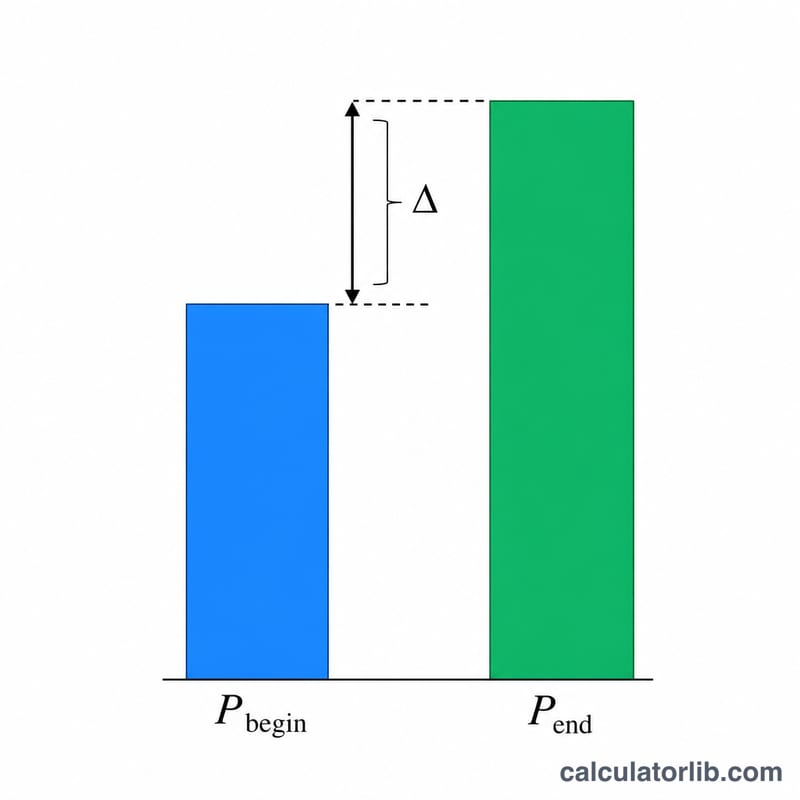
$$\text{CGY} = \frac{P_{\text{end}} - P_{\text{begin}}}{P_{\text{begin}}} \times 100\%$$
The numerator is the dollar capital gain. Dividing by the beginning price normalizes the gain so investments of different sizes can be compared on equal footing. A positive result is a gain; a negative result is a capital loss.
Worked Example
Suppose you bought a share for $100 and it is now worth $120. The capital gain is \(\$120 - \$100 = \$20\). The capital gains yield is $$\frac{\$20}{\$100} = 0.20, \text{ or } 20\%$$ If the stock also paid a $4 dividend, that adds a 4% dividend yield for a total return of 24%.
FAQ
Does CGY include dividends? No. Capital gains yield only reflects price change. Dividend yield is a separate component, and the two together make up total return.
Can capital gains yield be negative? Yes. If the ending price is lower than the beginning price, CGY is negative, indicating a capital loss.
What period does CGY cover? Whatever period your two prices span — a day, a year, or a multi-year hold. It is not automatically annualized.